
Astronomers have discovered a new class of objects in multiple galaxies. This result, made possible by NASA’s Chandra X-ray Observatory and outlined in our latest press release, may help scientists solve two outstanding mysteries in astrophysics.
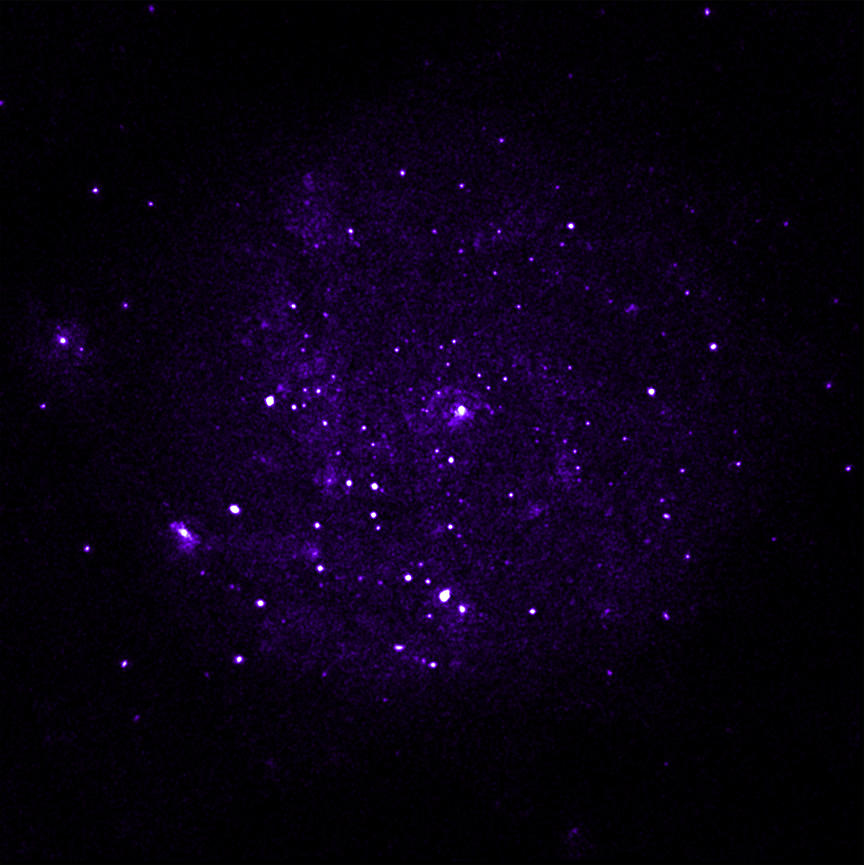
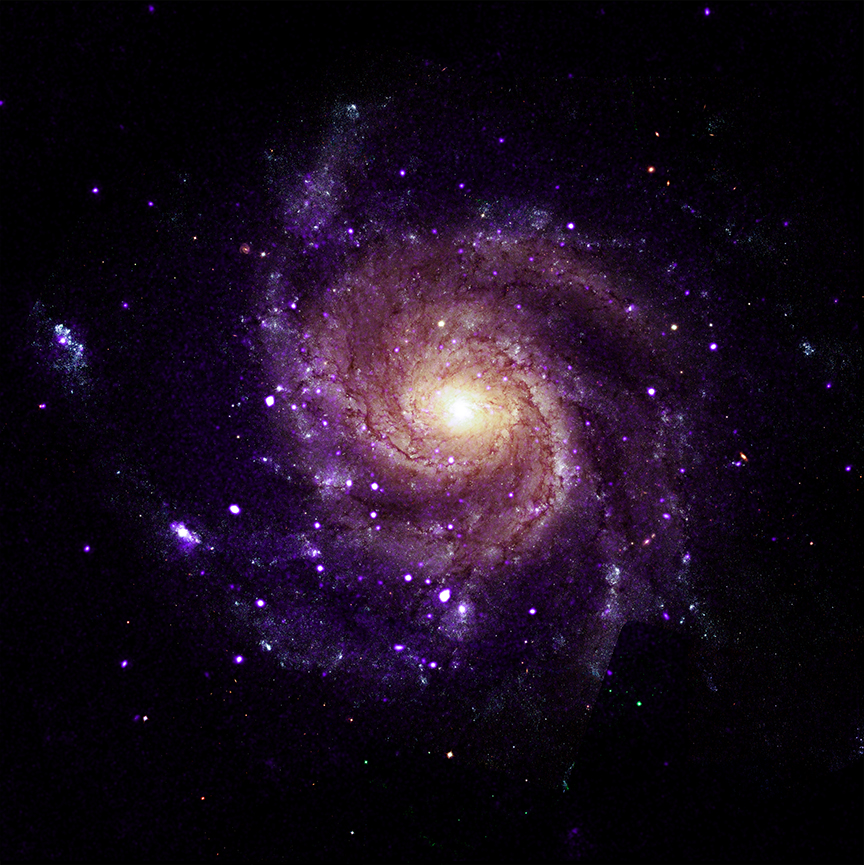
The face-on spiral galaxy M101, also known as the Pinwheel, is one of the galaxies where the new type of object was found. This new M101 composite image contains X-ray data from Chandra (purple) that have been combined with an optical image from the Hubble Space Telescope (red, green, and blue). Circles in an annotated version of the image show the location of the seven newly-discovered objects in M101.
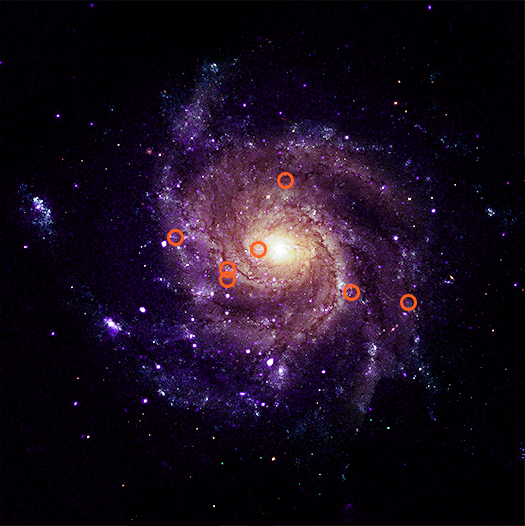
Researchers found a total of 84 of these mysterious objects in M101, Messier 31, and four elliptical galaxies. The objects were named “hypersoft X-ray sources” because they give off very low-energy X-rays that Chandra was only able to detect after long exposures. Because low-energy X-rays border energetic ultraviolet radiation on the electromagnetic spectrum, the team determined that these sources are likely producing large amounts of energetic ultraviolet radiation.
Astronomers are trying to determine what type — or types — of objects are responsible for these low-energy X-rays and intense ultraviolet radiation outputs. The most likely explanation, according to the team, is that these systems involve a black hole, neutron star or white dwarf pulling material from a companion star. The material pulled from the companion star is heated up to produce X-rays before falling onto the white dwarf or neutron star, or into the black hole. While scientists have discovered many binary systems over the years, astronomers have never seen any behaving like this before.
The discovery of this new class of sources suggests that astronomers have missed large populations of binary systems with energetic ultraviolet radiation until now. One idea is that these binary systems are the precursors to Type Ia supernova explosions, which astronomers used to discover the acceleration of the universe’s expansion.
Another open question that these hypersoft X-ray sources could help answer involves the stripping of electrons from gas in between galaxies. Scientists know this phenomenon plays an important role in the lifecycle of the stars, but they still need to accurately account for all of the energy sources that contribute to this process. This newly-discovered class of objects may play a significant role in this stripping.
These hypersoft X-ray sources were not found until now because in addition to the low-energy X-ray output that requires large amounts of observing time from a telescope like Chandra, the high-energy ultraviolet radiation is readily absorbed by helium and hydrogen gas that fills the space in between the stars. This creates a “nearly impenetrable barrier” to look through.
A paper describing this result appears in the most recent issue of Nature Astronomy and is available here. The authors of this paper are Mustafa Muhibullah (University of Alabama), Jimmy Irwin (University of Alabama), and Rosanne DiStefano (Center for Astrophysics | Harvard & Smithsonian).
NASA's Marshall Space Flight Center manages the Chandra program. The Smithsonian Astrophysical Observatory's Chandra X-ray Center controls science operations from Cambridge, Massachusetts, and flight operations from Burlington, Massachusetts.
This release features a composite image of a spiral galaxy, M101; one of six identified galaxies housing a new class of mysterious objects that give off unusually low-energy X-rays.
In this composite image, M101 faces us directly. It has multiple arms in shades of purple, spiraling clockwise around a golden yellow core. Scattered along and between the arms are scores of tiny specks in white and purple. Most of those specks are pairs of stars, but seven of them are a mystery.
To casual observers, the unusual objects are visually indistinguishable from the other specks of light in the galaxy. An annotated version of the composite image is included in this release, with red circles around the mysterious specks for easy identification.
These mystery specks behave like no other class of object discovered before. The curious objects give off X-rays of such low energy, they in fact produce large amounts of ultraviolet radiation, as UV radiation borders X-rays on the electromagnetic spectrum. Searching images of galaxies with low-energy X-rays in the Chandra Observatory archive, scientists have found a total of 84 such objects spread across M101 and five other galaxies. They have dubbed these mysterious objects "hypersoft X-ray sources."
|
||||||||||||||||||||||||||||||||