
A Hidden Population of Cosmic Beacons: Discovering Hypersoft X-ray Sources with Chandra

Mustafa Muhibullah (Credit: Mustafa Muhibullah)
We welcome Mustafa Muhibullah as a guest blogger. He is the first author of a Nature Astronomy paper that is the subject of our latest press release. Mustafa is a Ph.D. candidate in Physics & Astronomy at the University of Alabama, working with Prof. Jimmy Irwin since Fall 2021. His research focuses on high-energy astrophysics, particularly faint and compact X-ray sources and galaxy clusters, using NASA’s Chandra X-ray Observatory. He earned his M.S. in Physics from the University of Missouri–Kansas City in 2021 and his B.S. in Mechanical Engineering from Rajshahi University of Engineering & Technology, Bangladesh.
The “Unobserved” Window of the Universe
Modern astronomy explores the Universe across nearly the entire electromagnetic spectrum, from radio waves to X-rays. Yet one important window remains largely hidden: the extreme-ultraviolet (EUV), a narrow but energetic region between ultraviolet light and low-energy X-rays. For observers in the Milky Way, EUV radiation from distant sources is almost completely blocked by the cool, neutral hydrogen and helium that fill our Galaxy and readily absorbs these photons before they can reach our telescopes.
We know that powerful EUV emitters exist. For example, astronomers know that hot, massive stars, the solar corona, and active galaxies can all produce substantial EUV emission. Fortunately, they also radiate at other wavelengths, allowing astronomers to detect and study them even when their EUV light is absorbed.
The Discovery of Hypersoft X-ray Sources
Could other EUV-bright objects be hiding in the Universe, producing little detectable emission at other wavelengths? To find them, we took an indirect approach: searching archival observations from NASA’s Chandra X-ray Observatory for faint X-ray signatures from sources whose emission may peak in the EUV.
This search revealed a previously unrecognized class of cosmic sources in nearby galaxies, which we dubbed hypersoft X-ray sources (HSSs). They emit almost exclusively at the lowest X-ray energies accessible to Chandra, with little or no emission at higher energies (see Figure 1)—suggesting that much of their radiation may lie in the poorly explored EUV regime that abuts the low-energy X-rays on the electromagnetic spectrum. Their extreme X-ray “softness”, corresponding to the lowest energy X-rays, combined with absorption by intervening material, Chandra’s declining low-energy sensitivity, and their large apparent changes in brightness, likely explains why they remained largely hidden. Despite these challenges, we have been able to identify 84 HSSs in six nearby galaxies, spanning both spiral and elliptical systems, and have just announced the results in a paper in Nature Astronomy.
Extremely Bright Yet Exceptionally Cool
Although difficult to detect, HSSs can be extraordinarily luminous—in some cases radiating hundreds of thousands to millions of times more energy than the Sun. Their luminosities rival those of ultraluminous X-ray sources (ULXs), some of the brightest known X-ray sources that are not located in the centers of galaxies, where growing supermassive black holes, known as active galactic nuclei, can generate copious amounts of X-rays. Yet while ULXs are relatively rare, we find dozens of HSSs per galaxy in some of the systems we studied, suggesting that HSSs could be one of the most numerous populations of highly luminous, non-nuclear X-ray sources in nearby galaxies.
At the same time, their extremely soft emission indicates that HSSs are exceptionally cool for X-ray sources. They may be far hotter than ordinary stars but considerably cooler than most known X-ray-emitting compact objects—a combination that may hold the key to their true nature.
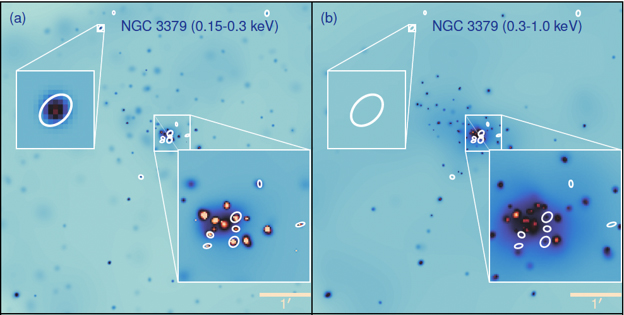
Credit: NASA/SAO/CXC/Mustafa Muhibullah (University of Alabama)
So, What Are They?
Their high luminosities and relatively cool temperatures suggest that HSSs could have large emitting regions, potentially associated with matter falling onto white dwarfs and, for the most luminous sources, perhaps even more massive compact objects such as black holes.
Our observations of the nearby galaxy Andromeda (M31) provide an important clue. Several of the least luminous HSSs are associated with novae—explosive events in close binary systems where a white dwarf accumulates hydrogen-rich material from its companion until it ignites in a thermonuclear runaway explosion.
More luminous HSSs could instead be tied to white dwarfs undergoing sustained nuclear burning. If the white dwarf’s photosphere expands, its effective temperature can decrease, shifting its emission toward longer wavelengths, potentially into the EUV, while leaving only a very soft X-ray signature detectable by Chandra.
This possibility has profound implications for Type Ia supernovae. If a growing white dwarf grows toward the Chandrasekhar mass, it could eventually explode as a Type Ia supernova. Although these explosions are among the most important tools astronomers use to measure the expansion rate of the Universe, their progenitor systems remain an enduring mystery. HSSs could represent an important, previously overlooked stage in the evolution of some Type Ia supernova progenitors.
HSSs may also help solve another long-standing mystery: what powers the ionization of gas between stars? Ionization occurs when energetic photons — particles of light — strip electrons from atoms. Hot, massive stars produce enough UV radiation to ionize hydrogen, but removing additional electrons from helium and heavier elements requires more energetic EUV photons—particularly difficult to explain in galaxies without an active galactic nucleus.
A recent paper by Triani et al. (2025) proposed that cool, highly luminous sources such as HSSs, emitting strongly in the EUV and very soft X-rays, could provide some of these missing ionizing photons. If so, HSSs may influence how the interstellar medium heats, cools, and forms stars.
Regardless of their nature, HSSs offer a new glimpse into the unexplored EUV Universe, with potential implications for galactic gas ionization and the mystery of Type Ia supernova progenitors. For now, they remain a cosmic mystery—and an invitation to keep looking.