
Zombie Disks May Solve a Cosmic Mystery
The cosmos is full of surprises. When new classes of objects are discovered they can turn out to have more than one explanation. Some supernova explosions, for example, are triggered by the dramatic collapse of massive stars, while others involve the thermonuclear explosions of white dwarf stars. These two types of stars are remarkably different in size, mass, composition and density, but both can produce explosions that outshine entire galaxies. Another example is gamma ray bursts, which involve either the collapse of massive stars or the merger of two neutron stars.
The origin of the newly-discovered class of hypersoft X-ray sources is unknown, but similar diversity may apply. One leading idea is that many of them involve matter falling onto the surfaces of white dwarfs. Once the white dwarfs reach a sufficient mass they may explode as Type Ia supernovas, addressing the mystery of what triggers these spectacular explosions. In other words, some of these hypersoft X-ray sources may represent the build up to Type Ias — a very important category of supernovas that lets astronomers measure the accelerating expansion of the Universe. However, this explanation struggles to explain the brightest of the hypersoft X-ray sources.
Matter pulled away from companion stars by stellar-mass black holes, which typically have masses more than about ten times that of the Sun, offers a different explanation for these bright sources. As with white dwarfs, material pulled towards a black hole should be heated by friction to produce ultraviolet radiation. Because stellar-mass black holes, however, are much more massive and compact than white dwarfs, this process produces a larger amount of radiation.
There is a major problem, however, with this simple interpretation of the hypersoft X-ray sources. When material in such systems approaches very close to a black hole, it should get so hot that it produces a lot of energetic X-rays — and astronomers are not seeing this with the hypersoft X-ray sources.
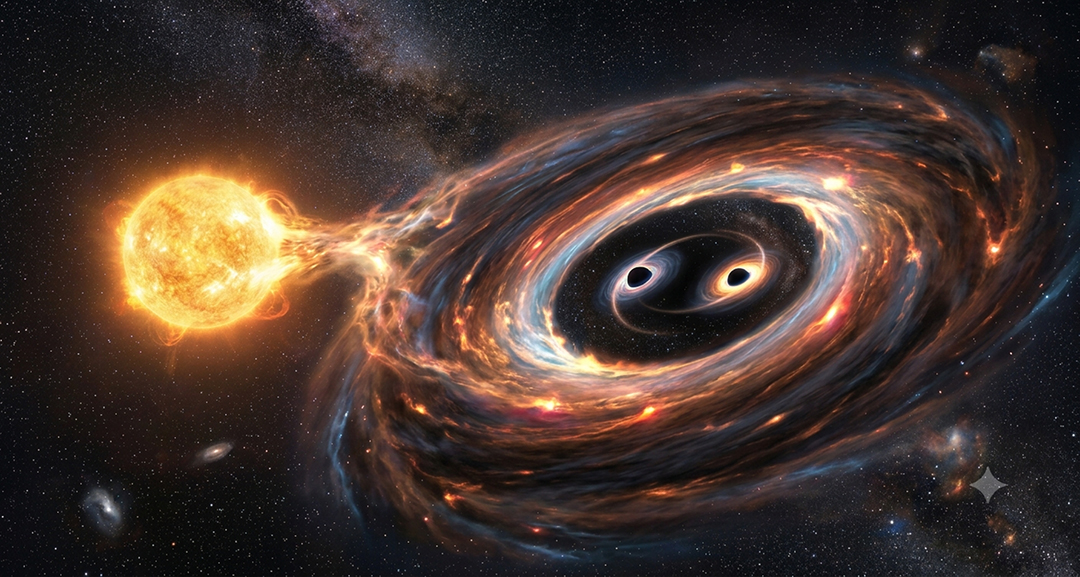
Credit: Generated with Google Gemini (prompt by Galina Lipunova).
An ingenious idea published earlier this year by Sergei Popov of the Sternberg Astronomical Institute in Russia, and Galina Lipunova of the Max Planck Institute for Radio Astronomy in Germany, may solve this problem. (The Research Note of the American Astronomical Society paper is here, an expanded version is here and a video from the AAS Author Journal Series is here.) They consider what happens in a triple system if a pair of closely orbiting black holes, rather than a single black hole, is pulling material away from a more distant companion star. The orbit of the two black holes should clear out a hole in the middle of the disk, as shown in their beautiful artist’s impression.
Some people call these “dead” or “zombie” disks because hardly any material ends up falling into the black hole. Importantly for understanding the brightest hypersoft X-ray sources, the lack of a disk near the black holes prevents gas from getting hot enough to produce large amounts of energetic X-rays.
Scientists will need more theoretical studies to determine how viable this idea is, including whether enough of these triple systems and zombie disks could form and survive to explain the brightest hypersoft X-ray sources. This work has the potential to not only explain some of the hypersoft X-ray sources, but also provide insight into the evolution of systems containing supermassive black holes orbiting each other and understanding the gravitational waves they can produce.
-Peter Edmonds, CXC