
Groups & Clusters of Galaxies
Astronomers Find Spark of Star Birth Across Billions of Years
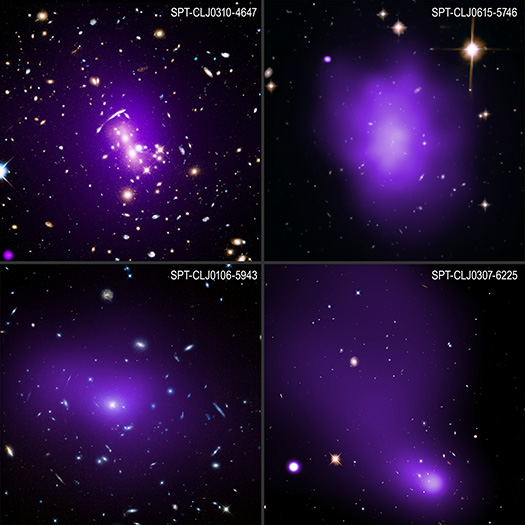
Brightest Cluster Galaxies Survey
Credit: X-ray: NASA/CXC/MIT/M. Calzadilla el al.; Optical: NASA/ESA/STScI;
Image Processing: NASA/CXC/SAO/N. Wolk & J. Major
These four images represent a sample of galaxy clusters that are part of the largest and most complete study to learn what triggers stars to form in the universe’s biggest galaxies, as described in our latest press release. This research, made using NASA’s Chandra X-ray Observatory and other telescopes, showed that the conditions for stellar conception in these exceptionally massive galaxies have not changed over the last ten billion years.
Galaxy clusters are the largest objects in the universe held together by gravity and contain huge amounts of hot gas seen in X-rays. This hot gas weighs several times the total mass of all the stars in all the hundreds of galaxies typically found in galaxy clusters. In the four galaxy cluster images in this graphic, X-rays from hot gas detected by Chandra are in purple and optical data from NASA’s Hubble Space Telescope, mostly showing galaxies in the clusters, are yellow and cyan.
NASA Telescopes Discover Record-Breaking Black Hole
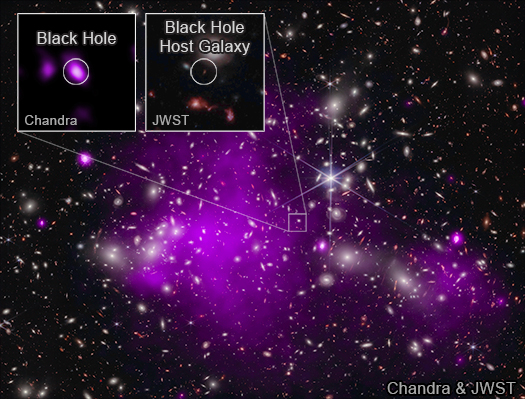
UHZ1
Credit: X-ray: NASA/CXC/SAO/Ákos Bogdán; Infrared: NASA/ESA/CSA/STScI; Image Processing: NASA/CXC/SAO/L. Frattare & K. Arcand
This image contains the most distant black hole ever detected in X-rays, a result that may explain how some of the first supermassive black holes in the universe formed. As we report in our press release, this discovery was made using X-rays from NASA’s Chandra X-ray Observatory (purple) and infrared data from NASA’s James Webb Space Telescope (red, green, blue).
The extremely distant black hole is located in the galaxy UHZ1 in the direction of the galaxy cluster Abell 2744. The galaxy cluster is about 3.5 billion light-years from Earth. Webb data, however, reveal that UHZ1 is much farther away than Abell 2744. At some 13.2 billion light-years away, UHZ1 is seen when the universe was only 3% of its current age.
"El Gordo": A Galaxy Cluster That Pushes the Limits
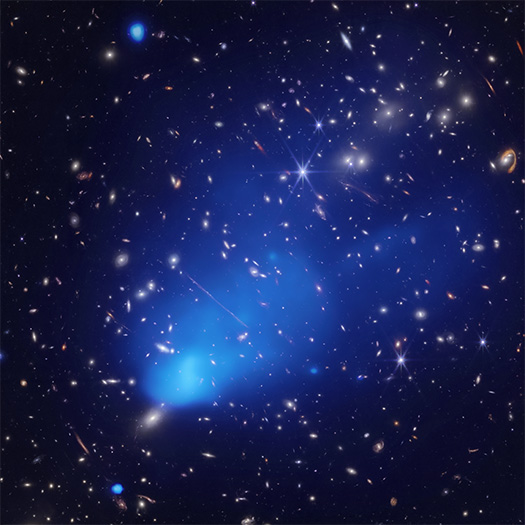
El Gordo
Credit: X-ray: NASA/CXC/Rutgers/J. Hughes et al.; Infrared: NASA/ESA/CSA, J.M. Diego (IFCA),
B.Frye (Univ. of Arizona), P.Kamieneski, T.Carleton & R.Windhorst (ASU);
When astronomers discovered the galaxy cluster ACT-CL J0102-4915 in 2012 with NASA's Chandra X-ray Observatory and ground-based optical telescopes, they nicknamed it "El Gordo" (Spanish for the "Fat One") because of its gigantic mass. Scientists estimate that El Gordo contains as much as 3 million billion (3,000,000,000,000,000) times the mass of the Sun. Thanks to its heft, El Gordo acts as a natural lens, distorting the light from more distant objects behind it through a process known as gravitational lensing.
A new composite image of El Gordo shows the diffuse, superheated gas in the cluster observed in X-rays from Chandra (blue) that have been combined with a new infrared image from NASA's James Webb Space Telescope (red, green, and blue). Webb's image shows galaxies in El Gordo plus background galaxies located further away from Earth. El Gordo is located about 7.3 billion light-years from Earth and the background galaxies are at a range of different distances including several that are 12.3 billion light-years from Earth. The appearance of some of the background galaxies has been distorted into a variety of unusual and highly elongated shapes because of gravitational lensing by the cluster.
Unexpectedly Calm and Remote Galaxy Cluster Discovered
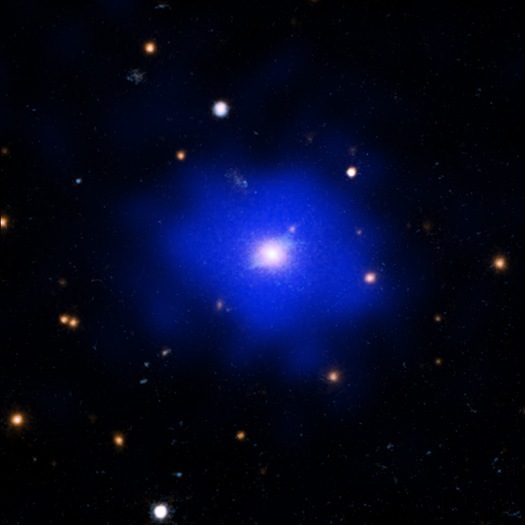
Credit: X-ray: NASA/CXC/MIT/M. Calzadilla; UV/Optical/Near-IR/IR: NASA/STScI/HST; Image processing: N. Wolk
The discovery of the most distant galaxy cluster with a specific important trait – as described in our press release – is providing insight into how these gigantic structures formed and why the universe looks like it does in the present day.
Galaxies Go on a Deep Dive and Leave Fiery Tail Behind
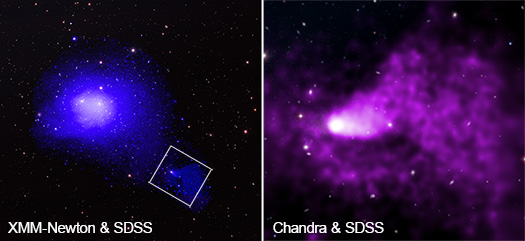
NGC 4839
Credit: X-ray: Chandra: NASA/SAO/Univ. of Alabama/M. S. Mirakhor et al.; XMM: ESA/XMM-Newton;
Optical: SDSS; Image processing: N. Wolk
A group of galaxies is plunging into the Coma galaxy cluster and leaving behind an enormous tail of superheated gas. Astronomers have confirmed this is the longest known tail behind a galaxy group and used it to gain a deeper understanding of how galaxy clusters – some of the largest structures in the universe – grow to their enormous sizes.
Powerful Yet Lonely: The Distant Quasar Left Alone in its Group

Valentina Missaglia
We are happy to welcome Valentina Missaglia as a guest blogger. She is the first author of the paper that is the subject of our latest press release. She is currently a postdoctoral researcher at the Institute of Astrophysics — FORTH in Heraklion (Crete) in the SMILE (“Search for Milli-LEnses”) group, recently funded by an ERC grant, that aims at investigating the nature of dark matter through observations of gravitational lenses on milli-arcsecond scales. Valentina earned her Ph.D. from the University of Turin (Italy) and her research focuses on radio and X-ray emission from radio-loud active galactic nuclei (which contain supermassive black holes that are rapidly pulling in material, producing intense radio waves) and how these sources interact with the surrounding medium. Before starting her Ph.D. in 2019, Valentina was a visiting student at the Center of Astrophysics | Harvard & Smithsonian, where she collaborated with Dr. Ralph Kraft on observations of galaxy clusters performed with NASA’s Chandra X-ray Observatory.
Looking at the night sky with the naked eye, we can only see an infinitesimal part of what the Universe contains, and the largest part cannot even be “seen”. Radio wavelengths have gifted us some of the most fascinating astronomical sources: radio-loud active galactic nuclei in the centers of galaxies, which can produce jets that extend way farther out from the optical galaxy itself.
The most powerful radio sources in the northern hemisphere are listed in a well- studied catalog, the Third Cambridge Catalog (3C), which contains the source we investigated with multiwavelength observations: 3C 297. This source appeared very intriguing in observations performed with Chandra in 2016. Therefore, we requested more time to better investigate features that we uncovered thanks to this first short observation, such as hot, X-ray emitting gas around our source.
Untangling a Knot of Galaxy Clusters
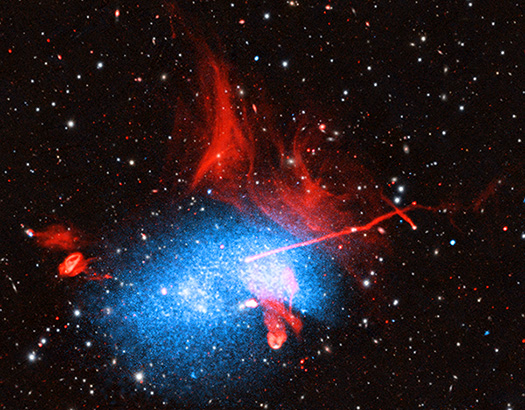
Abell 2256
Credit: X-ray: Chandra: NASA/CXC/Univ. of Bologna/K. Rajpurohit et al.; XMM-Newton: ESA/XMM-Newton/Univ. of Bologna/K. Rajpurohit et al. Radio: LOFAR: LOFAR/ASTRON; GMRT: NCRA/TIFR/GMRT; VLA: NSF/NRAO/VLA; Optical/IR: Pan-STARRS
Astronomers have captured a spectacular, ongoing collision between at least three galaxy clusters. Data from NASA’s Chandra X-ray Observatory, ESA’s (European Space Agency’s) XMM-Newton, and a trio of radio telescopes is helping astronomers sort out what is happening in this jumbled scene. Collisions and mergers like this are the main way that galaxy clusters can grow into the gigantic cosmic edifices seen today. These also act as the largest particle accelerators in the universe.
The giant galaxy cluster forming from this collision is Abell 2256, located 780 million light-years from Earth. This composite image of Abell 2256 combines X-rays from Chandra and XMM in blue with radio data collected by the Giant Metrewave Radio Telescope (GMRT), the Low Frequency Array (LOFAR), and the Karl G. Jansky Very Large Array (VLA) all in red, plus optical and infrared data from Pan-STARRs in white and pale yellow.
NASA's Chandra Finds Galaxy Cluster Collision on a "WHIM"
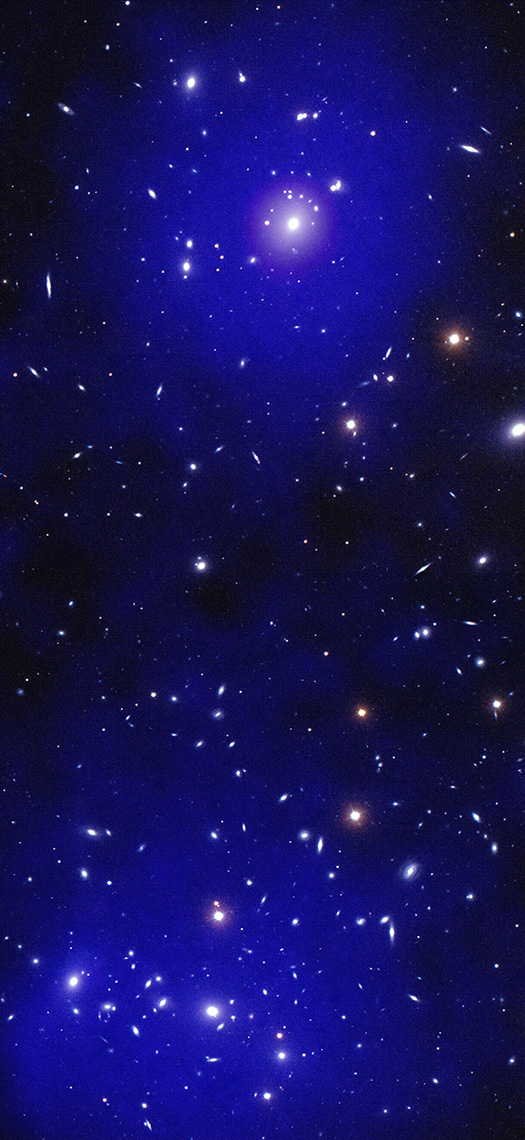
Credit: X-ray: NASA/CXC/CfA/A. Sarkar; Optical: NSF/NOIRLab/WIYN
This image features Abell 98, a system of galaxy clusters that includes a pair in the early stages of a collision. Astronomers have used data from NASA’s Chandra X-ray Observatory (shown as blue and purple with optical data from the WIYN telescope on Kitt Peak in Arizona appearing white and red) to identify key structures and look for “missing” matter in the Universe.
Chandra Adds X-ray Vision to Webb Images
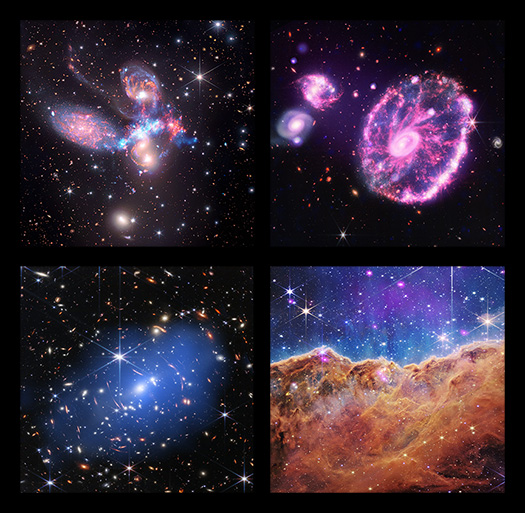
[Upper Left] Stephan's Quintet, [Upper Right] Cartwheel Galaxy,
[Lower Left] SMACS 0723, [Lower Right] The Cosmic Cliffs of the Carina Nebula (NGC 3324)
Credit: X-ray: NASA/CXC/SAO; IR (Spitzer): NASA/JPL-Caltech; IR (Webb): NASA/ESA/CSA/STScI
In the summer of 2022, NASA's James Webb Space Telescope released images from some of its earliest observations with the newly commissioned telescope. Almost instantaneously, these stunning images landed everywhere from the front pages of news outlets to larger-than-life displays in Times Square.
Webb, however, will not pursue its exploration of the universe on its own. It is designed to work in concert with NASA's many other telescopes as well as facilities both in space and on the ground. These new versions of Webb’s first images combine its infrared data with X-rays collected by NASA’s Chandra X-ray Observatory, underscoring how the power of any of these telescopes is only enhanced when joined with others.
NASA Telescopes Capture Stellar Delivery Service for Black Hole
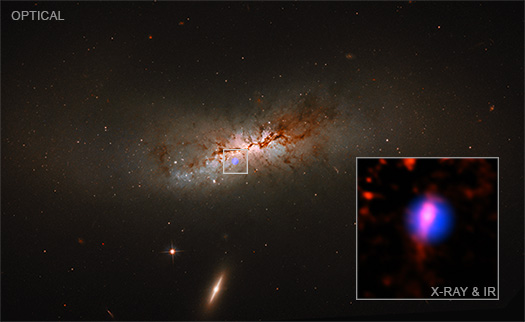
NGC 4424
Credit: X-ray: NASA/CXC/Swinburne Univ. of Technology/A. Graham et al.; Optical: NASA/ESA/STScI
Astronomers may have witnessed a galaxy’s black hole delivery system in action. A new study using data from NASA’s Chandra X-ray Observatory and Hubble Space Telescope outlines how a large black hole may have been delivered to the spiral galaxy NGC 4424 by another, smaller galaxy.
NGC 4424 is located about 54 million light-years from Earth in the Virgo galaxy cluster. The main panel of this image, which has been previously released, shows a wide-field view of this galaxy in optical light from Hubble. The image is about 45,000 light-years wide. The center of this galaxy is expected to host a large black hole estimated to contain a mass between about 60,000 and 100,000 Suns. There are also likely to be millions of stellar-mass black holes, which contain between about 5 and 30 solar masses, spread throughout the galaxy.