



CXC Home | Search | Help | Image Use Policy | Latest Images | Privacy | Accessibility | Glossary | Q&A
Quasars are peculiar objects that radiate as much energy per second as a thousand or more galaxies, from a region that has a diameter about one millionth that of the host galaxy. It is as if a powerhouse the size of a small flashlight produced as much light as all the houses and businesses in the entire L.A. basin!
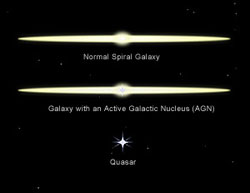
Illustration shows a comparison between normal galaxy, active galaxy and quasar.
Quasars are intense sources of X-rays as well as visible light. They are the most powerful type of X-ray source yet discovered. Some quasars are so bright that they can be seen at a distance of 12 billion light years.
The power of a quasar depends on the mass of its central supermassive black hole and the rate at which it swallows matter. Almost all galaxies, including our own, are thought to contain supermassive black holes in their centers. Quasars represent extreme cases where large quantities of gas are pouring into the black hole so rapidly that the energy output is a thousand times greater than the galaxy itself.
A galaxy with a somewhat less active supermassive black hole is called an Active Galaxy and its black hole is called an "Active Galactic Nucleus" or AGN. Our Milky Way Galaxy and our neighbor, the Andromeda Galaxy, are examples of normal galaxies, where the supermassive black hole has very little gas to capture.
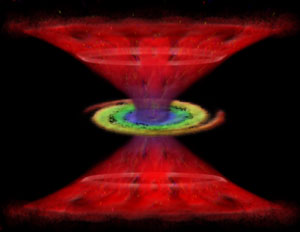
X-rays from quasars and AGNs are produced when in-falling matter is heated to temperatures of millions of degrees as it swirls toward the supermassive black hole. However, not all the matter in the gravitational whirlpool is doomed to fall into the black hole. In many quasars and AGNs, part of the gas escapes as a hot wind that is blown away from the disk at speeds as high as a tenth the speed of light.
Even more dramatic are the high-energy jets that radio and X-ray observations show exploding away from some supermassive black holes. These jets move at nearly the speed of light in tight beams that blast out of the galaxy and travel hundreds of thousands of light years.
According to a popular theory, Type 1 and Type 2 AGNs are the same objects viewed from a different angle. The central black hole is assumed to be surrounded by a thick donut-shaped cloud of gas and dust. The source appears different, depending on whether it is observed from the side through the edge of the donut (Type 2), or from the top through the hole (Type 1).
This theory explains many of the observations of active galaxies, and has won widespread acceptance among astronomers, though questions remain. Chief among these is whether the theory applies to quasars whose central black hole is at least a thousand times more energetic than the typical AGN. Could a cloud of gas exist for any length of time around a giant black hole that is generating energy at such a prodigious rate? Chandra observations of quasars have shown that they can.
Several strong candidates for Type 2, or obscured quasars have been discovered. These objects are inconspicuous at optical wavelengths, so the X-ray observations have led to the conclusion that the giant black hole population in the universe is much higher than observations with optical telescopes indicate.


Revised: June 01, 2012