





CXC Home | Search | Help | Image Use Policy | Latest Images | Privacy | Accessibility | Glossary | Q&A
Download Image
More Information
More Images
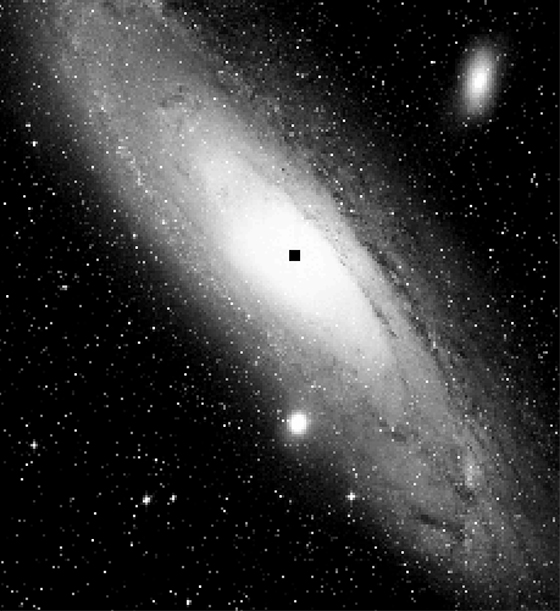
Optical Image of the Andromeda Galaxy
(Credit: Dr. M. Garcia, Dr. S. Murray, Palomar Sky Survey)
More Releases
M31:
Chandra Images Heart of Andromeda Galaxy

Chandra Images Heart of Andromeda Galaxy
[Please note: Additional observations of M31 that alter the conclusions in this release were announced on October 12, 2001. View the updated Chandra results on the Andromeda galaxy.]
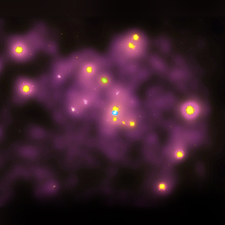
This Chandra X-ray image shows the central portion of the Andromeda Galaxy. The blue dot in the center of the image is an unusually "cool" million degree X-ray source of unknown nature. Just above this cool source is a source (yellow) that is thought to be due to X-rays from matter swirling toward a supermassive black hole in the nucleus of the galaxy. This black hole contains the mass of 30 million suns. Numerous other X-ray sources are also apparent. Most of these are probably due to X-ray binary systems, in which a neutron star or black hole is in a close orbit around a normal star.
|
||||||||||||||||||||||||||||
Visual Description:
This Chandra X-ray image shows the central portion of the Andromeda Galaxy (or M31). At the center of the image, there is a bright, circular object that resembles a star. Surrounding this star, there are numerous small, bright dots, which appear to be evenly distributed across the image. These dots can be seen in different shades of purple, with some appearing brighter or dimmer than others and some with bright yellow cores. The blue dot in the center of the image is an unusually "cool" million degree X-ray source of unknown nature. Numerous other X-ray sources are also apparent. Most of these are probably due to X-ray binary systems, in which a neutron star or black hole is in a close orbit around a normal star.


Revised: September 10, 2025