

CXC Home | Search | Help | Image Use Policy | Latest Images | Privacy | Accessibility | Glossary | Q&A
Before Chandra, when X-ray telescopes observed the sky, it was not dark between the points of X-ray light. Rather, a uniform background glow was apparent, similar to the diffuse glow produced by the lights from a distant city.
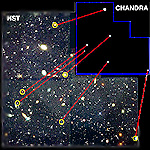
Chandra images made by observing particular patches of the sky for several days – called Deep Fields – have resolved most of the X-ray background into distinct sources. About half of these sources are galaxies with modest X-ray luminosity produced by stellar-size black holes in binary star systems, hot gas within the galaxy, remnants of supernova explosions, or a combination of the above.
The other half of the X-ray sources seen in the Deep Fields are active galaxies and their more powerful cousins, quasars. These extremely luminous galaxies have supermassive black holes in their centers that are sucking in huge quantities of gas. Some of these supermassive black holes are so distant that the observed X-rays left them more than 12 billion years ago!
Detailed studies of these Deep Field images will help astronomers to find out when supermassive black holes were formed, and how they are related to the formation of galaxies.


Revised: April 14, 2026