

CXC Home | Search | Help | Image Use Policy | Latest Images | Privacy | Accessibility | Glossary | Q&A
How do X-ray telescopes differ from optical telescopes?
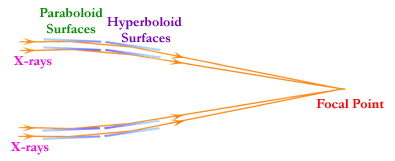
X-rays do not reflect off mirrors the same way that visible light does. Because of their high-energy, X-ray photons penetrate into the mirror in much the same way that bullets slam into a wall. Likewise, just as bullets ricochet when they hit a wall at a grazing angle, so too will X-rays ricochet off mirrors (see diagram below). These properties mean that X-ray telescopes must be very different from optical telescopes.
The mirrors have to be precisely shaped and aligned nearly parallel to incoming X-rays. Thus they look more like barrels than the familiar dish shape of optical telescopes.
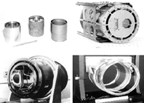
The first imaging X-ray telescope was made by a team of scientists under the direction of Riccardo Giacconi at American Science and Engineering in Cambridge, MA. It was flown on a small sounding rocket in 1963 and made crude images of hot spots in the upper atmosphere of the Sun.
This telescope was about the same diameter and length as the optical telescope Galileo used in 1610. Over a period of 380 years, optical telescopes improved in sensitivity by 100 million times from Galileo's telescope to the Hubble Space Telescope. Remarkably, Chandra represents a leap of 100 million in sensitivity, yet it took only 36 years to achieve!
Why are X-ray observatories in space?
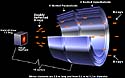
The building and operation of an X-ray observatory is a marvel of modern technology and ingenuity. Engineers, technicians and scientists design and build large, curving mirrors that can be nested inside one another to increase the total reflecting area of the telescope. The mirrors focus X-ray photons onto state-of-the-art detectors which record the direction and in some cases, the energy of the photons.
Because the Earth's atmosphere absorbs X-rays, X-ray observatories must be placed high above the Earth's surface. This means that the ultra-precise mirrors and detectors, together with the sophisticated electronics that conveys the information back to Earth must be able to withstand the rigors of a rocket launch, and operate in the hostile environment of space.
X-Ray Instruments Detect Neutron Stars and Black Holes
The first hint that cosmic X-rays exist came in 1949, when radiation detectors aboard rockets were briefly carried above the atmosphere where they detected X-rays coming from the Sun. It took more than a decade before a greatly improved detector discovered X-rays coming from sources beyond the solar system.
Some of the major X-ray astronomy missions include:
Uhuru

In the early 1970's, NASA's Uhuru X-ray satellite, equipped with a relatively simple instrument - a sensitive X-ray detector similar to a Geiger counter attached to a viewing pipe to locate the source -- made some astounding discoveries. Uhuru detected evidence of black holes and superdense neutron stars pulling matter from companion stars, and vast expanses of hot gas in gigantic systems containing thousands of galaxies.
Skylab

The first large focussing X-ray telescope was the Apollo Telescope Mount aboard Skylab in the early 1970's. This pioneering telescope used two pairs of concentric mirrors to make stunning X-ray images of the Sun. It set the stage for the development of the Einstein X-ray Observatory.
Einstein--the First Imaging X-Ray Observatory
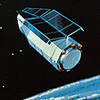
NASA's Einstein Observatory, launched in 1978, was the first large X-ray telescope with mirrors. It made the first X-ray images of shock waves from exploded stars, and images of hot gas in galaxies and clusters of galaxies. Einstein also located accurately over 7000 X-ray sources and made possible a new way to study the mysterious dark matter that surrounds many galaxies.
ROSAT

The Roentgensatellite or ROSAT, a joint venture between Germany, the United Kingdom and the United States, carried an even larger X-ray telescope into orbit in 1990. It has expanded the number of known X-ray sources to more than 60,000 and has proved to be especially valuable for investigating the multi-million degree gas present in the upper atmospheres of many stars.
ASCA
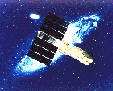
ASCA (Advanced Satellite for Cosmology and Astrophysics) was a joint mission by Japan and the United States. The ASCA X-ray observatory, launched in 1993, was especially designed to study the detailed distribution of X-rays with energy, which provide important information about the elements that make up the hot X-ray emitting gas. ASCA ceased operations in July of 2000.
RXTE
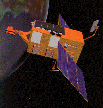
The Rossi X-ray Timing Explorer (RXTE) is a NASA mission which was launched in December 1995. Although RXTE does not have focusing X-ray mirrors, it has the unique capability to study rapid time variability in the emission of cosmic X-ray sources over a wide band of X-ray energies, and is expected to make valuable contributions to our understanding of neutron stars and black holes.
BeppoSAX
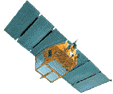
BeppoSAX was a program of the Italian Space Agency with participation of the Netherlands Agency for Aerospace Programs. It was launched on April 30, 1996 from Cape Canaveral, and was the first X-ray mission with a scientific payload covering more than three decades of energy - from 0.1 to 300 keV, with moderate imaging capability. BeppoSAX proved to be useful for X-ray imaging sources associated with Gamma-ray bursts, determining their positions with unprecedented precision, and monitoring the X-ray afterglow. All in-orbit operations of the BeppoSAX mission ended in April, 2002. In April 2003, the spacecraft re-entered Earth's atmosphere and splashed down in the Pacific Ocean.
XMM

ChandraXMM (The High-Throughput X-ray Spectroscopy Mission) is a large X-ray astrophysics observatory developed by the European Space Agency. It was launched on December 10, 1999. This facility class observatory, with an anticipated lifetime of ten years, will enable astronomers to conduct sensitive X-ray spectroscopic obsverations of a wide variety of cosmic sources, and should be a powerful complement to Chandra.
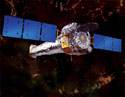
The most important X-ray astronomy mission of the present decade is NASA's Chandra X-ray Observatory, which was launched on July 23, 1999. This telescope contains four sets of nested mirrors and is the premier X-ray observatory to date. It can detect sources more than twice as far away and produce images with five times greater detail. The mirrors have been polished to a smoothness of a few atoms. If the surface of the Earth were as smooth as the Chandra mirrors, the largest mountain would be less than 2 meters (7 feet) tall!
X-ray telescopes have a different design from optical telescopes because X-rays will reflect off mirrors only if they strike them at grazing angles. Two reflections are used to focus the X-rays to a point.
The area of an X-ray telescope can be increased by nesting the mirrors inside one another.
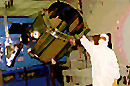
The largest of eight mirrors for Chandra is shown at the Eastman-Kodak laboratory, where the circular support structure was built. The mirror surface was coated with iridium, a material more reflective than gold.


Revised: April 15, 2026