



CXC Home | Search | Help | Image Use Policy | Latest Images | Privacy | Accessibility | Glossary | Q&A
Galaxy clusters are the largest gravitationally bound objects in the universe. They have three major components:
- Hundreds of galaxies containing stars, gas and dust;
- Vast clouds of hot (30 - 100 million degrees Celsius) gas that is invisible to optical telescopes;
- Dark matter, a mysterious form of matter that has so far escaped direct detection with any type of telescope, but makes its presence felt through its gravitational pull on the galaxies and hot gas.
The hot gas envelopes the galaxies and fills the space between galaxies. It contains more mass than all the galaxies in the cluster. Although the galaxies and hot gas clouds are very massive, scientists have determined that about 10 times more mass is needed to hold the cluster together. Something, namely dark matter must exist to provide the additional gravity.
Astronomers think that galaxy clusters form as clumps of dark matter and their associated galaxies are pulled together by gravity to form groups of dozens of galaxies, which in turn merge to form clusters of hundreds, even thousands of galaxies.

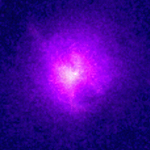
Comparison of optical image from La Palma & B.McNamara (left) and X-ray image from Chandra (right) of the Hydra A cluster of galaxies. This cluster is so large that it takes light millions of years to cross it.
The gas in galaxy clusters is heated as the cluster is formed. This heating can be a violent process as gas clouds enveloping groups of galaxies collide and merge to become a cluster over billions of years.
Chandra images provide dramatic evidence of these mega-mergers. Cosmic "weather systems" millions of light years across are observed, as relatively cool 50 million degree Celsius clouds of gas fall into much larger and hotter clouds.
It takes a long time to build a galaxy cluster. Exactly how long depends on details such as the amount of dark matter in the universe, whether the dark matter is hot or cold, how fast the universe is expanding, etc. The pressure in the hot gas is an accurate probe of the amount of dark matter in clusters of galaxies. By using this information, and X-ray surveys to count the number of large clusters in the universe, astronomers can test the various theories for the content and evolution of the universe.
Chandra observations of the clouds of hot gas in clusters of galaxies will provide other clues to the origin, evolution and destiny of the universe. Combined X-ray and microwave observations can measure the effect of the cluster gas as it scatters the cosmic microwave background streaming through the cluster from the depths of the universe. The amount of scattering makes it possible to estimate the distance to the cluster. This information can be used to estimate the size and age of the universe.
Another intriguing question is the ultimate fate of the colossal gas reservoirs in galaxy clusters. The crush of all the gas and dark matter in the cluster pushes the particles in the center of the cluster closer together. This causes them to collide more frequently and to slowly lose their energy to radiation, like a tire with a slow leak. In a billion years or so, this radiation leak will take its toll and, if there is no energy source to offset the losses, the gas will cool and slowly settle – in what is called a cooling flow – onto a massive galaxy in the center of the cluster.
Early X-ray observations indicated that the cooling was occurring at such a rate that hundreds of new stars or cool gas clouds should be forming every year in the centers of many clusters. As astronomers began searching for this cool matter, they found some, but not nearly enough.
New observations of galaxy clusters by Chandra and the XMM Newton X-ray Observatory, together with radio observations, may point to a resolution of this problem. They show that in a number of cases, the inflow of cooling gas appears to be deflected by magnetic fields, and perhaps heated by explosions from the vicinity of a supermassive black hole at the core of the central galaxy. Whether or not such violent activity will explain the shortage of cool gas should become clear in the next few years.


Revised: October 11, 2012