

CXC Home | Search | Help | Image Use Policy | Latest Images | Privacy | Accessibility | Glossary | Q&A
Ordinary matter, or the stuff we and everything around us is made of, consists largely of empty space. Even a rock is mostly empty space. This is because matter is made of atoms. An atom is a cloud of electrons orbiting around a nucleus composed of protons and neutrons.
The nucleus contains more than 99.9 percent of the mass of an atom, yet it has a diameter of only 1/100,000 that of the electron cloud. The electrons themselves take up little space, but the pattern of their orbit defines the size of the atom, which is therefore 99.9999999999999% open space!
What we perceive as painfully solid when we bump against a rock is really a hurly-burly of electrons moving through empty space so fast that we can't see—or feel—the emptiness. What would matter look like if it weren't empty, if we could crush the electron cloud down to the size of the nucleus? Suppose we could generate a force strong enough to crush all the emptiness out of a rock roughly the size of a football stadium. The rock would be squeezed down to the size of a grain of sand and would still weigh 4 million tons!
Such extreme forces occur in nature when the central part of a massive star collapses to form a neutron star. The atoms are crushed completely, and the electrons are jammed inside the protons to form a star composed almost entirely of neutrons. The result is a tiny star that is like a gigantic nucleus and has no empty space.
Neutron stars are strange and fascinating objects. They represent an extreme state of matter that physicists are eager to know more about. Yet, even if you could visit one, you would be well-advised to turn down the offer.
The intense gravitational field would pull your spacecraft to pieces before it reached the surface. The magnetic fields around neutron stars are also extremely strong. Magnetic forces squeeze the atoms into the shape of cigars. Even if your spacecraft prudently stayed a few thousand miles above the surface neutron star so as to avoid the problems of intense gravitational and magnetic fields, you would still face another potentially fatal hazard.
If the neutron star is rotating rapidly, as most young neutron stars are, the strong magnetic fields combined with rapid rotation create an awesome generator that can produce electric potential differences of quadrillions of volts. Such voltages, which are 30 million times greater than those of lightning bolts, create deadly blizzards of high-energy particles.
Rotation-powered pulsars
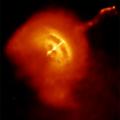
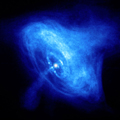
These high-energy particles produce beams of radiation from radio through gamma-ray energies. Like a rotating lighthouse beam, the radiation can be observed as a pulsing source of radiation, or pulsar. Pulsars were first observed by radio astronomers in 1967. There are now approximately 1000 known pulsars. The pulsar in the Crab Nebula, one of the youngest and most energetic pulsars known, has been observed to pulse in almost every wavelength—radio, optical, X-ray, and gamma-ray. A few dozen pulsars are observed to pulse in X-rays and six are seen to pulse in gamma-rays.
Magnetars
These illustrations show how an extremely rapidly rotating neutron star, which has formed from the collapse of a very massive star, can produce incredibly powerful magnetic fields. These objects are known as magnetars.
Magnetars are neutron stars with magnetic fields that are about a quadrillion times greater than the magnetic field of Earth. These awesome magnetic fields are thought to be produced when an extremely rapidly rotating neutron star is formed by the collapse of the core of a massive star. When a neutron star forms it triggers a supernova explosion that expels the outer layers of the star at high speeds.
The high rate of the rotation of the neutron star intensifies the already superstrong magnetic field to magnetar levels. When the magnetic forces get strong enough, they may cause starquakes on the surface of the neutron star that produce powerful outbursts of X-rays called X-ray flashes. These events may represent an intermediate type of supernova explosion - more energetic than ordinary supernovae, but less so than hypernovae, thought to be responsible for gamma ray bursts. Magnetar outbursts can also occur for hundreds of years after the initial explosion.
The strongest steady magnetic field produced on Earth in a lab is about a million times greater than the Earth's magnetic field. Beyond this limit ordinary magnetic material would be blown apart by magnetic forces. Only on a neutron star, where gravity is more than 100 billion times as great as on Earth, can matter withstand the magnetic forces of a magnetar, and even there the neutron star's crust can break apart under the strain.
The source of the power is the rapidly rotating magnetic field, so these pulsars are sometimes called rotationally powered pulsars, to distinguish them from another type of pulsar discovered by X-ray astronomers, the accretion powered pulsars.
Accretion powered pulsars
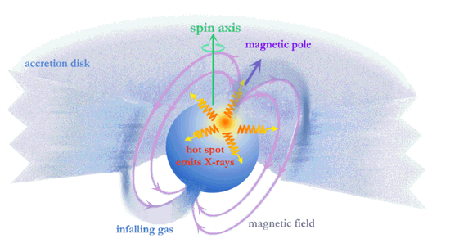
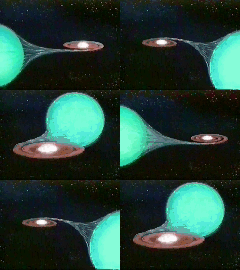
If a neutron star is in a close orbit around a normal companion star, it can capture matter flowing away from that star. This captured matter will form a disk around the neutron star from which it will spiral down and fall, or accrete, onto the neutron star.
The infalling matter will gain an enormous amount of energy as it accelerates. Much of this energy will be radiated away at X-ray energies. The magnetic field of the neutron star can funnel the matter toward the magnetic poles, so that the energy release is concentrated in a column, or spot of hot matter. As the neutron star rotates, the hot region moves into and out of view and produces X-ray pulses.
If you have a java enabled browser, you can view our animation and discussion of X-ray pulsars.
Accretion-powered pulsars are produced by matter flowing onto the neutron star, whereas rotation-powered pulsars produce an outflow of matter. (In some cases, a significant contribution to the X-ray emission can be from polar caps heated by "instreaming" particles.) For the latter, rapid rotation is required. For the former, an abundant source of infalling gas, such as a companion star is needed. (See Binary and Multiple Star Systems)
Some of the strongest X-ray sources in our galaxy are accreting neutron stars in binary star systems. With Chandra, astronomers have detected hundreds of such objects in other galaxies as well. Accreting neutron stars exhibit various behaviors thought to be related to the details of how the matter falls onto the neutron star. Some pulse steadily, some flicker in a quasi-periodic way, some burst explosively, some eject jets of high-energy particles. If you have a java-enabled browser, you can view our animation and discussion of X-ray pulsars.
A black hole in a binary system could also produce an accretion-powered source. Since black holes do not have a surface or a magnetic pole in the normal sense of the word, they cannot produce regular X-ray pulses, though they may flicker.


Revised: August 24, 2017