

CXC Home | Search | Help | Image Use Policy | Latest Images | Privacy | Accessibility | Glossary | Q&A
Until the last few years, brown dwarfs inhabited the "undiscovered country" between stars and planets. Their mass was too small for them to be stars and too large for planets. They were expected to be dim, a thousand times less luminous than the Sun, and relatively cool, with surface temperatures less than 2500 degrees Celsius.
Because of their intrinsic faintness and low temperature, brown dwarfs were not discovered until 1995. Today several dozen are known and the number is increasing rapidly thanks to surveys with telescopes equipped with sensitive infrared detectors. It is now estimated that brown dwarfs are approximately as numerous as normal stars in our galaxy.
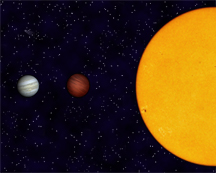
The approximate size of a brown dwarf (center) compared to Jupiter left) and the Sun (right). Although brown dwarfs are similar in size to Jupiter, they are much more dense and produce their own light whereas Jupiter shines with reflected light from the Sun. (Illustration: NASA/CXC/K.Arcand)
According to theory, an object that has a mass of less than about 8 percent of the mass of the Sun cannot sustain significant nuclear fusion reactions in its core. This marks the dividing line between red dwarf stars and brown dwarfs. When brown dwarfs are very young, they generate some energy from the fusion of heavy hydrogen, or deuterium, into helium nuclei, but this supply is used up in a few tens of millions of years. After that brown dwarfs glow because of the heat generated by the release of gravitational energy as they slowly contract.
The dividing line between planets and brown dwarfs occurs with objects that have masses below about 1 percent of the mass of the Sun, or 10 times the mass of Jupiter. These objects cannot fuse deuterium. It is also thought that planets form by a different mechanism from brown dwarfs. Planets form through the coalescence of small rocky or icy bodies in a disk around a star, whereas brown dwarfs form by collapsing from a cloud of dust and gas. Recent discoveries of large gaseous planets near stars may have cast some doubt on this distinction, however.
Because it has no strong central nuclear energy source, the interior of a brown dwarf is in a rapid boiling, or convective motion. When combined with the rapid rotation that most brown dwarfs exhibit, convection sets up conditions for the development of a strong, tangled magnetic field near the surface.
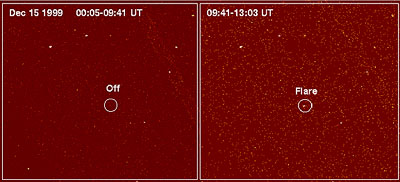
The flare observed by Chandra from LP944-20 could have its origin in the turbulent magnetized hot material beneath the brown dwarf's surface. A sub-surface flare could conduct heat to the atmosphere, allowing electric currents to flow and produce an X-ray flare, like a stroke of lightning. Further observations of brown dwarf flares will be very important for understanding the development of strong magnetic fields and flaring activity in brown dwarfs and giant planets.
The absence of X-rays from LP 944-20 during the non flaring period is also a significant result. It sets the lowest observational limit on steady X-ray power produced by a brown dwarf star, and shows that million degree Celsius upper atmospheres, or coronas, cease to exist as the surface temperature of a brown dwarf cools below about 2500 degrees Celsius and becomes electrically neutral.


Revised: April 15, 2026