

CXC Home | Search | Help | Image Use Policy | Latest Images | Privacy | Accessibility | Glossary | Q&A
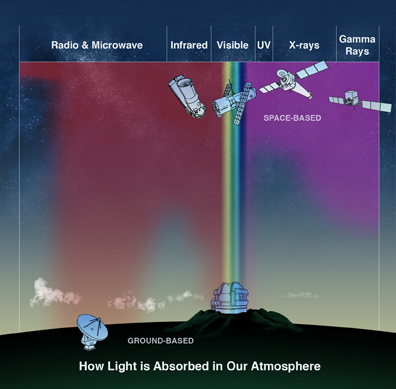
Absorption by the Earth's atmosphere restricts ground-based observations to radio, near infrared, and visible wavelengths. X-rays are absorbed high above the Earth in the following way:
X-ray photons--tiny high-energy packets of electromagnetic radiation--are absorbed by encounters with individual atoms. Even though the atoms in the atmosphere are widely spaced, the total thickness of the atmosphere is large and the total number of atoms is enormous. An X-ray photon passing through the atmosphere will encounter as many atoms as it would in passing through a 5 meter (16 ft) thick wall of concrete!
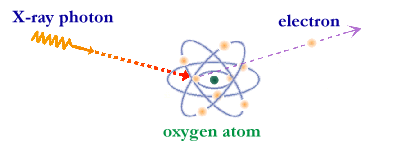
What happens when an X-ray is absorbed in the atmosphere?
The energy of the X-ray goes into tearing one of the electrons away from its orbit around the nucleus of a nitrogen or an oxygen atom.
This process is called photo-electric absorption, because a photon is absorbed in the process of removing an electron from an atom. The high-energy of X-rays is necessary for photo-electric absorption to take place.
X-ray telescopes in orbit above the Earth's atmosphere can collect X-rays from energetic sources billions of light years away. These cosmic X-rays are focused by barrel-shaped mirrors onto an instrument especially designed to measure properties such as the incoming direction and energy of the X-ray photon. A gaseous or solid material in the instrument absorbs the X-rays by the photo-electric effect.


Revised: August 03, 2010