
Supernovas & Supernova Remnants
A Cleaner Look at Our Galactic Center's Hot Mess
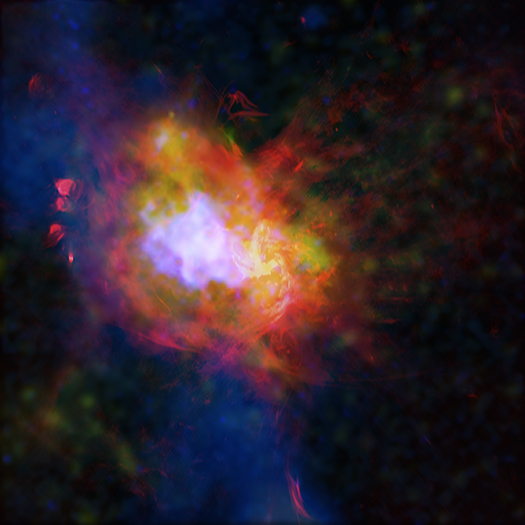
Sagittarius A East in our Galactic Center
More images and information
Credit: X-ray: NASA/CXC/McGill Univ./M. Balakrishnan et al.; Radio: NSF/NRAO/VLA; Sub-mm: EAO/James Clerk Maxwell Telecope;
Image Processing: NASA/CXC/SAO/P. Edmonds, N. Wolk
The center of the Milky Way galaxy is a chaotic place. In addition to the 4-million-solar mass black hole, known as Sagittarius A* (Sgr A*), the region is full of gas, dust, strong magnetic fields, and stars in various stages of life — from birth to death.
Now, astronomers have released the clearest view yet of the remains of an exploded star that sits amid this cluttered galactic environment. The supernova remnant is named Sagittarius A East, or Sgr A East, and it is the closest remnant to Sgr A* that astronomers know about.
Sgr A East emits light in many wavelengths, including X-rays that NASA’s Chandra X-ray Observatory can see. Supernova remnants like Sgr A East give off X-rays because powerful shock waves rumble outward into space after the explosion and the stellar debris is superheated to millions of degrees.
Rare Stellar Explosion Gives Astronomers a Front-Row Seat to a Massive Star's Death
Today astronomers have announced that they caught a massive star’s death from the first explosive moment. The supernova may represent a new way for stars to end their lives. Press releases based on two papers just published in The Astrophysical Journal Letters describe the extensive set of observatories they used to study the supernova, including NOIRLab telescopes, NASA’s Chandra X-ray Observatory and the National Radio Astronomy Observatory’s Very Large Array. In particular, a press release from Carnegie Mellon University (CMU) highlights work by Brendan O’Connor who led one of these papers. We are delighted to welcome Brendan as a guest blogger to describe Chandra’s important role in this work.

Brendan O'Connor (Credit: Brendan O'Connor)
O’Connor is a McWilliams Fellow in the McWilliams Center for Cosmology and Astrophysics at CMU, where he studies cosmic explosions. His research concentrates on time-domain and transient astrophysics with a focus on the formation and evolution of high-energy transients and their progenitors. He uses a range of optical, infrared, and X-ray observatories to investigate these phenomena across the electromagnetic spectrum and is an avid user of NASA’s Chandra X-ray Observatory. He received his PhD from The George Washington University in 2023 under the supervision of Dr. Chryssa Kouveliotou, Dr. Eleonora Troja, and Dr. Brad Cenko. He will soon move to the Joint Space-Science Institute at the University of Maryland, College Park and NASA Goddard Space Flight Center as a Neil Gehrels Prize Postdoctoral Fellow.
NASA's Chandra Finds Unexpected Fireworks in Aftermath of Stellar Explosions
M83
More images, videos, and information
Credit: X-ray: NASA/CXC/SAO; Optical: NASA/ESA/AURA/STScI, Hubble Heritage Team, W. Blair (STScI/Johns Hopkins University) and R. O'Connell (University of Virginia); Image Processing: NASA/CXC/SAO/A. Jubett, L. Frattare and P. Edmonds
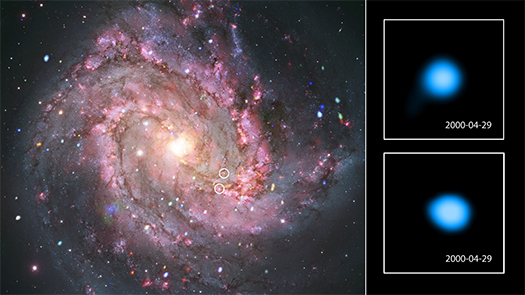
This graphic shows two of the X-ray sources in a nearby galaxy that are changing their brightness in surprising ways as described in our latest press release. By analyzing data from NASA’s Chandra X-ray Observatory that span over 14 years, researchers found over 20 previously identified supernova remnants — remains from stars that exploded — that vary unexpectedly in X-ray brightness in Messier 83 (M83). These represent roughly half of the X-ray sources associated with supernova remnants in their sample in M83.
The panel on the left contains a composite image of M83 with X-rays from Chandra (red, green, and blue) and optical light data from NASA’s Hubble Space Telescope (red, green, and blue). The two varying Chandra sources are circled in the composite image and close-up timelapse images of these sources are shown in the panels on the right.
NASA's Chandra Discovers Possible Supernova Remnant in Galactic Center
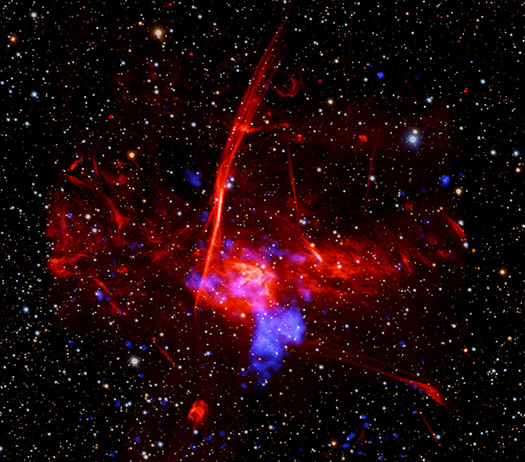
Sagittarius C
More images and information
Credit: X-ray: NASA/CXC/UCLA/Z. Zhu et al.; ESA/XMM-Newton; Optical: PanSTARRS; Radio: MeerKAT;
Image Processing: NASA/CXC/SAO/L. Frattare and P. Edmonds
Using data from NASA’s Chandra X-ray Observatory, astronomers may have found a supernova remnant in an intriguing neighborhood in the middle of our galaxy. A paper describing these new findings published in The Astrophysical Journal.
Supernova remnants are the expanding remains of exploded stars and provide elements — like iron, oxygen, and silicon — that are critical for the formation of planets and for life as we know it to form and flourish.
This new supernova remnant, if confirmed, would be one of the closest ever discovered to the supermassive black hole at the central region of the Milky Way galaxy, an exotic region crammed with massive stars, long threads of magnetic fields and dense clouds of gas orbiting rapidly around the Galactic Center.
NASA's IXPE and Chandra Take a New Look at an Old Supernova
RCW 86
More images and information
Credit: X-ray: Chandra: NASA/CXC/SAO, XMM: ESA/XMM-NEWTON, IXPE:NASA/MSFC; Optical: NSF/NOIRLab;
Image Processing: NASA/CXC/SAO/J. Schmidt
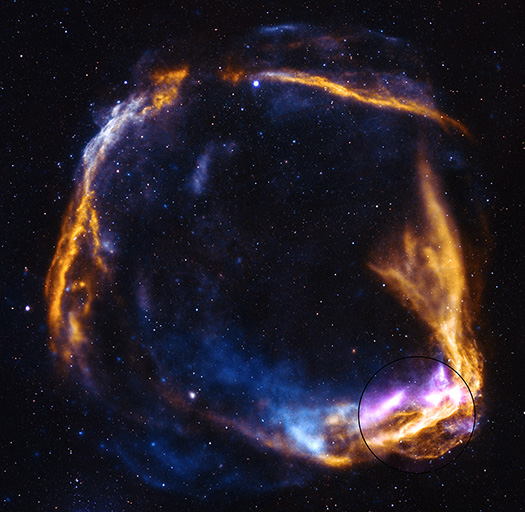
NASA’s Imaging X-ray Polarimetry Explorer (IXPE) has taken a new observation of what may be the first documented evidence of a supernova, RCW 86.
RCW 86 is approximately 8,000 light-years from Earth in the Southern constellation of Circinus, occupying a region of the sky slightly larger than the full moon. In the year 185 AD, Chinese astronomers recorded witnessing a “guest star” in this area of the night sky that remained visible for 8 months.
Supernova Remnant Video From NASA's Chandra Is Decades in Making
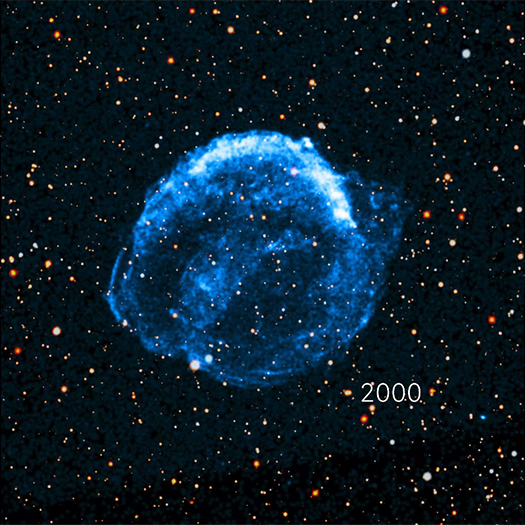
Kepler’s Supernova Remnant
More images, videos, and information
X-ray: NASA/CXC/SAO; Optical: Pan-STARRS
A new video shows changes in Kepler’s Supernova Remnant using data from NASA’s Chandra X-ray Observatory captured over more than two and a half decades with observations taken in 2000, 2004, 2006, 2014, and 2025. In this video, which is the longest-spanning one ever released by Chandra, X-rays (blue) from the telescope have been combined with an optical image (red, green, and blue) from Pan-STARRS.
Kepler’s Supernova Remnant, named after the German astronomer Johannes Kepler, was first spotted in the night sky in 1604. Today, astronomers know that a white dwarf star exploded when it exceeded a critical mass, after pulling material from a companion star, or merging with another white dwarf. This kind of supernova is known as a Type Ia and scientists use it to measure the expansion of the Universe.
Fall Collection: Before Fall Leaves, See Seasonal Offerings from NASA's Chandra
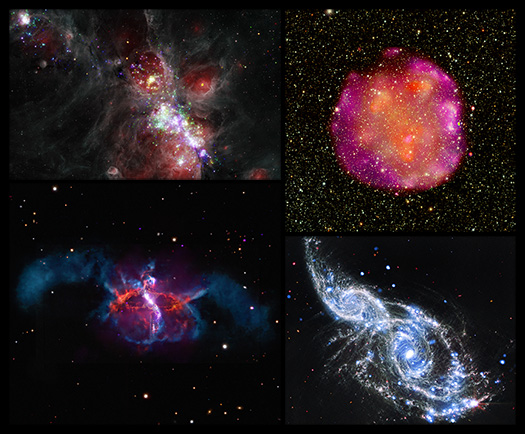
Before fall gives way to winter in the northern hemisphere, NASA’s Chandra X-ray Observatory has several images that celebrate autumn and its many delights to share. In spirit of the season, this collection gathers Chandra data with those from its telescopic family including NASA’s James Webb, Hubble, and Spitzer Space Telescopes, plus others in space and on the ground.
NASA's Chandra Releases New 3D Models of Cosmic Objects
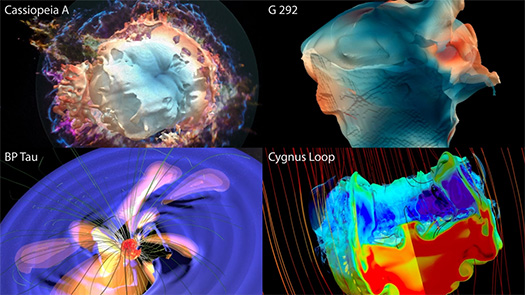
New three-dimensional (3D) models of objects in space have been released by NASA’s Chandra X-ray Observatory. These 3D models allow people to explore — and print — examples of stars in the early and end stages of their lives. They also provide scientists with new avenues to investigate scientific questions and find insights about the objects they represent.
These 3D models are based on state-of-the-art theoretical models, computational algorithms, and observations from space-based telescopes like Chandra that give us accurate pictures of these cosmic objects and how they evolve over time.
However, looking at images and animations is not the only way to experience this data. The four new 3D printable models of Cassiopeia A (Cas A), G292.0+1.8 (G292), Cygnus Loop supernova remnants, and the star known as BP Tau let us experience the celestial objects in the form of physical structures that will allow anyone to hold replicas of these stars and their surroundings and examine them from all angles.
Finding Clues in Ruins of Ancient Dead Star With NASA's Chandra
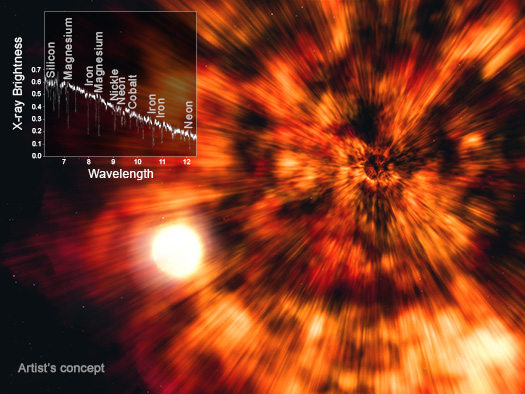
People often think about archaeology happening deep in jungles or inside ancient pyramids. However, a team of astronomers has shown that they can use stars and the remains they leave behind to conduct a special kind of archaeology in space.
Mining data from NASA’s Chandra X-ray Observatory, the team of astronomers studied the relics that one star left behind after it exploded. This “supernova archaeology” uncovered important clues about a star that self-destructed – probably more than a million years ago.
New NASA Sonifications Listen to the Universe's Past
Your browser does not support the video tag.
Cassiopeia A Sonification
Credit: X-ray: NASA/CXC/SAO; Optical: NASA/ESA/STScI; IR: NASA/ESA/CSA/STScI/Milisavljevic et al., NASA/JPL/CalTech; Image Processing: NASA/CXC/SAO/J. Schmidt and K. Arcand; Sonification: NASA/CXC/SAO/K.Arcand, SYSTEM Sounds (M. Russo, A. Santaguida)
A quarter of a century ago, NASA released the “first light” images from the agency’s Chandra X-ray Observatory. This introduction to the world of Chandra’s high-resolution X-ray imaging capabilities included an unprecedented view of Cassiopeia A, the remains of an exploded star located about 11,000 light-years from Earth. Over the years, Chandra’s views of Cassiopeia A have become some of the telescope’s best-known images.
To mark the anniversary of this milestone, new sonifications of three images — including Cassiopeia A (Cas A) — are being released. Sonification is a process that translates astronomical data into sound, similar to how digital data are more routinely turned into images. This translation process preserves the science of the data from its original digital state but provides an alternative pathway to experiencing the data.