

CXC Home | Search | Help | Image Use Policy | Latest Images | Privacy | Accessibility | Glossary | Q&A
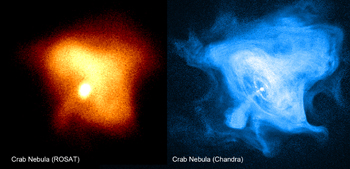
Credit: Crab Nebula - ROSAT: S. L.Snowden USRA, NASA/GSFC
Crab Nebula - Chandra: NASA/CXC/SAO/F.Seward et al High Res Tif
NASA's Chandra X-ray Observatory, which was launched and deployed by Space Shuttle Columbia on July 23, 1999, is the most sophisticated X-ray observatory built to date.
Chandra is designed to observe X-rays from high-energy regions of the universe, such as the remnants of exploded stars. The two images of the Crab Nebula supernova remnant and its pulsar shown below illustrate how higher resolution can reveal important new features.
The image on the left is from the High Resolution Imager on the Rontgensatellite (Rosat), the observatory with the best imaging capability before Chandra. The image on the right, taken by the Advanced CCD Imaging Spectrometer (ACIS) on Chandra, has approximately fifty times better resolution (pixel area fifty or more times smaller) than the one on the left. In the Chandra image, new details-rings and jets in the region around the pulsar-provide valuable information for understanding how the pulsar transmits energy to the nebula as a whole.
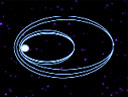
Quick Time Movie
of Chandra's orbit path.
(1.49 MB; Credit: NGST)
The Observatory has three major parts: (1) the X-ray telescope, whose mirrors focus X-rays from celestial objects; (2) the science instruments which record the X-rays so that X-ray images can be produced and analyzed; and (3) the spacecraft, which provides the environment necessary for the telescope and the instruments to work.
Chandra's unusual orbit was achieved after deployment by a built-in propulsion system which boosted the observatory to a high Earth orbit. This orbit, which has the shape of an ellipse, takes the spacecraft more than a third of the way to the moon before returning to its closest approach to the Earth of 16,000 kilometers (9,942 miles). The time to complete an orbit is 64 hours and 18 minutes.
The spacecraft spends 85% of its orbit above the belts of charged particles that surround the Earth. Uninterrupted observations as long as 55 hours are possible and the overall percentage of useful observing time is much greater than for the low Earth orbit of a few hundred kilometers used by most satellites.
Extraordinary commitment and precision is required to plan and build telescopes that will be placed in space where they are operated by remote control in a hostile environment of wild temperature swings and hard vacuum, after withstanding the controlled fury of launch. The entire process typically takes many years and creativity is demanded when unexpected changes are imposed. The Chandra observatory was first proposed to NASA in 1976 and funding began in 1977 when NASA's Marshall Space Flight Center started the definition studies of the telescope.
In 1992, there was a major restructuring of the observatory. NASA decided that in order to reduce cost, the number of mirrors would be decreased from twelve to eight and only four of the six scientific instruments would be used. At this point the planned orbit was changed from low to high Earth orbit to preserve the scientific capability of Chandra.
Teams of scientists, engineers, technicians and managers who work at numerous government centers, Universities and corporations have been building and assembling Chandra over the past twenty years. Many of these dedicated men and women have been involved in the project from its inception.
Organizations with major involvement in the Chandra project are listed below.
Overall Program Management- NASA Marshall Space Flight Center
- TRW (now NGST) - Spacecraft Construction and Integration
- Hughes/Danbury Optical Systems (now Goodrich Optical and Space Systems) - Mirror Grinding and Polishing
- Optical Coating Laboratories, Inc. - Mirror Coating and Cleaning
- Eastman Kodak Corporation - Mirror Assembly
- Ball Aerospace and Technology Corp. - Science Instrument Module & Aspect System
- Advanced CCD Imaging Spectrometer (ACIS) - Penn State University and Massachusetts Institute of Technology (MIT)
- High Resolution Camera (HRC) - Smithsonian Astrophysical Observatory (SAO)
- High Energy Transmission Grating - MIT
- Low Energy Transmission Grating - Space Research Institute Netherlands and Max Planck Institute in Germany
- Dr. Leon VanSpeybroeck, SAO
- SAO
- SAO (with MIT & NGST personnel)
- Science Support
- Operations Control Center
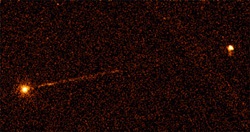
Pictor A
Credit: NASA/UMD/A.Wilson et al.
The Chandra X-ray Center (CXC) is located in Cambridge, Massachusetts at the Smithsonian Astrophysical Observatory and staffed by personnel from SAO, MIT, and NGST. Dr. Harvey Tananbaum was the Center's director from inception to April 20, 2014. He has been succeeded as CXC Director by Dr. Belinda J. Wilkes. Science Support is responsible for the mission planning and science operations. The Operations Control Center directs the flight and executes the observing plan of the observatory, and receives the scientific data from the observatory.
Chandra has begun an exploration of the hot turbulent regions in space with images 25 times sharper than previous X-ray pictures. The example below illustrates how Chandra can enable astronomers to study the process by which jets of matter are ejected from supermassive black holes in the dense central regions of galaxies.
Chandra's improved sensitivity can make possible more detailed studies of black holes, supernovas, and dark matter and increase our understanding of the origin, evolution, and destiny of the universe.


Revised: March 07, 2024