

CXC Home | Search | Help | Image Use Policy | Latest Images | Privacy | Accessibility | Glossary | Q&A
How do X-ray telescopes differ from optical telescopes? (java enhanced)
X-rays do not reflect off mirrors the same way that visible light does. Because of their high-energy, X-ray photons that strike a mirror directly will penetrate into the mirror in much the same way that bullets aimed directly at a surface will bury themselves in it. Likewise, just as a bullets can ricochet off a surface when they hit it at a grazing angle, so too will X-rays ricochet off mirrors if they hit at very shallow angles, like a stone skipping across the surface of a pond. These properties mean that X-ray telescopes must be very different from optical telescopes.
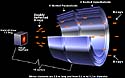
Schematic of the Chandra mirror
The Chandra mirrors look more like barrels than the familiar dish shape of optical telescopes. Four 'mirror' shells are nested inside one another to increase the total reflecting area of the telescope. The inner, reflecting surfaces of the mirrors have to be precisely shaped, and aligned nearly parallel to the incoming X-rays. The mirrors focus X-ray photons onto state-of-the-art detectors which record position, and in some cases the energy, of the photons. These X-ray data are then analyzed and reconstructed into images of the celestial objects that produce the emissions.


Revised: March 11, 2019