

CXC Home | Search | Help | Image Use Policy | Latest Images | Privacy | Accessibility | Glossary | Q&A
For Release: December 1, 2025
NASA/CXC
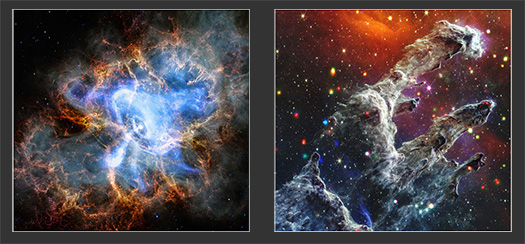
Credit: [Left] Crab Nebula: X-ray: NASA/CXC/SAO; Infrared: NASA/STScI; Image Processing: NASA/CXC/SAO/J. Major; [Right] Eagle Nebula, M16: X-ray: NASA/CXO/SAO; Infrared: NASA/ESA/CSA/STScI; Image processing: NASA/CXC/SAO/L. Frattare
A new symphony based on data from NASA’s Chandra X-ray Observatory, as well as the James Webb Space Telescope, transforms astronomical observations into music that traces the life cycle of stars.
While there have been many original pieces of music inspired by the heavens, this musical composition is uniquely mapped from data of space. By using data sonifications from Chandra, compiled with Webb data, the new composition provides an unprecedented connection to space through music via actual data.
The Chandra X-ray Observatory is one of NASA’s “Great Observatories” and has been the world’s premier X-ray telescope for over a quarter century. It also leads in the innovative use of data sonification—the process of converting scientific data into sound.
This new two-part suite by composer Sophie Kastner builds on and pairs with her previous work, “Where Parallel Lines Converge,” which was based on the Chandra data sonification of the Galactic Center. In both the original composition and this latest one, Kastner has created musical vignettes that human musicians can play based on the NASA data and how it is represented in the sonification.
“I am thrilled to continue working on a project that bridges gaps between science and music” said Kastner. “For these two new pieces, I was inspired by the life cycle of a star, and how new stars are born from matter left over by dying stars.
To create the new suite, Kastner worked closely with Dr. Kimberly Arcand, Chandra visualization scientist, and principal investigator of the sonification program.
“By turning Chandra and other multiwavelength data of the stars into a form that humans can play themselves, we create a connection between people here on Earth to objects in space that are millions of miles away,” said Arcand.
Live audiences were able to enjoy Chandra’s first piece, “When Parallel Lines Converge,” through premieres at the Smithsonian’s Hirshhorn Museum in Washington, DC with the 21st Century Consort, and internationally in Taiwan with the Taiwan National Symphony Orchestra.
Arcand and Kastner are working to schedule performances of this latest composition in 2026 with professional ensembles. They encourage interested musical and art organizations to contact them through the web site listed below.
To see and hear samples, find sheet music of the symphony, and learn more about the sonification project, visit https://chandra.si.edu/sound/symphony.html
NASA's Marshall Space Flight Center in Huntsville, Alabama, manages the Chandra program. The Smithsonian Astrophysical Observatory's Chandra X-ray Center controls science operations from Cambridge, Massachusetts, and flight operations from Burlington, Massachusetts.
Media Contact:
Megan Watzke
Chandra X-ray Center, Cambridge, Massachusetts
617-496-7998
mwatzke@cfa.harvard.edu


Revised: December 02, 2025