

Translating NASA data into compositions
and sheet music that you can play
The Universe of Sound data sonification project started out as a way to translate data from NASA’s Chandra X-ray Observatory and other NASA telescopes into sound, particularly for our community members who are blind or low vision. Working with our partners at SYSTEM Sounds, the project uses mathematical mappings to assign digital sounds to the pixel values of the NASA data (learn more about our sonifications here). A frequent question we get, however, when presenting this sonification work is from musicians who ask if they can play the data. These compositions address that need.
Using data from NASA’s Chandra, Webb, Hubble and Spitzer space telescopes, we have translated the information into a composition, with sheet music. Working with the composer Sophie Kastner, we have created a soundscape across three movements that can now be played by musicians. We hope you enjoy the free compositions, and please let us know if you are interested in performing this piece professionally with an ensemble.

I approached the form from a different perspective than the original sonifications: rather than scanning the image horizontally and treating the x-axis as time, I instead focused on small sections of the image creating short vignettes corresponding with these occurrences, approaching the piece as if I was writing a film score to accompany the image. Because the Galactic Center image was so full of information, of material, I wanted to draw the listener’s attention to smaller events within the greater data set.

Musical Arrangements
NASA Data from our Milky Way, in Three Movements
Galactic Center: Where Parallel Lines Converge
Where Parallel Lines Converge is a sonic rendering of a composite image of the Galactic Center, or the center of our Milky Way galaxy, with data from NASA’s Chandra, Hubble and Spitzer space telescopes. The piece is a tryptic, highlighting three astronomical objects or moments in the image: the X-ray binary, the arched filaments, and the supermassive black hole, Sagittarius A*. The X-ray binary section is characterized by contrast, how the darkness and the infrared light surround this extremely bright X-ray center. Arched filaments is the softest with a unique, shimmery texture of harmonic glissandos. Sagittarius A* focuses on repetitive, metered gestures that overlap and build, generating a sensation of spiraling toward an epicenter. The piece was conceived using the same principles as the original NASA Chandra data sonifications, converting data to sound by matching different parameters of the image with musical parameters.
Crab Nebula: Return to Dust
In this movement of the symphony titled Return to Dust, we journey into the heart of the Crab Nebula from Chandra & Webb —the brilliant, chaotic remnant of a star’s final moments. The piece opens with the sudden burst of the supernova, noticed by Earth-bound observers in 1054 AD, and conveyed through a percussive strike that sets the stage for what follows. As we dive into the NASA data, layers of flute, clarinet, strings, and shimmering piano recreate the high-speed spin of the pulsar at the Nebula’s core —a neutron star whirling nearly 30 times each second. These rapid, bright figures give way to more forceful percussion, echoing the pulsar’s powerful jets of matter and antimatter launched into surrounding space. A brief stillness follows, marked by resonant chords and darker textures in marimba and lower strings, as the view pulls back to reveal the clouds of dust and gas expanding outward—cosmic debris that will one day help form new stars. The music circles back to the pulsar once more, its relentless spin a reminder of both destruction and renewal in the universe.
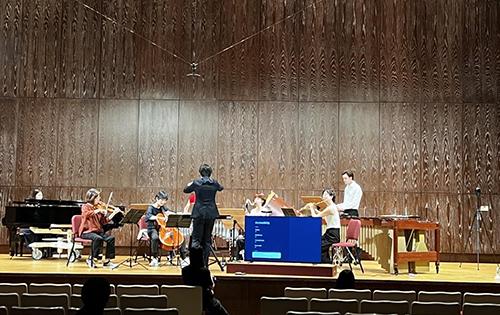
Performance at Taiwan National Symphony Orchestra
Pillars of Creation: Cathedrals of Dust and Light
In Cathedrals of Dust and Light, we enter a vast stellar nursery—an awe-inspiring region where stars are born from towering clouds of gas and dust. Translated from the data of the iconic Pillars of Creation, from Chandra & Webb, this movement unfolds in three layered sections, mirroring the complex structures of the nebula itself. Shimmering optical tones evoke the outer clouds—ghostly, sculpted by winds and radiation from older stars that have already ignited. As the music deepens, we journey inward to the dense columns where Evaporating Gas Globules (EGGs) swirl with potential. Through layered harmonies and spiraling rhythms, we hear matter gathering, compressing, heating—gravitational energy building toward ignition. At the center, bursts of bright, high-pitched notes mark the appearance of new stars, as their magnetic fields erupt and jets of matter escape along polar axes, breaking through their dusty cradles. This dynamic cycle, rendered through a shifting blend of pure notes and textured noise, captures the transformation of energy into light, and dust into life. Just as the Crab Nebula marks a star’s end, here we witness a beginning—two cosmic movements bound by a shared truth: from stellar death comes stellar birth.
The science

Data from NASA’s Great Observatories was combined to produce this image of the central region of the Milky Way. Near-infrared light from Hubble (yellow) outlines energetic regions where stars are being born. Infrared data from Spitzer (red) show glowing clouds of dust containing complex structures. And, X-rays from Chandra (blue and violet) reveal gas heated to millions of degrees by stellar explosions and outflows from the Galaxy’s supermassive black hole.
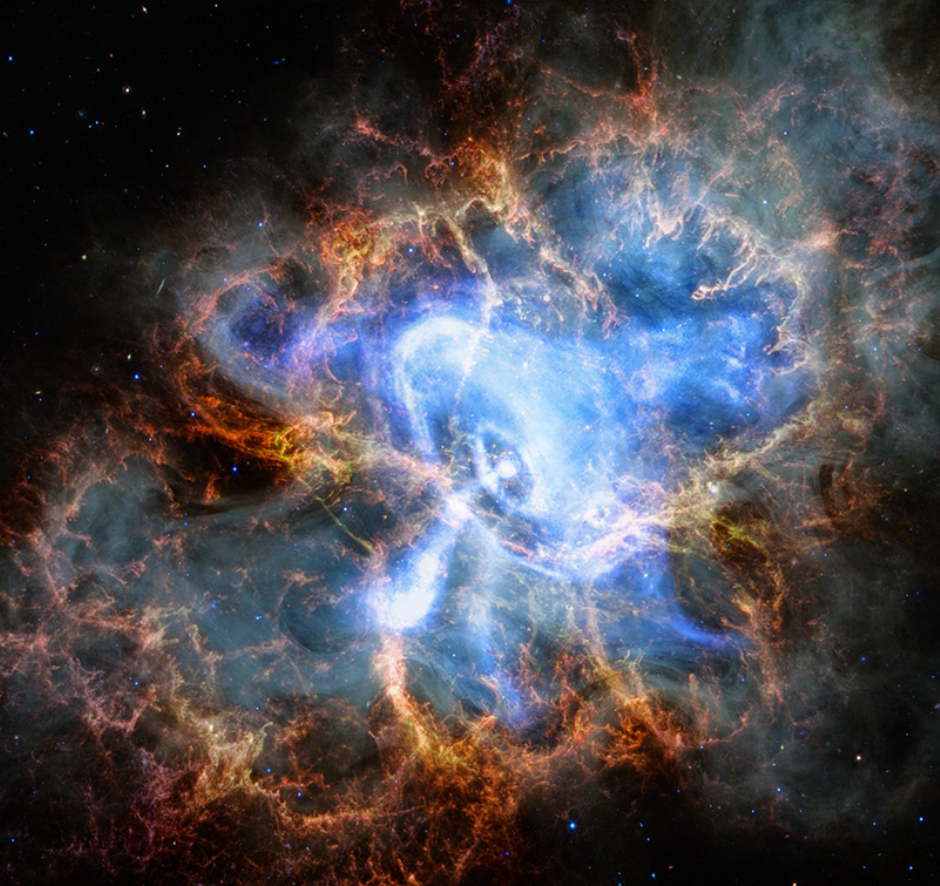
The Crab Nebula, the result of a bright supernova explosion seen by Chinese and other astronomers in the year 1054, is 6,500 light-years from Earth. At its center is a neutron star, a super-dense star produced by the supernova. As it rotates at about 30 times per second, its beam of radiation passes over the Earth every orbit, like a cosmic lighthouse. As the young pulsar slows down, large amounts of energy are injected into its surroundings.This image shows the X-ray data from Chandra in blue, along with infrared data from the Webb space telescope in grey, yellow, and gold.
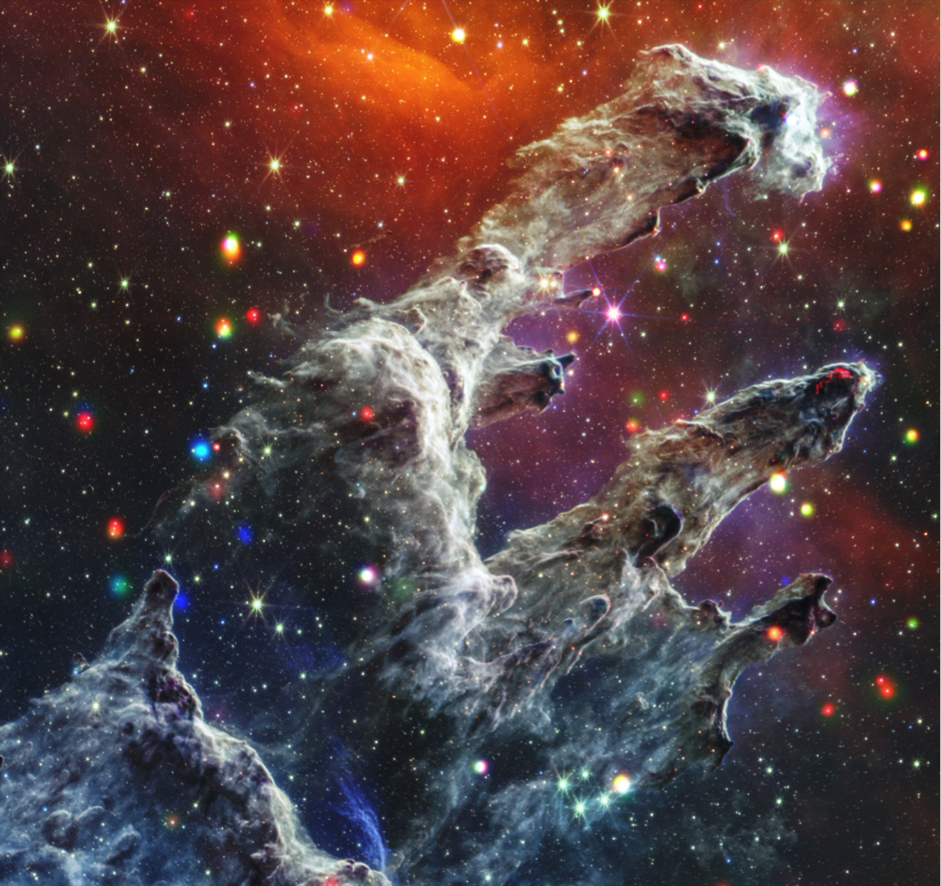
Messier 16, also known as the Eagle Nebula, is a famous region of the sky often referred to as the “Pillars of Creation.” The James Webb Space Telescope infrared image shows the dark columns of gas and dust shrouding the few remaining fledgling stars just being formed. The Chandra X-ray Observatory sources, which look like bright multicolored dots, are young stars that give off copious amounts of X-rays.
Experience the Music (Videos)
Music files for all movements
Listen to and download the composition’s files.
Credits/acknowledgements:
Pieces composed by Sophie Kastner
Science advisors: Dr. Kimberly Arcand, Dr. Joel Kastner
Original sonifications: NASA/CXC/Dr. Kim Arcand & SYSTEM Sounds/Dr. Matt Russo & Andrew Santaguida
Images: Chandra X-ray: NASA/CXC/SAO; Hubble Optical: NASA/STScI; Webb IR: NASA, ESA, CSA, STScI; Spitzer IR: NASA/JPL-Caltech
Videos edited by: NASA/CXC/SAO/April Jubett
Parallel Lines title inspired by “Relativity” a Poem by Sarah Howe
First performed/recorded by Ensemble Éclat, Montreal, McGill University
U.S. premiere by the 21st Century Consort, Smithsonian Hirshhorn, Washington, D.C.
International premiere with the Taiwan National Symphony Orchestra, Taiwan.


Chandra X-ray Center, Operated for NASA by the Smithsonian Astrophysical Observatory. This site was developed with funding from NASA under contract NAS8-03060 | Privacy | Accessibility