
Spring Collection: Spring Has Sprung in Space (As Always)
In the Northern Hemisphere this week, the calendar officially passes from winter into spring when the length of the day and the night become equal as the days become longer. Meanwhile, there are places in space where blooms of the stellar variety are always growing.
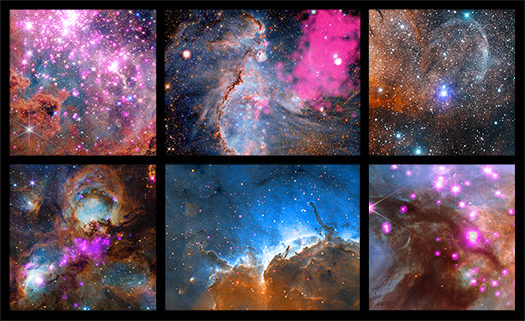
This collection of images from NASA’s Chandra X-ray Observatory and other telescopes contains regions where stars are forming. Often nicknamed “stellar nurseries,” they are cosmic gardens from which stars – not plants – emerge from the interstellar soil of gas and dust. X-rays are energetic enough that they can penetrate the gas and dust of these stellar nurseries, giving insight to the young stars and other high-energy phenomena that are happening within, including the effects of X-rays on any planets or planet-forming disks orbiting stars.
And, like gardens here on Earth, some stellar nurseries bloom before others. These images are listed roughly by their age, representing a span from “early” to “late spring,” cosmically speaking.
Credit: NASA/CXC/SAO
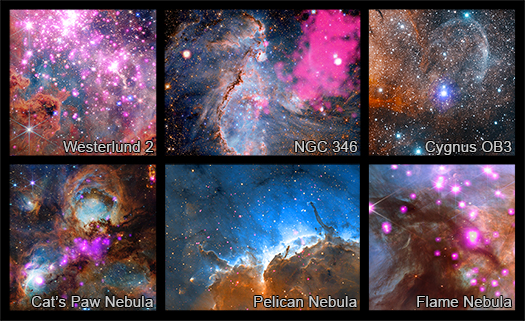
The Pelican Nebula (also known as NGC 7000) and the Cat’s Paw Nebula both contain stars that are mainly about a million years old. By comparison, the Sun is over 4.5 billion years old — or more than 4,000 times the age of these stars. In this new image of the Pelican Nebula, X-rays from Chandra (pink) are combined with an optical image from NASA’s Hubble Space Telescope (red, green, and blue). Meanwhile, the Cat’s Paw Nebula image has Chandra X-ray data (pink) overlaid on infrared data from NASA’s James Webb Space Telescope (red, orange, yellow, green, cyan and blue).
For stars that are slightly older — with ages between about one and three million years old — we look to NGC 346, the Flame Nebula, and Westerlund 2. For NGC 346, a star-forming region in the Small Magellanic Cloud, X-rays from Chandra (purple) are combined with an optical image from Hubble (red, green, and blue). In the Flame Nebula composite, Chandra’s X-rays (purple) are found throughout the gas and dust-filled landscape in infrared light seen by NASA’s James Webb Space Telescope (red, green, and blue). This Westerlund 2 image contains X-ray data from Chandra (purple) and infrared data from Webb (red, orange, green, cyan, and blue).
The most mature stars in these spring-themed images is the region around Cygnus X-1, a binary system where a black hole is partnered with a massive star. In this image of the Cygnus OB3 region, X-rays from Chandra (blue) are combined with optical data from Kitt Peak National Observatory (red and blue).
The companion star to the black hole in Cygnus X-1 is particularly interesting. Because it more than 20 times more massive than the Sun, it is likely going to explode in a supernova in the future. This event would seed the area with new elements that will become the cosmic soil for the next generation of stars.
This process of supernova explosions sending essential elements out into space will happen to many of the most massive stars in these stellar nurseries, underscoring the similar rhythms between the cycle of life here on Earth and the cycle of the stars across space.