
Where Are They Now? Steve Hawley
Steve Hawley was the flight engineer on the STS-93 Columbia mission that carried Chandra into space in 1999. Before that he was on four previous shuttle flights, one in 1990 to deploy the Hubble Space Telescope, and one in 1997 to assist in making major upgrades and repairs to Hubble. His role in the deployment of two of the most productive telescopes ever has secured him an important place in the history of astronomy.
At a recent symposium celebrating 15 years of Chandra Science, Steve sat down over breakfast to talk about his illustrious career so far, and plans for the future.
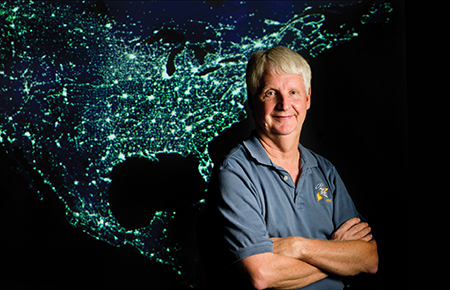
Steve Hawley
When did you first think you wanted to be an astronaut?
SH: I wanted to be astronomer since I was very young. My grandfather taught physics at a small college in Kansas. He used to say, "In physics, you learn how to think." In astronomy you can learn how the universe works just by looking. And I was drawn to become an astronaut NASA, because NASA is a great organization because they try to do things that have never been done before.
"Mini Supernova" Explosion Could Have Big Impact
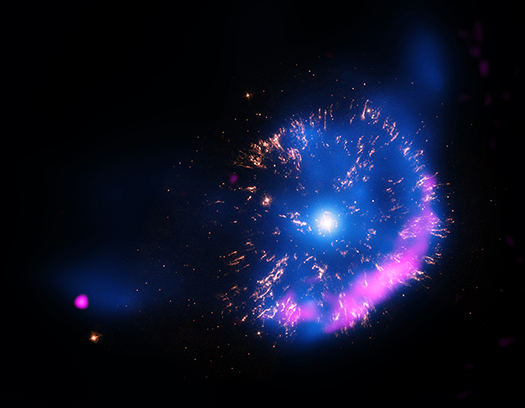
In Hollywood blockbusters, explosions are often among the stars of the show. In space, explosions of actual stars are a focus for scientists who hope to better understand their births, lives, and deaths and how they interact with their surroundings.
Using NASA's Chandra X-ray Observatory, astronomers have studied one particular explosion that may provide clues to the dynamics of other, much larger stellar eruptions.
NASA's Chandra Observatory Finds Cosmic Showers Halt Galaxy Growth
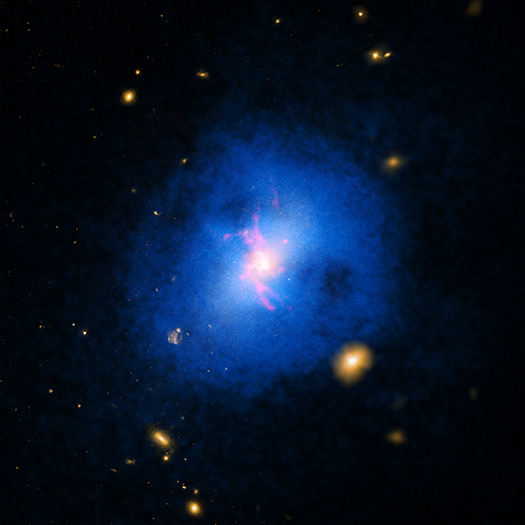
This galaxy cluster comes from a sample of over 200 that were studied to determine how giant black holes at their centers affect the growth and evolution of their host galaxy, as reported in our latest press release. This study revealed that an unusual form of cosmic precipitation enables a feedback loop of cooling and heating, stifling star formation in the middle of these galaxy clusters.
Growing Black Holes: Hunting for the First Seeds

Mar Mezcua
We are pleased to welcome Mar Mezcua as a guest blogger today. She led the study that is the subject of our latest press release, about an intermediate mass black hole. Mar is from Balaguer (Lleida, Spain) and studied Physics in the University Autonomous of Barcelona and in the University of La Laguna, where she also specialized in Astrophysics. She completed her PhD at the Max-Planck-Institut fuer Radioastronomie (Bonn, Germany) in 2011 and then moved to the Instituto de Astrofisica de Canarias (Canary Islands, Spain) as a postdoctoral researcher. She is currently a postdoctoral researcher at the Harvard-Smithsonian Center for Astrophysics.
I found my calling when I was 13 years old and serendipitously watched a documentary on TV about galaxies and supermassive black holes. I wanted to become an astrophysicist and study these exciting objects!
Supermassive black holes reside at the center of galaxies and are more than a million times more massive than the Sun. As their name implies, they are black and thus cannot be observed directly. Hence, to detect black holes we have to observe the matter that surrounds and feeds them, this is, the material that the black hole “accretes.” In supermassive black holes, this accreting material heats up high enough to emit X-rays so that we can detect it with X-ray satellites like NASA’s Chandra X-ray Observatory. Some supermassive black holes also eject outflows of plasma or jets, which emit mainly at radio wavelengths.
NASA's Chandra Finds Intriguing Member of Black Hole Family Tree
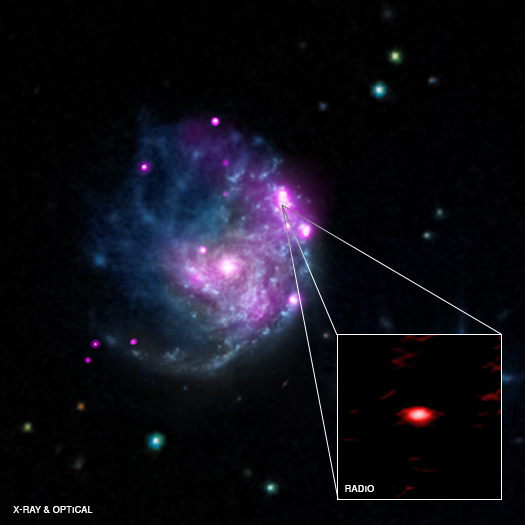
A newly discovered object in the galaxy NGC 2276 may prove to be an important black hole that helps fill in the evolutionary story of these exotic objects, as described in our latest press release. The main image in this graphic contains a composite image of NGC 2766 that includes X-rays from NASA's Chandra X-ray Observatory (pink) combined with optical data from the Hubble Space Telescope and the Digitized Sky Survey (red, green and blue). The inset is a zoom into the interesting source that lies in one of the galaxy's spiral arms. This object, called NGC 2276-3c, is seen in radio waves (red) in observations from the European Very Long Baseline Interferometry Network, or EVN.
Exploded Star Blooms Like a Cosmic Flower
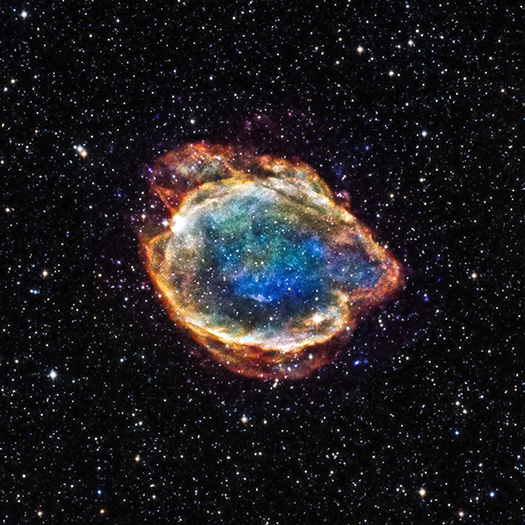
Because the debris fields of exploded stars, known as supernova remnants, are very hot, energetic, and glow brightly in X-ray light, NASA's Chandra X-ray Observatory has proven to be a valuable tool in studying them. The supernova remnant called G299.2-2.9 (or G299 for short) is located within our Milky Way galaxy, but Chandra's new image of it is reminiscent of a beautiful flower here on Earth.
Light: Going Beyond the Bulb
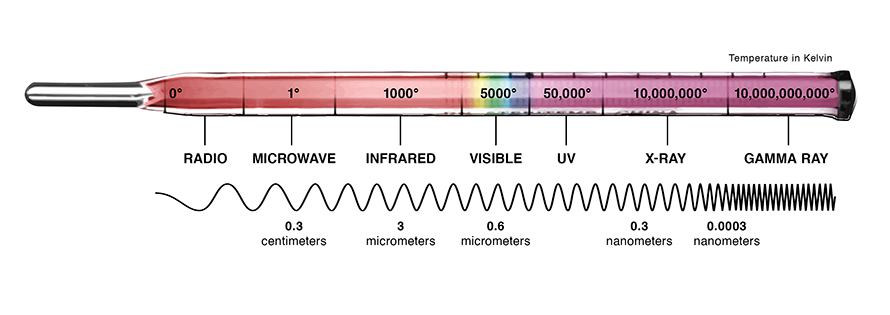
2015 has been declared the International Year of Light and Light-based Technologies (#IYL2015) by the United Nations. Working for NASA’s Chandra X-ray Observatory, a space-based telescope that observes X-rays from the Universe, we talk about light all the time. X-rays are a kind of light. There are many different kinds of light that make up the electromagnetic spectrum, from radio waves to gamma rays, but only one that human eyes can detect naturally (known as optical, or visible, light).

Caption: This illustration shows the full range of the electromagnetic spectrum, in order of increasing frequency or energy, from radio waves, to microwave, to infrared, to visible or optical, to ultraviolet, to X rays, to gamma rays.
Image file: https://lightexhibit.org/images/featured/about_light.jpg
Image Credit: NASA/CXC/M.Weiss
Chandra Celebrates The International Year of Light
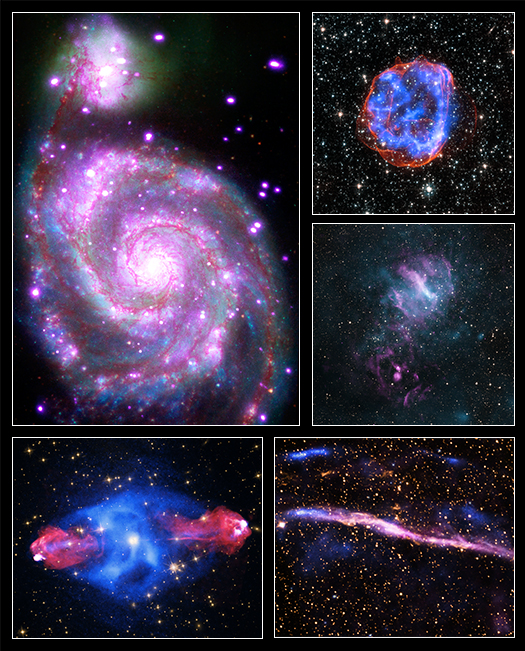
The year of 2015 has been declared the International Year of Light (IYL) by the United Nations. Organizations, institutions, and individuals involved in the science and applications of light will be joining together for this yearlong celebration to help spread the word about the wonders of light.
In many ways, astronomy uses the science of light. By building telescopes that can detect light in its many forms, from radio waves on one end of the "electromagnetic spectrum" to gamma rays on the other, scientists can get a better understanding of the processes at work in the Universe.
NASA's Chandra Detects Record-Breaking Outburst from Milky Way's Black Hole
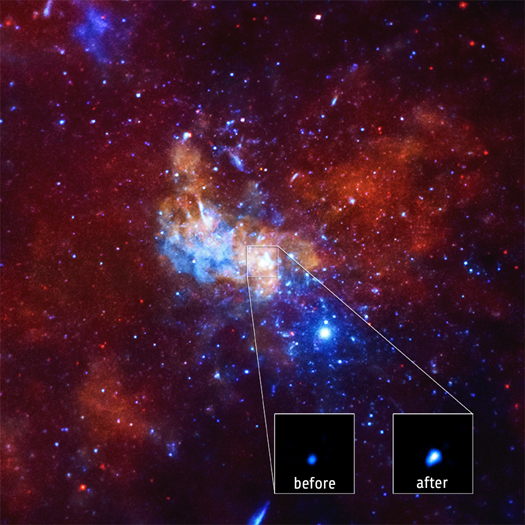
On September 14, 2013, astronomers caught the largest X-ray flare ever detected from the supermassive black hole at the center of the Milky Way, known as Sagittarius A* (Sgr A*). This event, which was captured by NASA's Chandra X-ray Observatory, was 400 times brighter than the usual X-ray output from Sgr A*, as described in our press release. The main portion of this graphic shows the area around Sgr A* in a Chandra image where low, medium, and high-energy X-rays are red, green, and blue respectively. The inset box contains an X-ray movie of the region close to Sgr A* and shows the giant flare, along with much steadier X-ray emission from a nearby magnetar, to the lower left. A magnetar is a neutron star with a strong magnetic field. A little more than a year later, astronomers saw another flare from Sgr A* that was 200 times brighter than its normal state in October 2014.
Chandra Weighs Most Massive Galaxy Cluster in Distant Universe
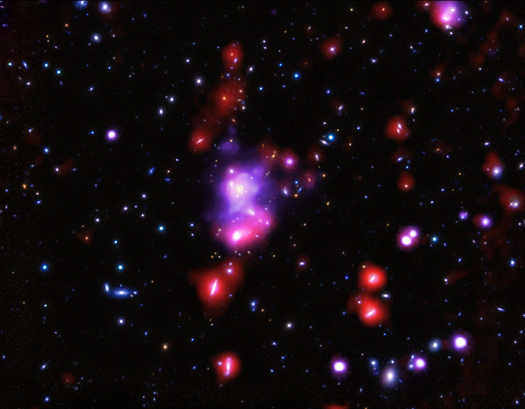
A newly discovered galaxy cluster is the most massive one ever detected with an age of 800 million years or younger. Using data from NASA's Chandra X-ray Observatory, astronomers have accurately determined the mass and other properties of this cluster, as described in our latest press release. This is an important step in understanding how galaxy clusters, the largest structures in the Universe held together by gravity, have evolved over time.