





CXC Home | Search | Help | Image Use Policy | Latest Images | Privacy | Accessibility | Glossary | Q&A
Download Image
More Information
More Images
Animation & Video
More Releases

Related Images


Vela Pulsar Jet:
Firehose-Like Jet Observed In Action

Firehose-Like Jet Observed In Action
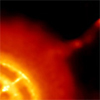
The Chandra images in this montage show the erratic variability of a jet of high energy particles that is associated with the Vela pulsar, a rotating neutron star. These images are part of a series of 13 images made over a period of two and a half years that has been used to make a time-lapse movie of the motion of the jet.
Much like an untended firehose, the jet bends and whips about spectacularly at half the speed of light. Bright blobs move in the jet at similar speeds.
The jet is half a light year (3 trillion miles) in length and is shooting out ahead of the moving neutron star. The extremely high-energy electrons or positrons that compose the jet were created and accelerated by the combined action of the fast rotation of the neutron star and its intense magnetic field. These particles produce X-rays as they spiral outward around the magnetic field of the jet.
Over its entire length, the width of the jet (about 200 billion miles) remains approximately constant. This suggests that the jet is confined by magnetic fields generated by the charged particles flowing along the axis of the jet. Laboratory studies of beams of particles confined in this manner have shown that they can change rapidly due to an effect called the "firehose instability". This is the first time such behavior has been observed in astrophysical jets.
To picture how the firehose instability works, imagine a firehose lying on the ground. When the water is turned on, different parts of the hose will kink and move rapidly in different directions, pushed by the increased pressure at the bends in the hose. The Vela jet resembles a hose made of magnetic fields, which confines the charged particles. The bright blobs in the jet are thought to be a manifestation of the increased magnetic field and particle pressure at the kinks in the jet.
The instability could be triggered by the strong headwind created as the pulsar moves through the surrounding gas at a speed of about 200,000 miles per hour. The activity of the Vela pulsar jet could also help to understand the nature of the enormous jets coming from supermassive black holes. Those jets may also vary, but on time scales of millions of years, instead of weeks as in the Vela pulsar jet.
|
||||||||||||||||||||||||||||
Visual Description:
This Chandra X-ray Observatory image features the Vela Pulsar, which is one of the brightest pulsars in the sky at X-ray energies. The image consists of four panels, each showing a different time stamped observation of the Vela Pulsar. The dominant colors in the image are shades of bright yellow and orange set amidst a solid black backdrop, which create an eerie and mysterious atmosphere. The key structures of the Vela Pulsar can be seen clearly in the image, including its disk-shaped structure, and its pulsar wind nebula (PWN) that surrounds it. The Chandra images in this montage essentially show the erratic variability of a jet of high energy particles that is associated with the Vela pulsar, a rotating neutron star. These images are part of a series of 13 images made over a period of two and a half years that has been used to make a time-lapse video of the motion of the jet. Much like an untended firehose, the jet bends and whips about spectacularly at half the speed of light. Bright blobs move in the jet at similar speeds.


Revised: September 05, 2025