


CXC Home | Search | Help | Image Use Policy | Latest Images | Privacy | Accessibility | Glossary | Q&A
When a star runs out of nuclear fuel, it will collapse. If the core, or central region, of the star has a mass that is greater than three Suns, no known nuclear forces can prevent the core from forming a deep gravitational warp in space called a black hole.
A black hole does not have a surface in the usual sense of the word. There is simply a region, or boundary, in space around a black hole beyond which we cannot see. This boundary is called the event horizon.
Anything that passes beyond the event horizon is doomed to be crushed as it descends ever deeper into the gravitational well of the black hole. No visible light, nor X-rays, nor any other form of electromagnetic radiation, nor any particle, no matter how energetic, can escape. The radius of the event horizon (proportional to the mass) is very small, only 30 kilometers for a non-spinning black hole with the mass of 10 Suns.
Can astronomers see a black hole? Not directly. The only way to find one is to use circumstantial evidence. Observations must imply that a sufficiently large amount of matter is compressed into a sufficiently small region of space so that no other explanation is possible. For stellar black holes, this means observing the orbital acceleration of a star as it orbits its unseen companion in a double or binary star system.
Searching for black holes is tricky business. One way to locate them has been to study X-ray binary systems. These systems consist of a visible star in close orbit around an invisible companion star which may be a neutron star or black hole. The companion star pulls gas away from the visible star.
As this gas forms a flattened disk, it swirls toward the companion. Friction caused by collisions between the particles in the gas heats them to extreme temperatures and they produce X-rays that flicker or vary in intensity within a second.
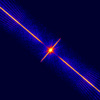
Chandra image of the
black hole candidate
XTE J1118+480
(central bright point).
The spikes and rays extending from the bright point are instrumental artifacts.
Many bright X-ray binary sources have been discovered in our galaxy and nearby galaxies. In about ten of these systems, the rapid orbital velocity of the visible star indicates that the unseen companion is a black hole. (The figure at right is an X-ray image of the black hole candidate XTE J1118+480.) The X-rays in these objects are produced by particles very close to the event horizon. In less than a second after they give off their X-rays, they disappear beyond the event horizon.
However, not all the matter in the disk around a black hole is doomed to fall into the black hole. In many black hole systems, some of the gas escapes as a hot wind that is blown away from the disk at high speeds. Even more dramatic are the high-energy jets that radio and X-ray observations show exploding away from some stellar black holes. These jets can move at nearly the speed of light in tight beams and travel several light years before slowing down and fading away.
Do black holes grow when matter falls into them? Yes, the mass of the black hole increases by an amount equal to the amount of mass it captures. The radius of the event horizon also increases by about 3 kilometers for every solar mass that it swallows. A black hole in the center of a galaxy, where stars are densely packed, may grow to the mass of a billion Suns and become what is known as a supermassive black hole. Recently Chandra has found evidence that black holes with masses of about a thousand Suns can be formed in dense star clusters by processes that are not yet understood.


Revised: August 13, 2025