

CXC Home | Search | Help | Image Use Policy | Latest Images | Privacy | Accessibility | Glossary | Q&A
For Release: April 14, 2026
NASA/CXC
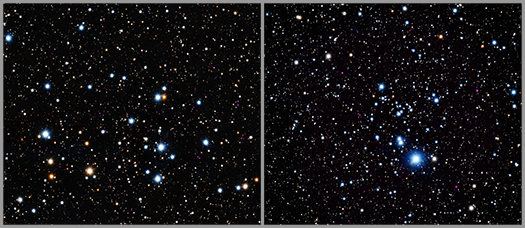
Open Clusters Trumpler 3 and NGC 2353
Credit: X-ray: NASA/CXC/Penn State Univ/K. Getman; Optical/IR: PanSTARRS; Image Processing: NASA/CXC/SAO/N. Wolk
Press Image, Caption, and Videos
Scientists have found that young stellar cousins of our Sun are calming down and dimming more quickly in their X-ray output than previously thought, according to a new study using NASA’s Chandra X-ray Observatory. A paper describing the results published Monday in The Astrophysical Journal.
Unlike in the new movie “Project Hail Mary,” this quieting of young stars is a benefit for the prospects for life on orbiting planets around these stars — not a threat.
Astronomers used Chandra and other telescopes to monitor how powerful radiation from young stars — often in the form of dangerous X-rays — can pummel planets surrounding them. They did not know, however, how long this high-energy barrage continued.
This latest study looked at eight clusters of stars between the ages of 45 million and 750 million years old. The researchers found that Sun-like stars in these clusters unleashed only about a quarter to a third of the X-rays they expected.
"While science fiction imagines alien life that dims stellar output by consuming its energy — like the microbes in Project Hail Mary — our real observations reveal a natural ‘quieting’ of young Sun-like stars in X-rays,” said Konstantin Getman, the lead author of the new study from Penn State University. “This is not because an outside force is consuming their light, but because their internal generation of magnetic fields becomes less efficient.”
In fact, this calming could be a boon to the formation of life on planets around stars that are younger versions of our own Sun. (Our Sun is about 4.6 billion years old, so significantly older than the stellar cousins in this study.) This is because large amounts of X-rays can erode a planet’s atmosphere and prevent formation of molecules necessary for organic life as we know it. On average, three-million-year-old stars with a mass equal to the Sun produce about a thousand times more X-rays than today's Sun. Meanwhile, 100-million-year-old solar-mass stars are about 40 times brighter in X-rays than the present Sun.
“It’s possible that we owe our existence to our Sun doing the same thing, several billion years ago, that we see these young stars doing now,” said co-author Vladimir Airapetian of NASA’s Goddard Space Flight Center in Greenbelt, Maryland. “This real-world dimming echoes the dramatic stellar change in fiction, but it may be even more fascinating because it highlights our own Sun's actual history.”
The researchers found that stars with about the same mass as the Sun quieted down relatively rapidly — after a few hundred million years — while ones with less mass kept up their high levels of X-ray emission for longer. Combined with a decrease in the energy of the X-rays and the disappearance of energetic particles, the Sun-sized stars are apparently better suited to host planets with robust atmospheres and possibly blossoming life than previously thought.
The research team also used data from ESA’s (European Space Agency’s) Gaia satellite and X-ray data from the ROSAT (ROentgen SATellite) mission. This data allowed them to identify the stars that were members of the clusters (not foreground or background stars). To measure the X-ray output from the stars, they made new Chandra observations of five clusters with ages between 45 million and 100 million years, in addition to using Chandra and ROSAT data from archives to study three older clusters with ages between 220 and 750 million years.
Astronomers have not been able to study the X-ray output of stars in this age range well before. Most astronomers have relied on sparse data and a relationship from previous work between the X-ray emission young stars produce and their ages and rates of spin. Older and more slowly rotating stars are usually fainter in X-rays, but the team found that X-ray output drops off about 15 times more rapidly than the relationship predicts during this specific adolescent phase.
“We can only see our Sun at this current snapshot in time, so to really understand its past we must look to other stars with about the same mass,” said co-author Eric Feigelson, also of Penn State University. “By studying X-rays from stars that are hundreds of millions of years old, we have filled in a large gap in our understanding of their evolution.”
While they are still investigating the cause of this slower-than-expected activity, scientists think the process that generates magnetic fields in these stars may become less efficient. This would lead to the stars becoming quieter in X-rays more quickly, as they age. The researchers will continue to look at this and other potential causes for the rapid dimming of young Sun-like stars.
NASA's Marshall Space Flight Center in Huntsville, Alabama, manages the Chandra program. The Smithsonian Astrophysical Observatory's Chandra X-ray Center controls science operations from Cambridge, Massachusetts, and flight operations from Burlington, Massachusetts.
Media Contacts:
Megan Watzke
Chandra X-ray Center, Cambridge, Massachusetts
617-496-7998
mwatzke@cfa.harvard.edu
Joel Wallace
Marshall Space Flight Center, Huntsville, Alabama
256-544-0034
joel.w.wallace@nasa.gov


Revised: April 13, 2026