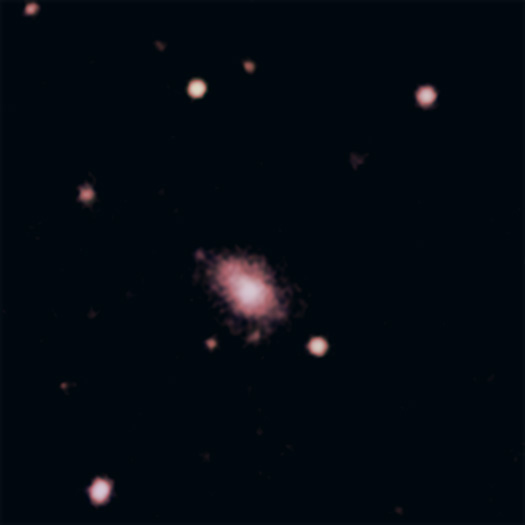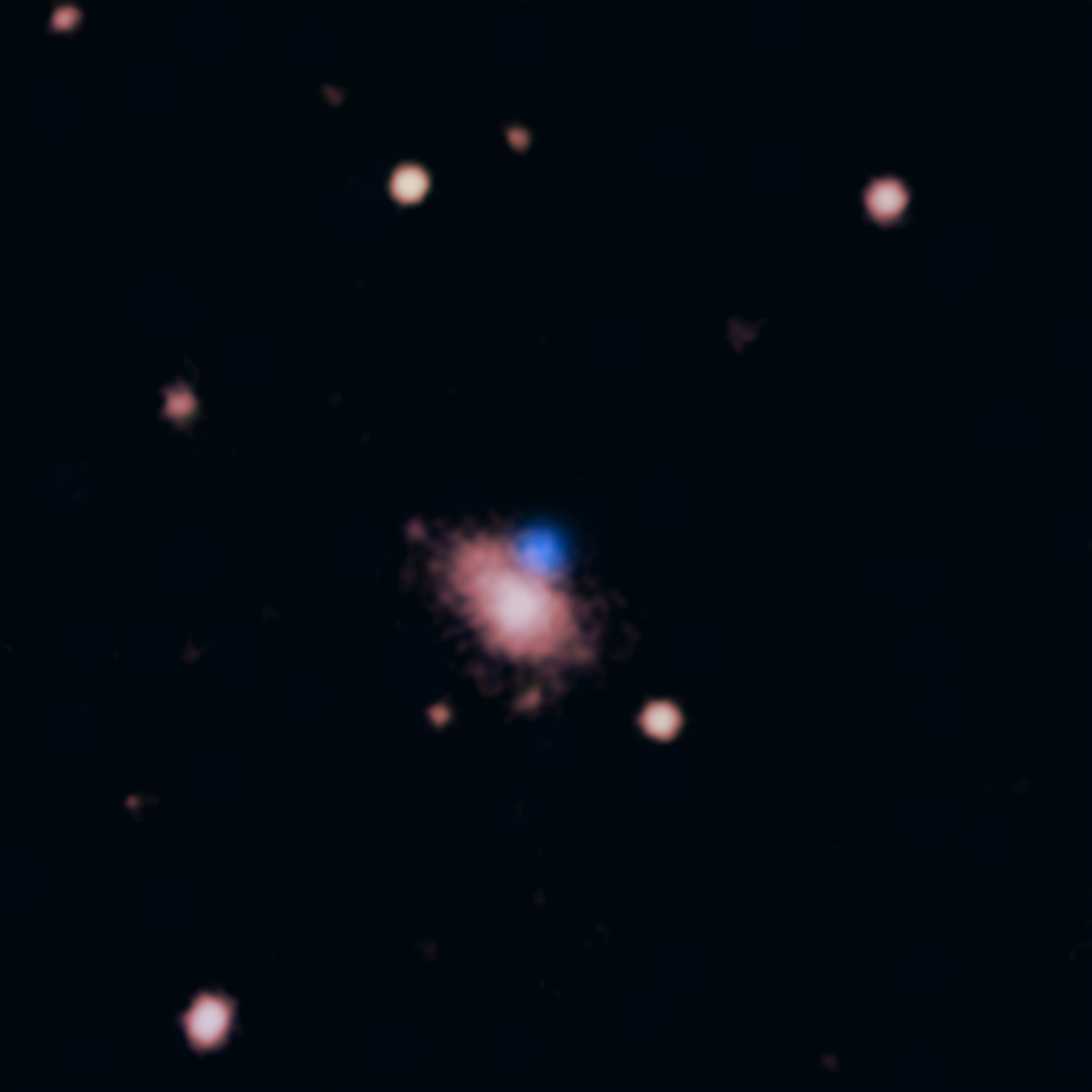

This composite image features X-ray and optical data of a so-called luminous fast blue optical transient (LFBOT) named AT 2024wpp. LFBOTs are a class of object involving bright flashes of blue and ultraviolet light that gradually fade away, leaving behind faint X-ray and radio signals. The X-ray data from NASA’s Chandra X-ray Observatory shows AT 2024wpp as a blue point source within its host galaxy, seen in optical data from the Legacy Survey (red and white). As the brightest LFBOT ever seen, AT 2024wpp is easily detected despite being about 1.1 billion light-years from Earth.
Two new papers report that AT 2024wpp likely came from an extreme event where a black hole up to 100 times the mass of the Sun tore apart a companion star that got too close. As reported in a press release from Berkeley, these papers rule out two alternative explanations for AT 2024wpp, either that the LFBOT came an unusual type of supernova or by gas in the galaxy falling into a black hole. After the companion star was torn apart, collisions between the stellar debris and gas already pulled from the companion star generated X-ray, UV and blue light.
Both papers were recently accepted by The Astrophysical Journal Letters. Nayana A.J. from the University of California Berkeley is first author of an analysis of X-ray and radio emission from AT 2024wpp, while Natalie LeBaron, also from Berkeley, is first author of an analysis of the optical, ultraviolet and near infrared emissions. Raffaella Margutti from Berkeley is the senior author of both papers.
A large collection of telescopes was used to study the various wavelengths of light emitted by the LFBOT. These included two NASA telescopes besides Chandra, the Neil Gehrels Swift Observatory and the Nuclear Spectroscopic Telescope Array (NuSTAR); radio telescopes including the Atacama Large Millimeter/submillimeter Array (ALMA) and the Australia Telescope Compact Array (ATCA); and several ground-based optical telescopes, including the Keck, Lick and Gemini Observatories.
NASA's Marshall Space Flight Center in Huntsville, Alabama, manages the Chandra program. The Smithsonian Astrophysical Observatory's Chandra X-ray Center controls science operations from Cambridge, Massachusetts, and flight operations from Burlington, Massachusetts.
|
||||||||||||||||||||||||||||||