
Helpful Cosmic Ghost Brings Stellar Birth, Not Death
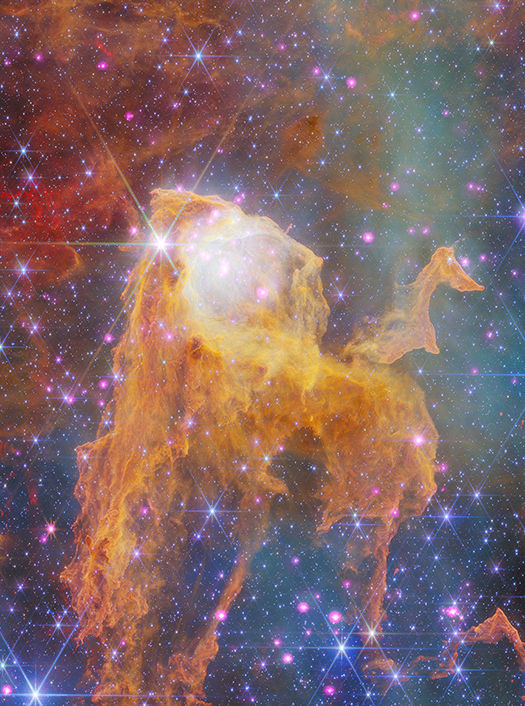
The Ghost in Carina
More images and information
Credit: X-ray: NASA/CXC/SAO; Optical: CTIO/NOIRLab/NSF/AURA/N.Smith(Univ of Minnesota); Infrared: NASA/ESA/CSA/STScI;
Image Processing: NASA/CXC/SAO/L. Frattare
An eerie structure resembling a ghostly figure has been captured by NASA’s Chandra X-ray Observatory and James Webb Space Telescope. Unlike most of the scary associations with this topic, however, this cosmic apparition hosts stellar birth where a new generation of stars is thriving.
The phantom-like structure is part of the Carina Nebula, which is located about 7,500 light years from Earth within the Milky Way galaxy. The Carina Nebula is a vast star-forming region and contains some of the most massive stars in our Galaxy, including the famous Eta Carinae system that astronomers suspect could soon explode as a supernova.
In this latest representation of this region, X-rays detected by Chandra (pink) — that reveal young stars in the nebula — have been combined with Webb’s infrared data (red, green, and blue).
The glowing ghost is an isolated cloud of gas and dust that has a glowing hooded head and a sweeping cape-like tail. Because of their resemblance to comets, astronomers sometimes objects refer to these objects as cometary globules despite having no connection to the traveling bodies. The shape may come from the cloud being eroded by powerful radiation from some of the region’s massive stars — including Eta Carinae — that are outside the field of view in this image.
NASA's Marshall Space Flight Center in Huntsville, Alabama, manages the Chandra program. The Smithsonian Astrophysical Observatory's Chandra X-ray Center controls science operations from Cambridge, Massachusetts, and flight operations from Burlington, Massachusetts.