
Celebrating NASA's Chandra and Swift Exploring Space Together
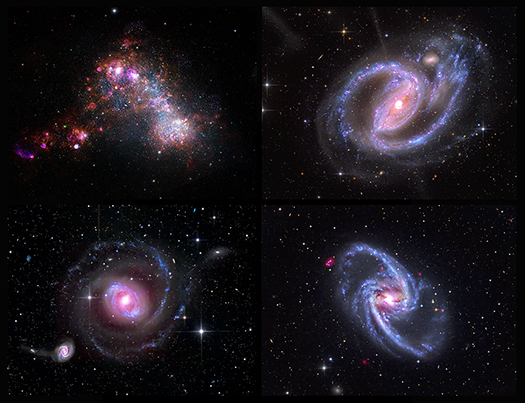
The Small Magellanic Cloud, NGC 1097, NGC 4151, and NGC 1365.
More images and information
Credit: NASA/CXC/SAO
As NASA’s Neil Gehrels Swift Observatory nears its final days in orbit, it is an excellent opportunity to celebrate this telescope and its place in NASA’s fleet of eyes on the universe.
NASA’s Chandra X-ray Observatory is one of the many telescopes that frequently teamed up with Swift to make important discoveries about the cosmos. Chandra and Swift have complementary abilities. While Swift can quickly capture rapidly-changing events in space in ultraviolet, X-ray, and gamma-ray light, Chandra is able to gather more detailed data with its sharp X-ray vision. When combined, these two telescopes helped provide a more complete picture of events and objects in space than either could alone.
This new image collection is just a sample of the many cosmic objects that Chandra and Swift have both observed in the pursuit of learning more about the mysteries of space
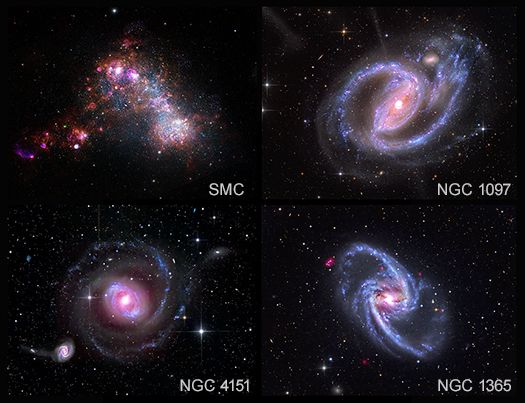
Top left: The Small Magellanic Cloud (SMC) is one of the Milky Way’s closest galactic neighbors, and orbits around our home galaxy, at a distance of about 200,000 light-years from Earth. This new view of the SMC contains a multitude of layers of light including ultraviolet data from Swift (magenta and cyan), X-rays from the Chandra X-ray Observatory and ESA’s XMM-Newton (red, green and navy), infrared data from NASA’s retired Spitzer Space Telescope and ESA’s Herschel Space Observatory (orange), and optical data the Cerro Tololo Inter-American Observatory in Chile (pink, peach and purple).
Top right: NGC 1097 is a spiral galaxy about 48 million light-years from Earth that contains a supermassive black hole about 140 million times more massive than our Sun. The region around the black hole glows brightly in X-rays as material nearing the black hole is heated to millions of degrees. In this combined view, X-rays from Chandra (yellow and orange) have been combined with ultraviolet data from Swift (blue) along with an optical light image from Hubble and a ground-based telescope (red, green, and blue).
Bottom left: NGC 4151 is also a spiral galaxy with an actively-growing supermassive black hole at its center. The X-ray emission detected by Chandra (orange) has been attributed to an outburst powered by the black hole. Ultraviolet data and X-ray light detected by Swift (magenta) has been combined with the Chandra data and added to an optical light image taken from the ground by an astrophotographer.
Bottom right: There is another growing giant hole at the center of the galaxy NGC 1365. Astronomers call these very bright cores “active galactic nuclei” (or AGN), which are fueled by a steady flow of material streaming onto the black hole. In this composite, there are X-rays from Chandra (purple) and Swift (magenta), ultraviolet data from Swift (teal), and an optical light image from a ground-based telescope.
NASA's Marshall Space Flight Center in Huntsville, Alabama, manages the Chandra program. The Smithsonian Astrophysical Observatory's Chandra X-ray Center controls science operations from Cambridge, Massachusetts, and flight operations from Burlington, Massachusetts.