
Normal Stars & Star Clusters
X-rays Reveal Temperament of Possible Planet-hosting Stars
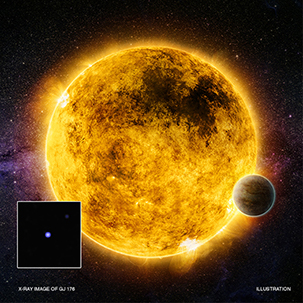
Illustration Credit: NASA/CXC/M.Weiss
A new study using data from NASA's Chandra X-ray Observatory and ESA's XMM-Newton suggests X-rays emitted by a planet's host star may provide critical clues to just how hospitable a star system could be. A team of researchers looked at 24 stars similar to the Sun, each at least one billion years old, and how their X-ray brightness changed over time.
Since stellar X-rays mirror magnetic activity, X-ray observations can tell astronomers about the high-energy environment around the star. In the new study the X-ray data from Chandra and XMM-Newton revealed that stars like the Sun and their less massive cousins calm down surprisingly quickly after a turbulent youth.
This artist's illustration depicts one of these comparatively calm, older Sun-like stars with a planet in orbit around it. The large dark area is a "coronal hole", a phenomenon associated with low levels of magnetic activity. The inset box shows the Chandra data of one of the observed objects, a two billion year old star called GJ 176, located 30 light years from Earth.
W51: Chandra Peers into a Nurturing Cloud
In the context of space, the term 'cloud' can mean something rather different from the fluffy white collections of water in the sky or a way to store data or process information. Giant molecular clouds are vast cosmic objects, composed primarily of hydrogen molecules and helium atoms, where new stars and planets are born. These clouds can contain more mass than a million suns, and stretch across hundreds of light years.
The giant molecular cloud known as W51 is one of the closest to Earth at a distance of about 17,000 light years. Because of its relative proximity, W51 provides astronomers with an excellent opportunity to study how stars are forming in our Milky Way galaxy.
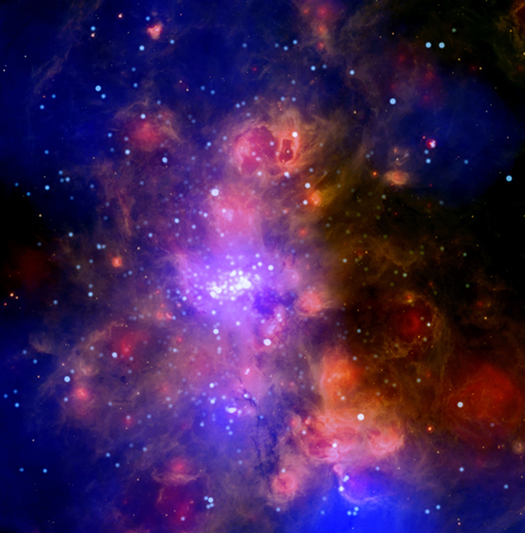
A new composite image of W51 shows the high-energy output from this stellar nursery, where X-rays from Chandra are colored blue. In about 20 hours of Chandra exposure time, over 600 young stars were detected as point-like X-ray sources, and diffuse X-ray emission from interstellar gas with a temperature of a million degrees or more was also observed. Infrared light observed with NASA's Spitzer Space Telescope appears orange and yellow-green and shows cool gas and stars surrounded by disks of cool material.
Watching a Volatile Stellar Relationship
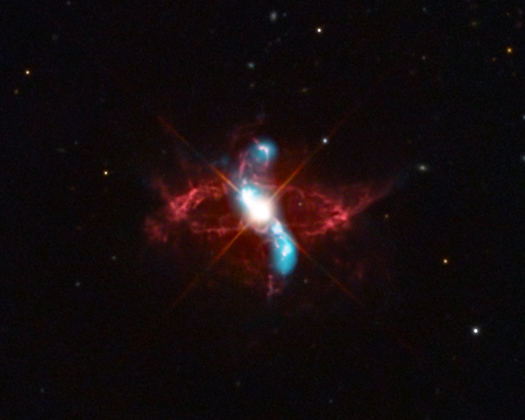
In biology, "symbiosis" refers to two organisms that live close to and interact with one another. Astronomers have long studied a class of stars – called symbiotic stars – that co-exist in a similar way. Using data from NASA’s Chandra X-ray Observatory and other telescopes, astronomers are gaining a better understanding of how volatile this close stellar relationship can be.
R Aquarii (R Aqr, for short) is one of the best known of the symbiotic stars. Located at a distance of about 710 light years from Earth, its changes in brightness were first noticed with the naked eye almost a thousand years ago. Since then, astronomers have studied this object and determined that R Aqr is not one star, but two: a small, dense white dwarf and a cool red, giant star.
NGC 6357: Cosmic 'Winter' Wonderland

Although there are no seasons in space, this cosmic vista invokes thoughts of a frosty winter landscape. It is, in fact, a region called NGC 6357 where radiation from hot, young stars is energizing the cooler gas in the cloud that surrounds them.
This composite image contains X-ray data from NASA's Chandra X-ray Observatory and the ROSAT telescope (purple), infrared data from NASA's Spitzer Space Telescope (orange), and optical data from the SuperCosmos Sky Survey (blue) made by the United Kingdom Infrared Telescope.
Cygnus X-3 and Its Little Friend

Michael McCollough
We are pleased to welcome Dr. Michael McCollough as our guest blogger. Dr. McCollough is the first author of a paper that is the subject of our latest press release. He has spent the last 30 years working with and analyzing data from astronomical radio, optical, X-ray, and gamma-ray telescopes. Currently, he serves as an Archival Astrophysicist at the Chandra X-ray Center in Cambridge, Mass.
Throughout my career I have been a multi-wavelength astronomer. To fully understand astronomical objects, one must look across the electromagnetic spectrum (from radio waves to gamma-rays). Also throughout my career I have been doing spacecraft operations. Starting with NASA’s Hubble Space Telescope (before, during, and after launch), ROSAT, NASA’s Compton Gamma-Ray Observations with the Burst and Transient Source Experiment (BATSE), and currently with NASA’s Chandra X-Ray Observatory. It was when I was working with BATSE that I was introduced to Cygnus X-3. Discovering that high-energy X-rays (as seen by BATSE) were correlated with emissions in the radio.
The Secrets of the Sun Revealed in the Stars
We are pleased to welcome Nick Wright as our guest blogger. Nick is the lead author on a paper featured in our latest press release, about how magnetic fields are generated in stars. He is an astrophysicist working at Keele University in the UK. He completed his PhD at University College London before moving to the Smithsonian Astrophysical Observatory to study X-ray emission from both young and old stars. After almost 5 years working in the US he returned to England as a Royal Astronomical Society research fellow at the University of Hertfordshire and is now an Ernest Rutherford Fellow at Keele University. When not studying the stars or writing about them on his blog, Nick enjoys cooking, gardening and travelling.

Nick Wright Credit: Nick Wright
Magnetic fields in the Sun and Sun-like stars are generated by a dynamo, a process involving the rotation of the star as well as convection, the rising and falling of hot gas in the star's interior. Understanding the magnetic dynamo of our Sun is important because it is responsible for a lot of interesting and energetic solar phenomena, some of which can have a considerable impact on our Earth and the wider Solar System. The Sun's magnetic field is responsible for sunspots on its surface, the 22-year magnetic activity cycle (the "Solar cycle"), the Solar wind that pummels planets throughout our Solar System and the ejections of large quantities of plasma – a gas composed of free electrons and free atomic nuclei – known as coronal mass ejections. This ejected material can have a serious impact on Earth, resulting in geomagnetic storms that disrupt radio transmissions, damage satellites and electrical grids, as well as harm astronauts or even people flying in airplanes at high altitudes.
Smaller Stars Pack Big X-ray Punch For Would-be Planets
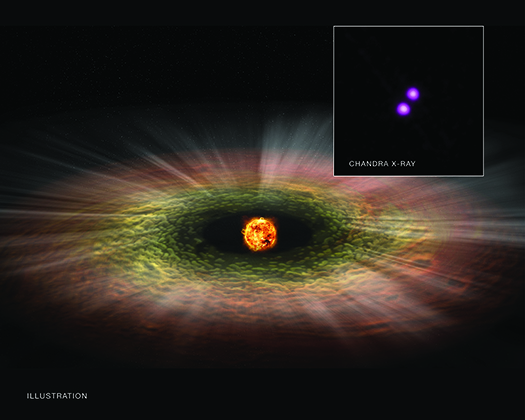
Young stars much less massive than the Sun can unleash a torrent of X-ray radiation that can significantly shorten the lifetime of planet-forming disks surrounding these stars. This result comes from a new study of a group of nearby stars using data from NASA's Chandra X-ray Observatory and other telescopes.
Researchers found evidence that intense X-ray radiation produced by some of the young stars in the TW Hya association (TWA), which on average is about 160 light years from Earth, has destroyed disks of dust and gas surrounding them. These disks are where planets form. The stars are only about 8 million years old, compared to the 4.5-billion-year age of the Sun. Astronomers want to learn more about systems this young because they are at a crucial age for the birth and early development of planets.
More Than Meets the Eye: Delta Orionis in Orion's Belt
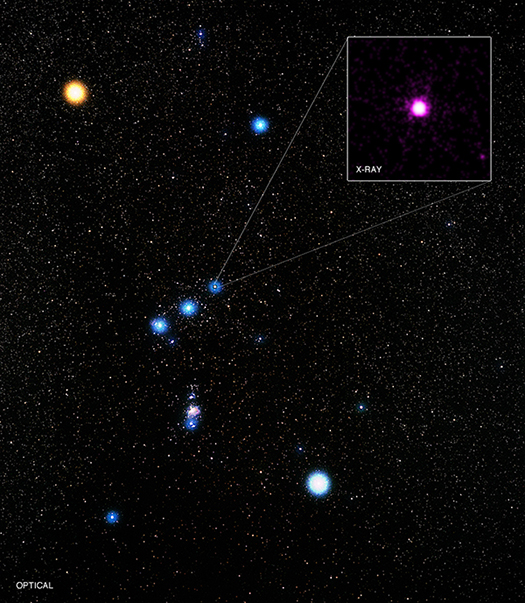
One of the most recognizable constellations in the sky is Orion, the Hunter. Among Orion's best-known features is the "belt," consisting of three bright stars in a line, each of which can be seen without a telescope.
The westernmost star in Orion's belt is known officially as Delta Orionis. (Since it has been observed for centuries by sky-watchers around the world, it also goes by many other names in various cultures, like "Mintaka".) Modern astronomers know that Delta Orionis is not simply one single star, but rather it is a complex multiple star system.
Stellar Sparklers That Last
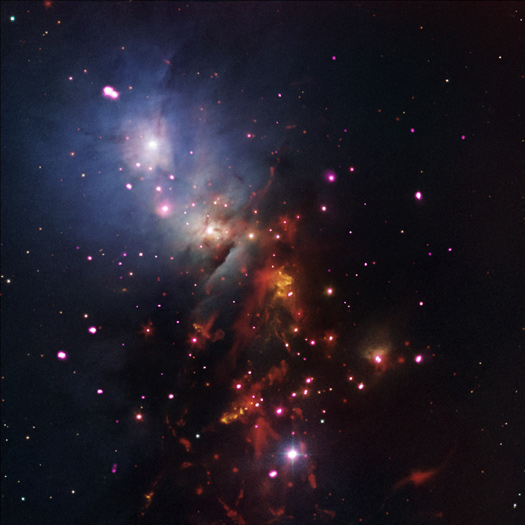
While fireworks only last a short time here on Earth, a bundle of cosmic sparklers in a nearby cluster of stars will be going off for a very long time. NGC 1333 is a star cluster populated with many young stars that are less than 2 million years old, a blink of an eye in astronomical terms for stars like the Sun expected to burn for billions of years.
White Dwarf May Have Shredded Passing Planet
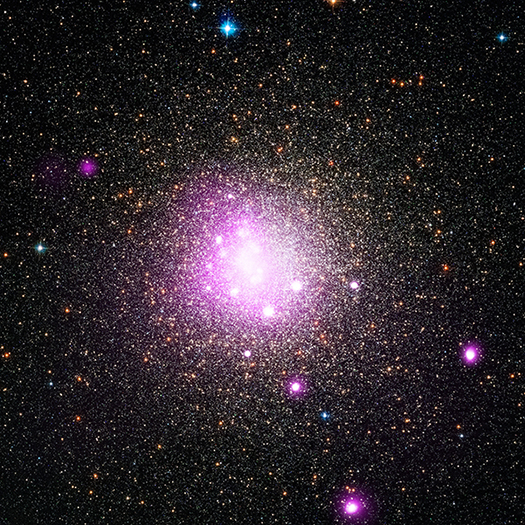
The destruction of a planet may sound like the stuff of science fiction, but a team of astronomers has found evidence that this may have happened in an ancient cluster of stars at the edge of the Milky Way galaxy.
Using several telescopes, including NASA's Chandra X-ray Observatory, researchers have found evidence that a white dwarf star - the dense core of a star like the Sun that has run out of nuclear fuel - may have ripped apart a planet as it came too close.