
Normal Stars & Star Clusters
Assessing The Habitability of Planets Around Old Red Dwarfs
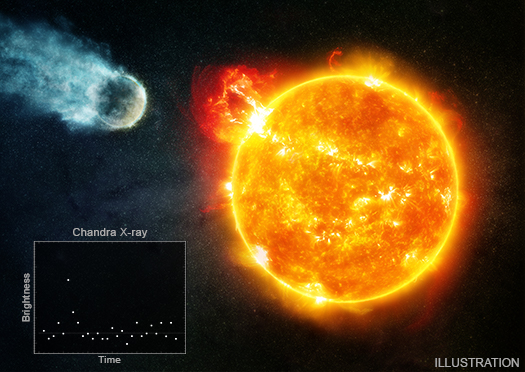
Barnard's Star (GJ 699)
Credit: X-ray light curve: NASA/CXC/University of Colorado/K. France et al.;
Illustration: NASA/CXC/M. Weiss
A new study using data from NASA's Chandra X-ray Observatory and Hubble Space Telescope gives new insight into an important question: how habitable are planets that orbit the most common type of stars in the Galaxy? The target of the new study, as reported in our press release, is Barnard's Star, which is one of the closest stars to Earth at a distance of just 6 light years. Barnard's Star is a red dwarf, a small star that slowly burns through its fuel supply and can last much longer than medium-sized stars like our Sun. It is about 10 billion years old, making it twice the age of the Sun.
The authors used Barnard's Star as a case study to learn how flares from an old red dwarf might affect any planets orbiting it. This artist's illustration depicts an old red dwarf like Barnard's Star (right) and an orbiting, rocky planet (left).
Gazing at the Youngest Star From Chile
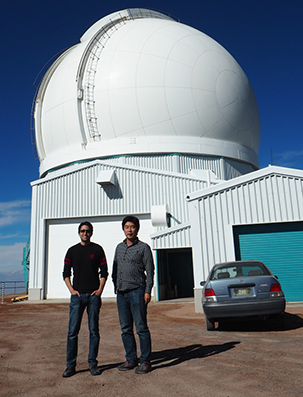
David Principe and Kenji Hamaguchi
As our guest blogger, we welcome Kenji Hamaguchi of the Center for Research and Exploration in Space Science & Technology and NASA’s Goddard Space Flight Center in Greenbelt, MD. He is part of the team that made the discovery described in our latest press release on an X-ray flare from a very young Sun-like star.
The observatory dome appeared over the hill. "Where is it standing?" I mumbled to myself. The Southern Astrophysical Research (SOAR) Telescope stands at the dead-end of a mountain ridge. The road just before the observatory has a bottleneck with steep slopes on both sides. The dome looked as if it were standing on the head of a spear. The telescope is a part of the Cerro Tololo Inter-American Observatory in Chile, along with the Gemini South observatory, and the Vera Rubin Observatory (formerly the LSST), which is now under construction. David Principe and I had come to the SOAR observatory in mid-December 2017, to take images of the extremely young star ("protostar") HOPS 383 at near-infrared wavelengths.
The observation we were undertaking was conducted in coordination with an observation of the same protostar with NASA’s Chandra X-ray Observatory. The Chandra observation aimed to find any sign of high-energy (X-ray) radiation from this newborn star. In contrast, the SOAR observation was designed to monitor the current status of an outburst from HOPS 383 that peaked in 2008. We planned to deepen the understanding of its nature by combining these two observing techniques.
A Cosmic Jekyll and Hyde
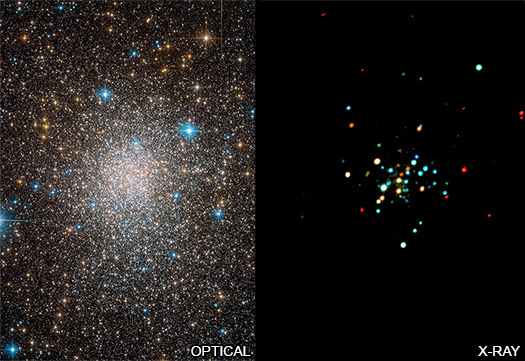
Terzan 5
Credit: X-ray: NASA/CXC/Univ. of Amsterdam/N.Degenaar, et al.; Optical: NASA, ESO/F.Ferraro
A double star system has been flipping between two alter egos, according to observations with NASA's Chandra X-ray Observatory and the National Science Foundation's Karl F. Jansky Very Large Array (VLA). Using nearly a decade and a half worth of Chandra data, researchers noticed that a stellar duo behaved like one type of object before switching its identity, and then returning to its original state after a few years. This is a rare example of a star system changing its behavior in this way.
Astronomers found this volatile double, or binary, system in a dense collection of stars, the globular cluster Terzan 5, which is located about 19,000 light years from Earth in the Milky Way galaxy. This stellar duo, known as Terzan 5 CX1, has a neutron star (the extremely dense remnant left behind by a supernova explosion) in close orbit around a star similar to the Sun, but with less mass.
Hunting for Stellar CMEs: The Chandra Success

Costanza Argiroffi
We are pleased to welcome Costanza Argiroffi as a guest author. Costanza led the study reporting the first secure detection of a coronal mass ejection from a star other than the Sun. She is an astrophysicist from the University of Palermo, Italy, where she is from. Her main research field is the study of low-mass stars. She obtained her PhD from the University of Palermo in 2006, and during her studies spent a few months at the Smithsonian Astrophysical Observatory in Cambridge, MA. Then she worked as a postdoc and, since 2008, as a researcher at the University of Palermo.
Coronal Mass Ejections (CMEs) are large-scale expulsions of material previously confined in the atmosphere of a star. CMEs are among the most powerful magnetic phenomena occurring in the atmosphere of the Sun, reaching velocities of about 2 million miles per hour, masses of about 200,000 billion pounds, and kinetic energies equivalent to about 125 million Krakatoa eruptions.
Using data from NASA’s Chandra X-ray Observatory, we have made the first unambiguous detection of a CME by a star other than the Sun.
NGC 3079: Galactic Bubbles Play Cosmic Pinball with Energetic Particles
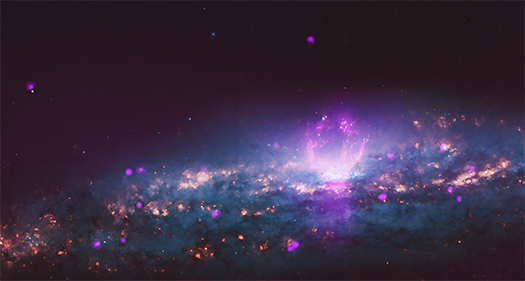
We all know bubbles from soapy baths or sodas. These bubbles of everyday experience on Earth are only a few inches across, and consist of a thin film of liquid enclosing a small volume of air or other gas. In space, however, there are very different bubbles — composed of a lighter gas inside a heavier one — and they can be huge.
The galaxy NGC 3079, located about 67 million light years from Earth, contains two "superbubbles" unlike anything here on our planet. A pair of balloon-like regions stretch out on opposite sides of the center of the galaxy: one is 4,900 light years across and the other is only slightly smaller, with a diameter of about 3,600 light years. For context, one light year is about 6 trillion miles, or 9 trillion kilometers.
Chandra Serves up Cosmic Holiday Assortment
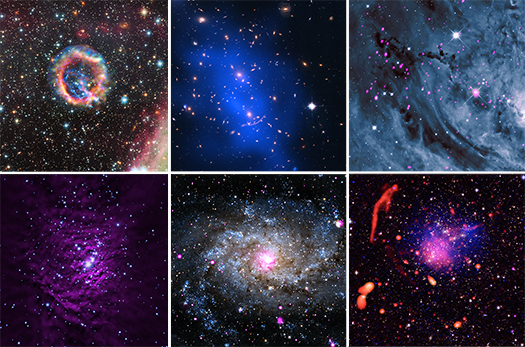
This is the season of celebrating, and the Chandra X-ray Center has prepared a platter of cosmic treats from NASA's Chandra X-ray Observatory to enjoy. This selection represents different types of objects — ranging from relatively nearby exploded stars to extremely distant and massive clusters of galaxies — that emit X-rays detected by Chandra. Each image in this collection blends Chandra data with other telescopes, creating a colorful medley of light from our Universe.
Chandra May Have First Evidence of a Young Star Devouring a Planet
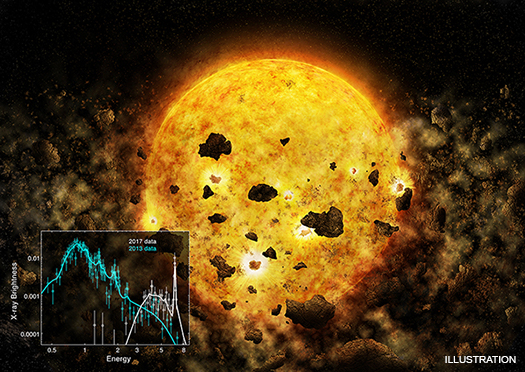
Credit: Illustration: NASA/CXC/M.Weiss; X-ray spectrum: NASA/CXC/MIT/H.M.Günther
"X"-ploring the Eagle Nebula and "Pillars of Creation"
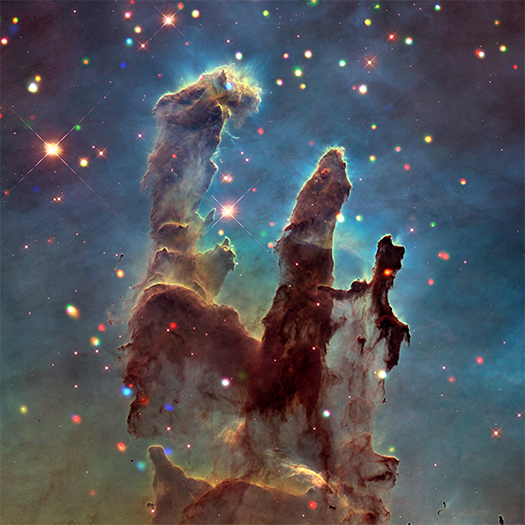
The Eagle Nebula, also known as Messier 16, contains the young star cluster NGC 6611. It also the site of the spectacular star-forming region known as the Pillars of Creation, which is located in the southern portion of the Eagle Nebula.
Stellar Family Portrait in X-rays
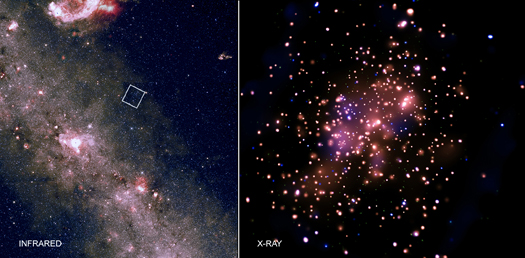
In some ways, star clusters are like giant families with thousands of stellar siblings. These stars come from the same origins – a common cloud of gas and dust – and are bound to one another by gravity. Astronomers think that our Sun was born in a star cluster about 4.6 billion years ago that quickly dispersed.
By studying young star clusters, astronomers hope to learn more about how stars – including our Sun – are born. NGC 6231, located about 5,200 light years from Earth, is an ideal testbed for studying a stellar cluster at a critical stage of its evolution: not long after star formation has stopped.
The discovery of NGC 6231 is attributed to Giovanni Battista Hodierna, an Italian mathematician and priest who published observations of the cluster in 1654. Sky watchers today can find the star cluster to the southwest of the tail of the constellation Scorpius.
Two Stars, Three Dimensions, and Oodles of Energy
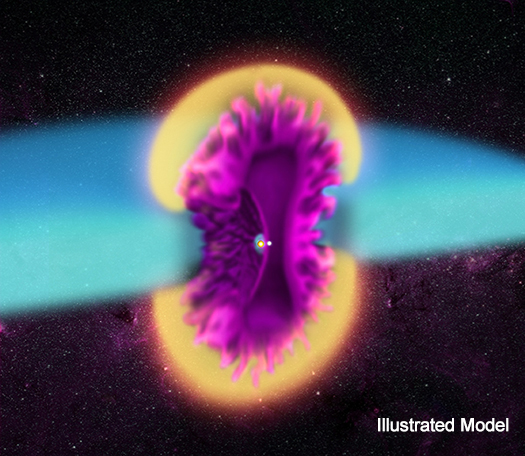
For decades, astronomers have known about irregular outbursts from the double star system V745 Sco, which is located about 25,000 light years from Earth. Astronomers were caught by surprise when previous outbursts from this system were seen in 1937 and 1989. When the system erupted on February 6, 2014, however, scientists were ready to observe the event with a suite of telescopes including NASA’s Chandra X-ray Observatory.
V745 Sco is a binary star system that consists of a red giant star and a white dwarf locked together by gravity. These two stellar objects orbit so closely around one another that the outer layers of the red giant are pulled away by the intense gravitational force of the white dwarf. This material gradually falls onto the surface of the white dwarf. Over time, enough material may accumulate on the white dwarf to trigger a colossal thermonuclear explosion, causing a dramatic brightening of the binary called a nova. Astronomers saw V745 Sco fade by a factor of a thousand in optical light over the course of about 9 days.