


CXC Home | Search | Help | Image Use Policy | Latest Images | Privacy | Accessibility | Glossary | Q&A
A starburst galaxy is a galaxy experiencing a period of intense star forming activity. Although this activity may last for ten million years or more, that is like a month in the life of a ten billion year old galaxy. During a starburst, stars can form at tens, even hundreds of times greater rates than the star formation rate in normal galaxies. Many of these newly formed stars are very massive and very bright, so starburst galaxies are among the most luminous galaxies.
The burst occurs over a region a few thousand light years in diameter. The most popular theory for the cause of a starburst is that it is triggered by a close encounter or collision with another galaxy. This collision sends shock waves rushing through the galaxy. These shock waves push on giant clouds of gas and dust, causing them to collapse and form a few hundred stars. The massive stars use up their fuel quickly and explode as supernovas, which produce more shock waves and more star formation. In this way, a chain reaction of star formation and supernovas can sweep through the central region of a galaxy, where most of the gas is located. When most of the gas is used up or blown away by the explosions, the starburst ends.
The infrared satellite IRAS discovered thousands of starburst galaxies. Many of the new stars remain surrounded by dust and gas for a million years. Their light is absorbed by the dust, which radiates away the heat as infrared radiation. The "heat radiation" produced by hot sidewalks on a summer day is infrared radiation. Starburst galaxies are rare among nearby galaxies, but they were common many billions of years ago. The universe is expanding, so galaxies were much closer together in the past and collisions or close encounters were more frequent, causing more starbursts.
Chandra observations are playing an important role in understanding starburst galaxies. The rapid rate of supernova explosions in these galaxies produces expanding bubbles of multimillion degree gas. Several striking examples of these superbubbles can be seen in the Chandra image of two colliding galaxies known as the Antennae.
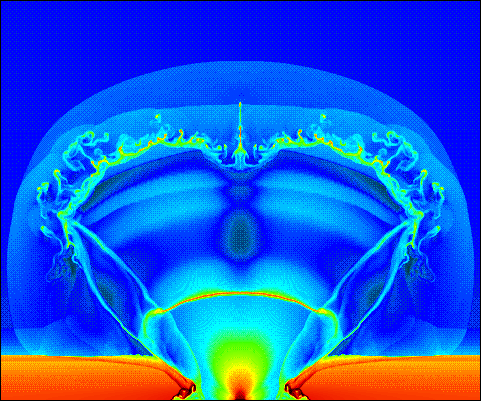
Starburst-driven galactic winds
(D.Strickland)
When the starburst is sufficiently intense, it can create a superbubble so hot and energetic that it expands out of the galaxy in what is called a superwind. Dramatic examples of superwinds can be seen in Chandra's images of M82, Arp 220 and NGC 253.
Superwinds are thought to contain the carbon, nitrogen, oxygen, iron and other heavy elements dispersed by supernovas and spread these elements throughout the space between galaxies. With Chandra, astronomers hope to measure the amounts of these elements in the superwinds.


Revised: October 09, 2026