



CXC Home | Search | Help | Image Use Policy | Latest Images | Privacy | Accessibility | Glossary | Q&A
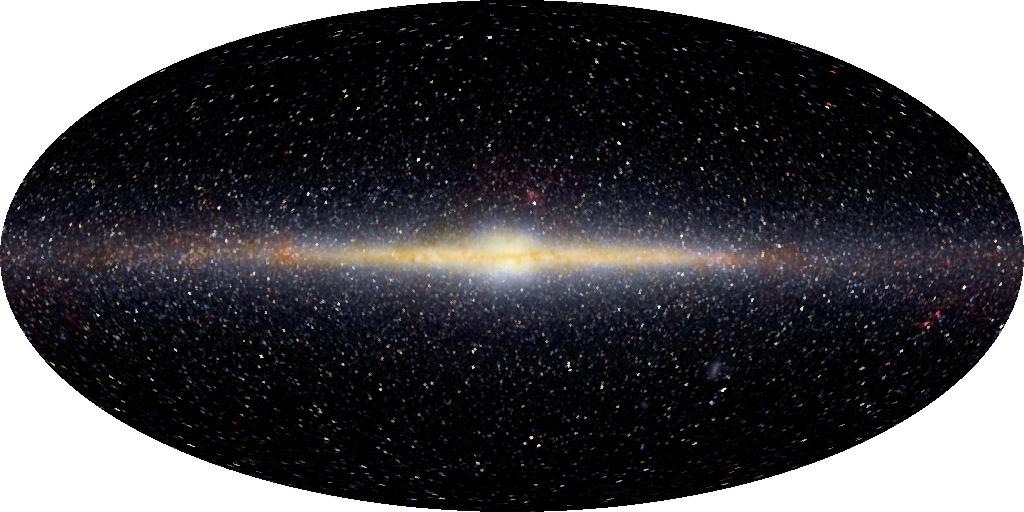
Galaxies are gravitationally-bound systems of stars, gas, dust and dark matter. A typical large spiral galaxy such as our home galaxy, the Milky Way, consists of hundreds of billions of stars, enough gas and dust to make billions more stars, and at least ten times as much dark matter as all the stars and gas put together.
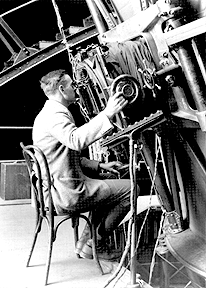
In the 1920s, Edwin Hubble used the 100-inch optical telescope on Mount Wilson, in California, to find other galactic systems. NASA's Hubble Space Telescope, named in Hubble's honor, has observed billions of galaxies of different sizes and shapes. There are irregular small dwarf galaxies, majestic spiral galaxies, and elliptical galaxies ranging in size from dwarfs to supergiants ten times larger than the Milky Way galaxy.
The X-ray images of elliptical galaxies reveal that they are filled with multimillion degree gas, heated presumably by supernova explosions. Most of the gas in spiral galaxies is in the form of cool, dusty clouds. In both elliptical and spiral galaxies, X-ray images give us portraits of the end phases of stellar evolution - regions where supernovas have heated gas to millions of degrees, and objects where gravity has tightened its grip to form neutron stars and black holes.
The most extreme examples of gravity's force are found deep in the centers of most galaxies where supermassive black holes lurk. These gravitational monsters can contain masses ranging from a few million to a few billion Suns. In normal galaxies, the supermassive black hole mainly makes its presence known through its gravitational force on the motions of stars, and by X-rays produced when gas is heated as it falls toward the black hole. But when supermassive black holes are surrounded by large supplies of dust and gas, the acceleration and heating of this gas as it is pulled into the black hole can produce stupendous amounts of energy at X-ray and other wavelengths and transform the appearance of the entire galaxy. Such galaxies are called active galaxies or quasars.


Revised: October 11, 2012