
Chandra and the Latest Giant Solar Flare
On Friday March 2, 2012, we noticed Sunspot Group 1429 moving onto the Earth facing part of the Sun. The NOAA space weather service informed us that the magnetic topology was complex and this was a cell to watch out for. Sure enough, on Sunday night (March 4, Eastern time) the Sun emitted a short X1 flare. We all felt a bit better, because this often will relax the magnetic field. And since it was well off on the Eastern limb of the Sun, any coronal mass ejection (CME) should have missed us.

Dark Matter and Galaxies Part Ways in Collision between Hefty Galaxy Clusters
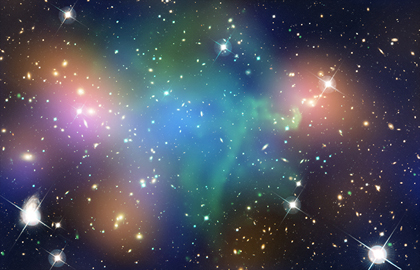
This composite image shows the distribution of dark matter, galaxies, and hot gas in the core of the merging galaxy cluster Abell 520, formed from a violent collision of massive galaxy clusters that is located about 2.4 billion light years from Earth.
The Unexpected: The Solar System
Looking back on the more than twelve years of science from NASA’s Chandra X-ray Observatory and trying to predict what it will find in the future, one thing is certain: we can expect the unexpected.
This blog series will look at both some of the anticipated findings from the past dozen or so years, plus some of the unexpected results so far from the Chandra mission. Today, we look at discoveries involving our Solar System.
Expected and Detected:
X-ray emission was detected from the atmospheres of planets and comets. The X-rays are produced when solar X-rays and high-speed particles flowing away from the Sun hit these atmospheres. The observed X-radiation provides information on the outer atmospheres of these objects that is difficult to obtain with other telescopes.
AAAS Meeting in Vancouver

While we usually talk about meetings where astronomers get together, there are also other meetings where all types of scientists meet and exchange ideas. The AAAS meeting is one of them. "AAAS" stands for the American Association for the Advancement of Science, and it is the world's largest general scientific society.
NASA'S Chandra Finds Fastest Wind From Stellar-Mass Black Hole
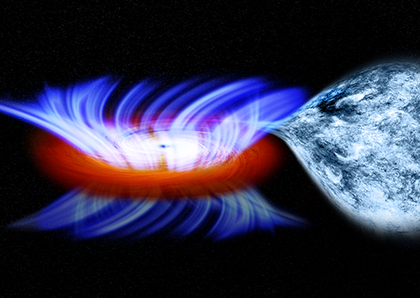
This artist's impression shows a binary system containing a stellar-mass black hole called IGR J17091-3624, or IGR J17091 for short. The strong gravity of the black hole, on the left, is pulling gas away from a companion star on the right. This gas forms a disk of hot gas around the black hole, and the wind is driven off this disk.
Q and A of the Day: Where did the name "Chandra" come from?
Q: Where did the name "Chandra" originate?
A: NASA's premier X-ray observatory was named the Chandra X-ray Observatory in honor of the late Indian-American Nobel laureate, Subrahmanyan Chandrasekhar (pronounced: su/bra/mon'/yon chandra/say/kar). Known to the world as Chandra (which means "moon" or "luminous" in Sanskrit), he was widely regarded as one of the foremost astrophysicists of the twentieth century.

NASA's Chandra Finds Milky Way's Black Hole May be Grazing on Asteroids
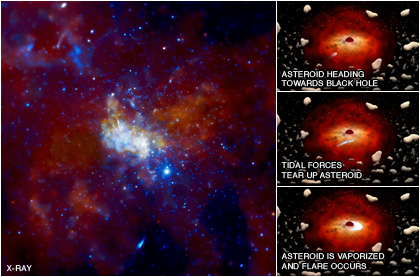
This image from NASA's Chandra X-ray Observatory shows the center of our Galaxy, with a supermassive black hole known as Sagittarius A* (Sgr A* for short) in the center. Using intermittent observations over several years, Chandra has detected X-ray flares about once a day from Sgr A*. The flares have also been seen in infrared data from ESO's Very Large Telescope in Chile.
Remembering Columbia
Nine years ago today, we experienced a terrible tragedy. On February 1, 2003, the seven-member crew of STS-107 was lost when the Space Shuttle Columbia disintegrated over Texas and Louisiana on its re-entry into Earth's atmosphere.
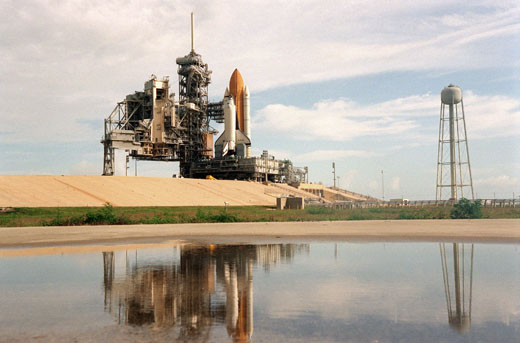
Remnant of an Explosion With a Powerful Kick?
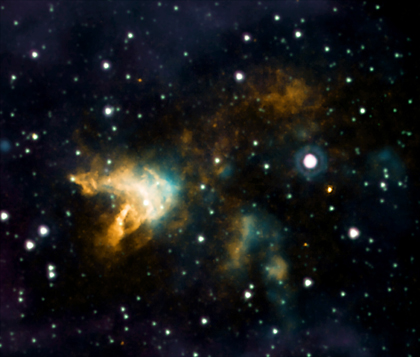
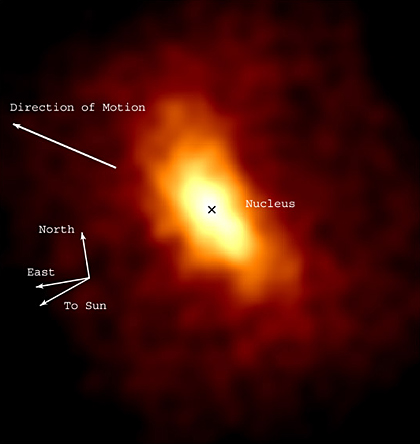
Vital clues about the devastating ends to the lives of massive stars can be found by studying the aftermath of their explosions. In its more than twelve years of science operations, NASA's Chandra X-ray Observatory has studied many of these supernova remnants sprinkled across the Galaxy.
Maneuvering Chandra in the Solar Storm
By now you may have seen the headlines:
"Strongest Solar Storm Since 2005 Striking Earth."
"Raging Solar Storm Triggers Northern Lights"
"Solar Storm Is Taste of Things to Come."
Hopefully, for some of you it was a nice view of the northern lights. For us, it was a busy start to the week. This started last Thursday (Jan. 19, 2012) with an M2 solar flare. Flares below M5 usually don't worry us too much, but this one was unusually long - about 6 hours - which indicated a lot of material was involved and coronal mass ejection (CME) was heading our way with a scheduled arrival of Saturday or Sunday. Sure enough on Saturday (Jan. 21), the ACE satellite, the GOES satellites and our on-board monitors started to notice a minor jump in the background particles. The rate got even higher by Sunday. By Sunday night, we had received about half our orbital budget.
When this happened our alerts system went off and we had a phone meeting. This was around half time of the NFC Champion ship game, not that I knew, since I was with my daughters at a Girl Scout camp reunion. So while they were cooking s'mores in the snow, I was on my cell phone. We know that periodically long slow radiation storms will happen and we "budget" for 10 a year. This is the first storm like this in several years. So when we "met", we reviewed how much time was left in the orbit (5 hours) and what additional fraction of out budget we would receive in the next 5 hours assuming either constant or worst-case. Since it was only 5 hours until the end of the orbit, we figured the 50% of the budget might get to 55% so we decided to ride it out, go behind the Earth and start fresh on the next orbit. Little did we know, we'd never get there.

Northern lights dance over the Lyngan Alps in a picture taken Tuesday night near Tromsø, Norway.
Photograph by Ole C. Salomonsen, arcticlightphoto.no.