
Unraveling a Cosmic Illusion: Can Some Radio Relics Pretend to Be a Radio Halo?

Mustafa pfern (Credit: Mustafa pfern)
We welcome Paola Domínguez-Fernández as a guest blogger. Paola is the first author of a recent paper exploring the origin of radio emission in the unusual merging galaxy cluster MACS J0018.5+1626. She was formerly a researcher at Harvard University working at the Center for Astrophysics | Harvard & Smithsonian, and has since started as an Assistant Professor at UNAM, where her work focuses on cosmic magnetism, particle acceleration, and the physics of galaxy clusters. Before Harvard, she worked at the University of Bologna in Italy and at UNIST in South Korea. She received her PhD from the University of Hamburg in Germany and her master’s degree from the University of Bonn. She earned her bachelor’s degree at UNAM in Mexico.
What? Galaxy clusters are the largest gravitationally bound structures in our Universe, containing hundreds to thousands of galaxies, enormous reservoirs of hot gas visible in X-rays, and large amounts of dark matter. But clusters are not quiet places. As they form, they experience several collisions with other galaxy clusters. Galaxy cluster collisions, or merger events, are among the most energetic events since the Big Bang and generate the largest shock waves in the Universe, traveling through the outer regions of the cluster atmosphere. When these shock waves emit radio waves, we nickname them as “radio relics,” typically observed as elongated regions in the peripheries of clusters. These energetic events also produce turbulence, which can re-accelerate particles to emit radio waves as well. In these cases, however, the emission sits at the center of the clusters and we nickname them "radio halos." Either way, these vast regions of diffuse radio emission reveal the presence of magnetic fields and particles spiraling around them at nearly the speed of light: cosmic ray electrons.
Helpful Cosmic Ghost Brings Stellar Birth, Not Death
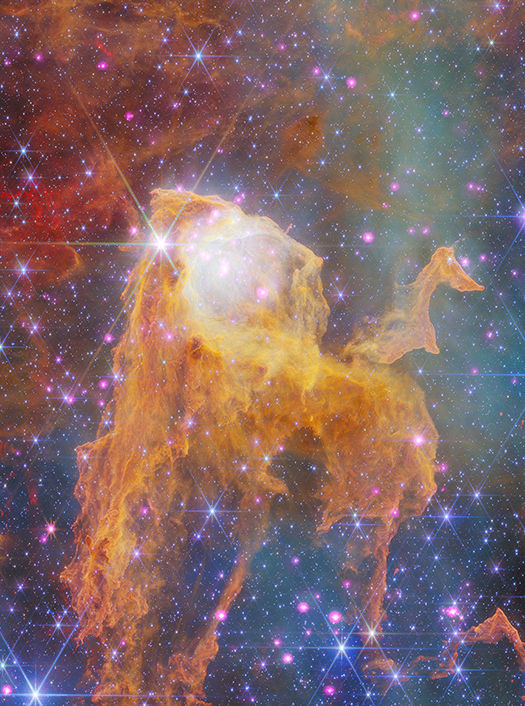
The Ghost in Carina
More images and information
Credit: X-ray: NASA/CXC/SAO; Optical: CTIO/NOIRLab/NSF/AURA/N.Smith(Univ of Minnesota); Infrared: NASA/ESA/CSA/STScI;
Image Processing: NASA/CXC/SAO/L. Frattare
An eerie structure resembling a ghostly figure has been captured by NASA’s Chandra X-ray Observatory and James Webb Space Telescope. Unlike most of the scary associations with this topic, however, this cosmic apparition hosts stellar birth where a new generation of stars is thriving.
The phantom-like structure is part of the Carina Nebula, which is located about 7,500 light years from Earth within the Milky Way galaxy. The Carina Nebula is a vast star-forming region and contains some of the most massive stars in our Galaxy, including the famous Eta Carinae system that astronomers suspect could soon explode as a supernova.
In this latest representation of this region, X-rays detected by Chandra (pink) — that reveal young stars in the nebula — have been combined with Webb’s infrared data (red, green, and blue).
NASA's Chandra Breaks Down 'Treble Clef's' Galaxy Cluster Collision
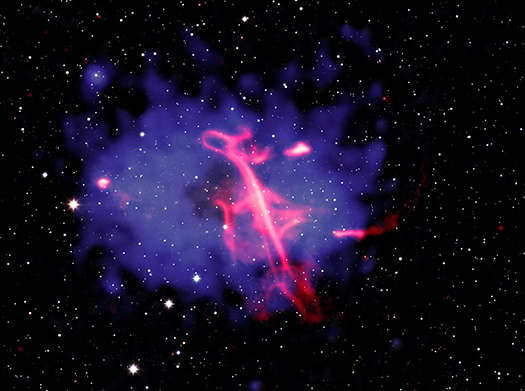
The Treble Clef Cluster / VLSS J0318.9+5755
More images, videos, and information
Credit: X-ray: NASA/CXC/INAF-IRA/A. Botteon et al.; Infrared: UKIDSS-GPS ; Radio: ASTRON/LOFAR; Image Processing: NASA/CXC/SAO/N. Wolk
Astronomers have used NASA’s Chandra X-ray Observatory to break down the cause of a remarkable formation of radio waves they have nicknamed the “Treble Clef” because its distinct shape strongly resembles the musical symbol.
The researchers discovered the Treble Clef is likely caused by an outburst from a supermassive black hole, followed by a collision of two galaxy clusters. A paper describing the findings, led by Andrea Botteon of the National Institute for Astrophysics, or INAF, in Italy, published Wednesday in the Astronomy & Astrophysics journal.
An explanation for the Treble Clef has been particularly difficult to find because the formation lies almost directly behind the plane of the Milky Way, meaning that stars, gas, and dust from our home galaxy largely block the view from Earth. However, by using telescopes that can peer through the intervening material, a team of researchers was able to identify what is responsible for this uncommon structure.
Celebrating NASA's Chandra and Swift Exploring Space Together
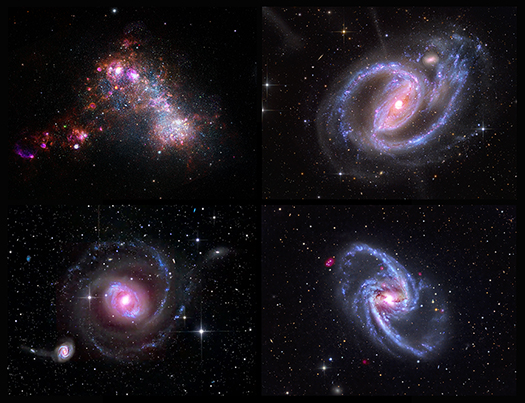
The Small Magellanic Cloud, NGC 1097, NGC 4151, and NGC 1365.
More images and information
Credit: NASA/CXC/SAO
As NASA’s Neil Gehrels Swift Observatory nears its final days in orbit, it is an excellent opportunity to celebrate this telescope and its place in NASA’s fleet of eyes on the universe.
NASA’s Chandra X-ray Observatory is one of the many telescopes that frequently teamed up with Swift to make important discoveries about the cosmos. Chandra and Swift have complementary abilities. While Swift can quickly capture rapidly-changing events in space in ultraviolet, X-ray, and gamma-ray light, Chandra is able to gather more detailed data with its sharp X-ray vision. When combined, these two telescopes helped provide a more complete picture of events and objects in space than either could alone.
This new image collection is just a sample of the many cosmic objects that Chandra and Swift have both observed in the pursuit of learning more about the mysteries of space
A Cleaner Look at Our Galactic Center's Hot Mess
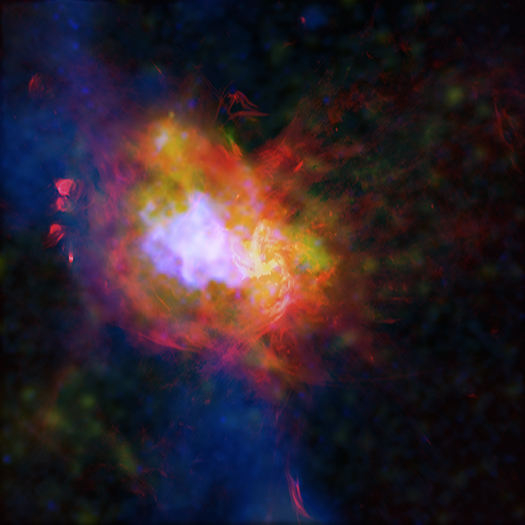
Sagittarius A East in our Galactic Center
More images and information
Credit: X-ray: NASA/CXC/McGill Univ./M. Balakrishnan et al.; Radio: NSF/NRAO/VLA; Sub-mm: EAO/James Clerk Maxwell Telecope;
Image Processing: NASA/CXC/SAO/P. Edmonds, N. Wolk
The center of the Milky Way galaxy is a chaotic place. In addition to the 4-million-solar mass black hole, known as Sagittarius A* (Sgr A*), the region is full of gas, dust, strong magnetic fields, and stars in various stages of life — from birth to death.
Now, astronomers have released the clearest view yet of the remains of an exploded star that sits amid this cluttered galactic environment. The supernova remnant is named Sagittarius A East, or Sgr A East, and it is the closest remnant to Sgr A* that astronomers know about.
Sgr A East emits light in many wavelengths, including X-rays that NASA’s Chandra X-ray Observatory can see. Supernova remnants like Sgr A East give off X-rays because powerful shock waves rumble outward into space after the explosion and the stellar debris is superheated to millions of degrees.
Unearthing the Hidden Universe: How Scientists Use AI to Mine Chandra’s Archive
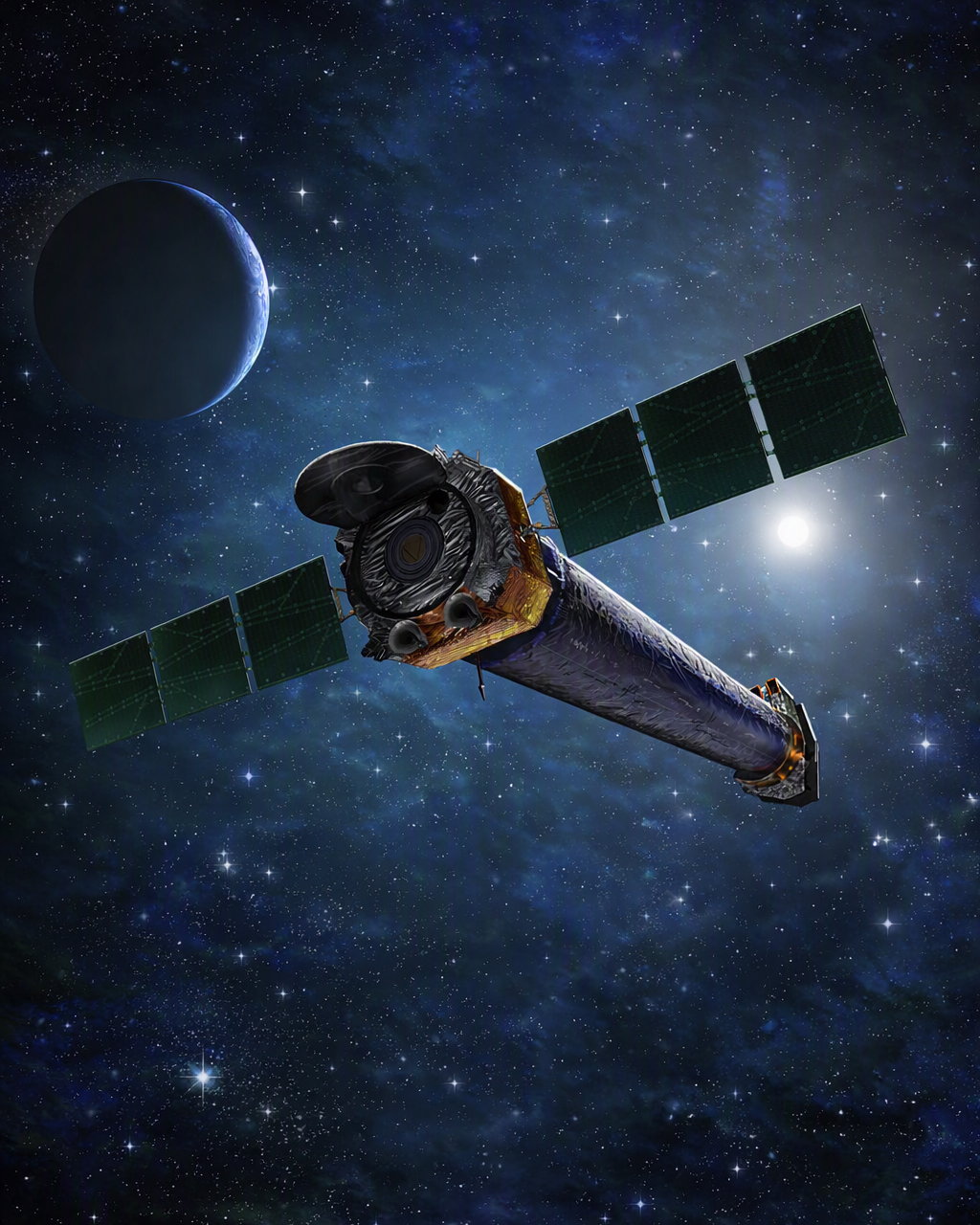
Artist's illustration of the Chandra X-ray Observatory in space. (Credit: NASA/CXC & J.Vaughan)
Over 27 years of observations from NASA's Chandra X-ray Observatory, the agency’s flagship X-ray mission, have created one of astronomy's richest scientific archives. Today, scientists are using artificial intelligence (AI) to uncover discoveries hidden within those decades of collected X-ray data.
The Chandra archive is a unique treasure — holding tens of thousands of separate pointings of the telescope and hundreds of millions of seconds of X-ray observations. Because the archive is openly available, scientists (and the public) can revisit decades of observations with new ideas and new tools. This enables new opportunities for discovery that were potentially not possible when the data were first collected.
While scientists consistently comb through the Chandra archive and make important and exciting discoveries, modern computational tools allow researchers to analyze this vast reservoir of data at unprecedented scale. This is where AI becomes a powerful scientific tool, serving as an extension of human ingenuity to uncover subtle patterns and produce new cosmic discoveries from invaluable open archives of data.
Acting like a microphone to a singer, AI can boost the capabilities of scientists and help them analyze more data and do so more quickly than without it. But just as there would be no song without the singer, there would be no science without the scientists. AI enhances, amplifies, and expands capabilities, but it does not replace what humans do in the scientific process.
Researchers decide what questions to ask, they train and evaluate the algorithms, and carefully verify and interpret every result before it becomes part of the scientific record. Whatever an AI system generates still needs to be rigorously checked and interpreted by researchers before those insights can be shared with the wider scientific community.
A Hidden Population of Cosmic Beacons: Discovering Hypersoft X-ray Sources with Chandra

Mustafa Muhibullah (Credit: Mustafa Muhibullah)
We welcome Mustafa Muhibullah as a guest blogger. He is the first author of a Nature Astronomy paper that is the subject of our latest press release. Mustafa is a Ph.D. candidate in Physics & Astronomy at the University of Alabama, working with Prof. Jimmy Irwin since Fall 2021. His research focuses on high-energy astrophysics, particularly faint and compact X-ray sources and galaxy clusters, using NASA’s Chandra X-ray Observatory. He earned his M.S. in Physics from the University of Missouri–Kansas City in 2021 and his B.S. in Mechanical Engineering from Rajshahi University of Engineering & Technology, Bangladesh.
The “Unobserved” Window of the Universe
Modern astronomy explores the Universe across nearly the entire electromagnetic spectrum, from radio waves to X-rays. Yet one important window remains largely hidden: the extreme-ultraviolet (EUV), a narrow but energetic region between ultraviolet light and low-energy X-rays. For observers in the Milky Way, EUV radiation from distant sources is almost completely blocked by the cool, neutral hydrogen and helium that fill our Galaxy and readily absorbs these photons before they can reach our telescopes.
We know that powerful EUV emitters exist. For example, astronomers know that hot, massive stars, the solar corona, and active galaxies can all produce substantial EUV emission. Fortunately, they also radiate at other wavelengths, allowing astronomers to detect and study them even when their EUV light is absorbed.
Zombie Disks May Solve a Cosmic Mystery
The cosmos is full of surprises. When new classes of objects are discovered they can turn out to have more than one explanation. Some supernova explosions, for example, are triggered by the dramatic collapse of massive stars, while others involve the thermonuclear explosions of white dwarf stars. These two types of stars are remarkably different in size, mass, composition and density, but both can produce explosions that outshine entire galaxies. Another example is gamma ray bursts, which involve either the collapse of massive stars or the merger of two neutron stars.
The origin of the newly-discovered class of hypersoft X-ray sources is unknown, but similar diversity may apply. One leading idea is that many of them involve matter falling onto the surfaces of white dwarfs. Once the white dwarfs reach a sufficient mass they may explode as Type Ia supernovas, addressing the mystery of what triggers these spectacular explosions. In other words, some of these hypersoft X-ray sources may represent the build up to Type Ias — a very important category of supernovas that lets astronomers measure the accelerating expansion of the Universe. However, this explanation struggles to explain the brightest of the hypersoft X-ray sources.
Time-lapse Photon Imaging: A New Way to Visualize Deep Chandra X-ray Observations

Joel Kastner
(Credit: Joel Kastner, Rochester Institute of Technology)
We welcome Joel Kastner, a professor at the Center for Imaging Science and School of Physics & Astronomy at the Rochester Institute of Technology, as our guest blogger. In this post, he describes how the final project of an RIT student, Tristan Liberace, for Kastner’s course in astronomical imaging resulted in a novel method to visualize long-duration Chandra observations — and a new view of the many (X-ray) faces of the active galaxy Centaurus A.
This past May, I once again sat down to grade more than 50 final projects for the course ‘Fundamentals of Astronomical Imaging’ at Rochester Institute of Technology (RIT). Astro Imaging Fun, as our imaging science department staff and faculty prefer to call it, is a General Education course of my own design. Each spring I get to guide 50-60 RIT students, with majors ranging from graphic arts to business to computer science to engineering, through the wonderful world of imaging in astronomy across the electromagnetic spectrum, from radio to X-rays.
Though (like many professors) I abhor assigning grades to student work, the final project images and image descriptions for Astro Imaging Fun are always, well, fun to see and read. It’s rewarding to see what the students have learned during the semester and how they’ve made use of that new knowledge, and there are always gems and pleasant surprises among the students’ image submissions.
Galactic Gems Glisten in New Gallery From NASA's Chandra
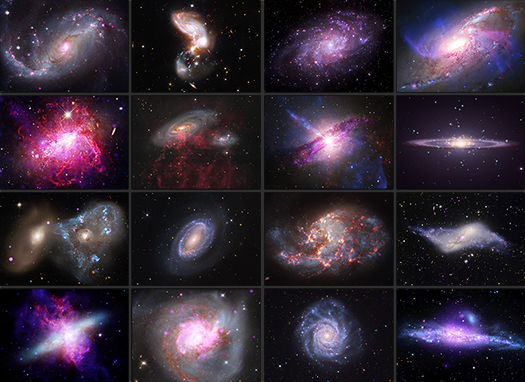
Galaxies are like cosmic gems, each with characteristics including size and shape that make them distinct. A new gallery released today from NASA’s Chandra X-ray Observatory and other telescopes displays a collection of galactic images that showcase this variety.
Astronomers put galaxies into three main categories: spirals like our own Milky Way with arms emanating from their cores, ellipticals that are older and likely the results of mergers, and irregulars that can encompass a wide range of galactic phenomena.
Just as gems reveal the history of Earth through how they were forged over billions of years, these galactic gems are a way to study Earth’s place in our home galaxy of the Milky Way. By looking outward to other galaxies, we learn more about our own – including clues to its past and future.