
Unraveling a Cosmic Illusion: Can Some Radio Relics Pretend to Be a Radio Halo?

Mustafa pfern (Credit: Mustafa pfern)
We welcome Paola Domínguez-Fernández as a guest blogger. Paola is the first author of a recent paper exploring the origin of radio emission in the unusual merging galaxy cluster MACS J0018.5+1626. She was formerly a researcher at Harvard University working at the Center for Astrophysics | Harvard & Smithsonian, and has since started as an Assistant Professor at UNAM, where her work focuses on cosmic magnetism, particle acceleration, and the physics of galaxy clusters. Before Harvard, she worked at the University of Bologna in Italy and at UNIST in South Korea. She received her PhD from the University of Hamburg in Germany and her master’s degree from the University of Bonn. She earned her bachelor’s degree at UNAM in Mexico.
What? Galaxy clusters are the largest gravitationally bound structures in our Universe, containing hundreds to thousands of galaxies, enormous reservoirs of hot gas visible in X-rays, and large amounts of dark matter. But clusters are not quiet places. As they form, they experience several collisions with other galaxy clusters. Galaxy cluster collisions, or merger events, are among the most energetic events since the Big Bang and generate the largest shock waves in the Universe, traveling through the outer regions of the cluster atmosphere. When these shock waves emit radio waves, we nickname them as “radio relics,” typically observed as elongated regions in the peripheries of clusters. These energetic events also produce turbulence, which can re-accelerate particles to emit radio waves as well. In these cases, however, the emission sits at the center of the clusters and we nickname them "radio halos." Either way, these vast regions of diffuse radio emission reveal the presence of magnetic fields and particles spiraling around them at nearly the speed of light: cosmic ray electrons.
These mega-collisions between galaxy clusters help us understand how the largest structures in our Universe form while also revealing the physical processes that govern hot gas in clusters. However, obtaining a complete physical picture of galaxy cluster collisions is extremely challenging without observations across multiple wavelengths of the electromagnetic spectrum. By combining observations at different wavelengths with numerical simulations, we can reconstruct how these enormous collisions unfold: the sizes and masses of the colliding clusters, how fast they are moving toward each other, how direct the collision is, and how the system is oriented relative to our line of sight. That reconstruction is exactly what the novel ICM-SHOX pipeline (Improved Constraints on Mergers with SZ, Hydrodynamical simulations, Optical, and X-ray), developed by PhD student Emily Silich at Caltech, delivers. The pipeline combines X-ray, optical, gravitational lensing, and Sunyaev–Zel’dovich observations. Chandra X-ray observations in the 0.5-7 keV band were central to the study, but data from the W. M. Keck Observatory, the Hubble Space Telescope, the Herschel Space Observatory, the Planck Observatory, the Caltech Submillimeter Observatory, and the Atacama Submillimeter Telescope.
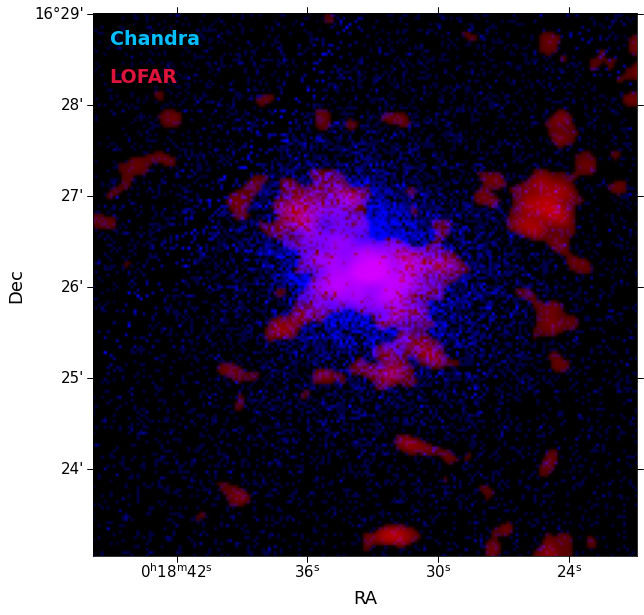
Hiding in Plain Sight: In this work, we show that the use of ICM-SHOX also provides a powerful new way to study the origin of diffuse radio emission in colliding galaxy clusters. Our test case is the galaxy cluster MACS J0018.5+1626 (hereafter MACS J0018.5), which has been revealed to be a particularly unusual system: we found the hot gas in the cluster, tracing the normal matter, was moving in the opposite direction from the dark matter. This type of separation between normal matter and dark matter has been seen before, most famously in the Bullet Cluster.
However, MACS J0018.5 has another remarkable feature. The geometry of the collision suggests that we are observing the system almost along the direction of the merger itself. In other words, one of the clusters is moving nearly toward us while the other is moving away from us. With this picture in hand, we simulated the collision and found that the encounter drives two powerful shock waves (similar to sonic booms from supersonic aircraft) through the hot gas. Under the right conditions, shocks like these can accelerate electrons to relativistic energies (corresponding to particles traveling at close to the speed of light) that radiate in the radio band producing the “radio relics” mentioned earlier. So in this work we add another piece to the puzzle using new 144 MHz radio observations from the LOw Frequency ARray (LOFAR).
Because the merger axis of MACS J0018.5 is nearly aligned with our line of sight, we are seeing these “radio relics” almost face-on: their emission is projected onto the central region of the cluster rather than spread out toward the outskirts. From our vantage point on Earth, the two overlapping shock fronts create the illusion of a single, round “radio halo”.
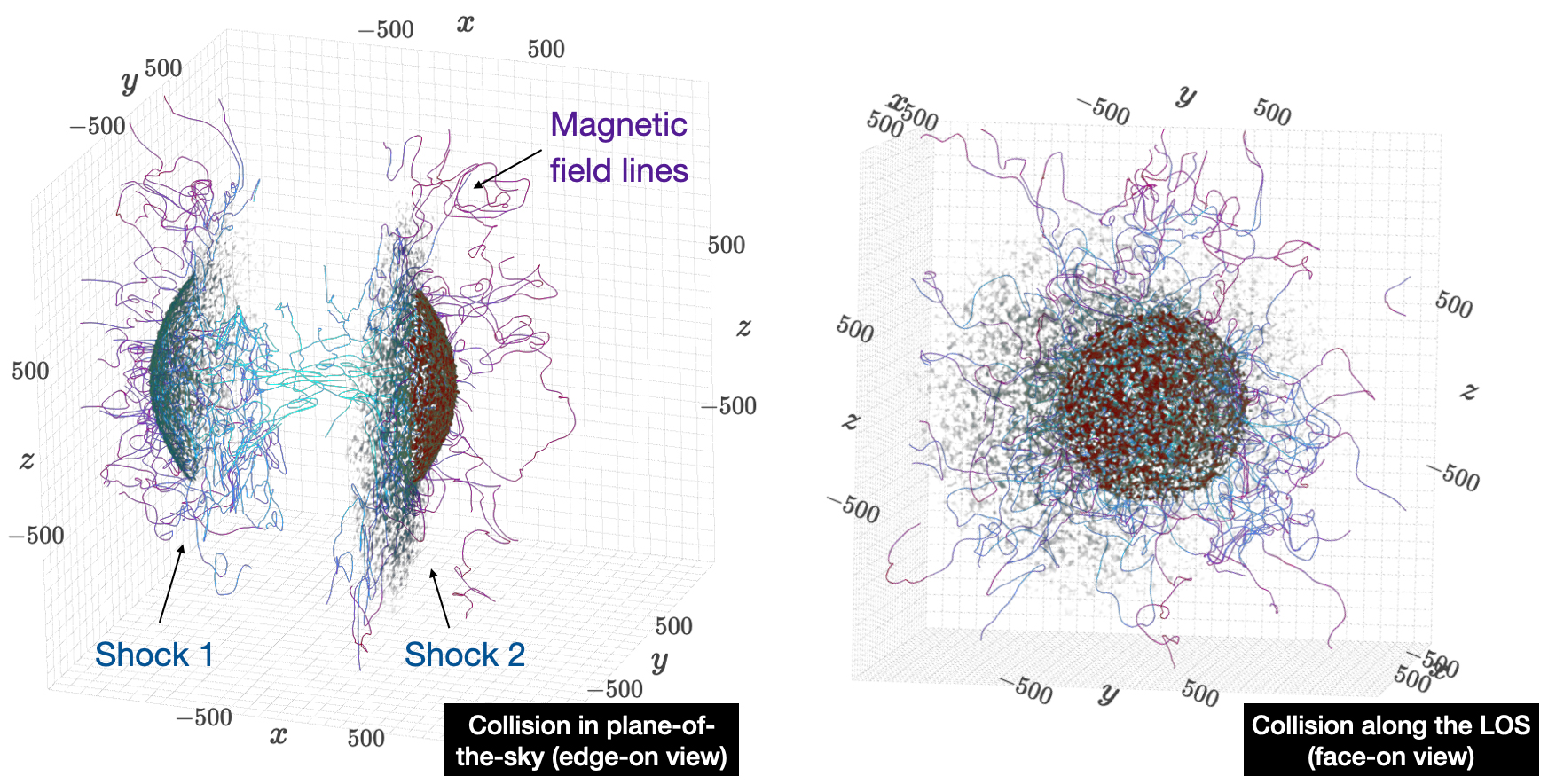
To test this idea, we used simulations to study how populations of relativistic electrons are accelerated at these shocks and radiate radio waves. The problem is that these merger shocks, even though they are the largest shocks in the Universe, are usually quite weak, and a weak shock often isn't powerful enough to kick electrons up to the energies needed to glow in radio light. That made us skeptical at first that this idea would pan out, as noted by team member J. A. ZuHone from the Center for Astrophysics | Harvard & Smithsonian.
Our results showed that a combination of factors could reproduce the emission, along with the relevant correlations that hold between the radio (LOFAR) and X-ray (Chandra) observations: a magnetic field of a few microGauss (much smaller than the Earth’s magnetic field of about 0.5 Gauss), a fast collision (roughly 2,400 to 3,000 kilometers per second, more than ~80,000 times highway speed), and only a small fraction, at most a few percent, of the shock's energy funneled into accelerating those electrons.
If this model holds up, it would make MACS J0018.5 the first cluster in which we can build a detailed, physically motivated case that a radio halo-like source is actually two radio shocks viewed nearly face-on, rather than the more common turbulence-driven radio halo.
Is that the end of the story? Not quite. The acceleration efficiencies our best-fit models need are on the optimistic side of what's typically invoked for weak shocks in the hot gas in clusters, so this is a viable picture rather than a closed case. The team is now pursuing deeper, higher-frequency radio follow-up with MeerKAT to further test this shock-driven picture, and we're also extending the simulations to include the role of turbulence, which can further accelerate electrons.
As new and upgraded radio observatories continue to turn up more diffuse radio sources in clusters, projection effects like the one we've uncovered in MACS J0018.5 are likely not unique. We expect more surprises ahead, and perhaps more radio shocks hiding in plain sight, ones that only a multi-wavelength view will ever unmask.