
Unearthing the Hidden Universe: How Scientists Use AI to Mine Chandra’s Archive
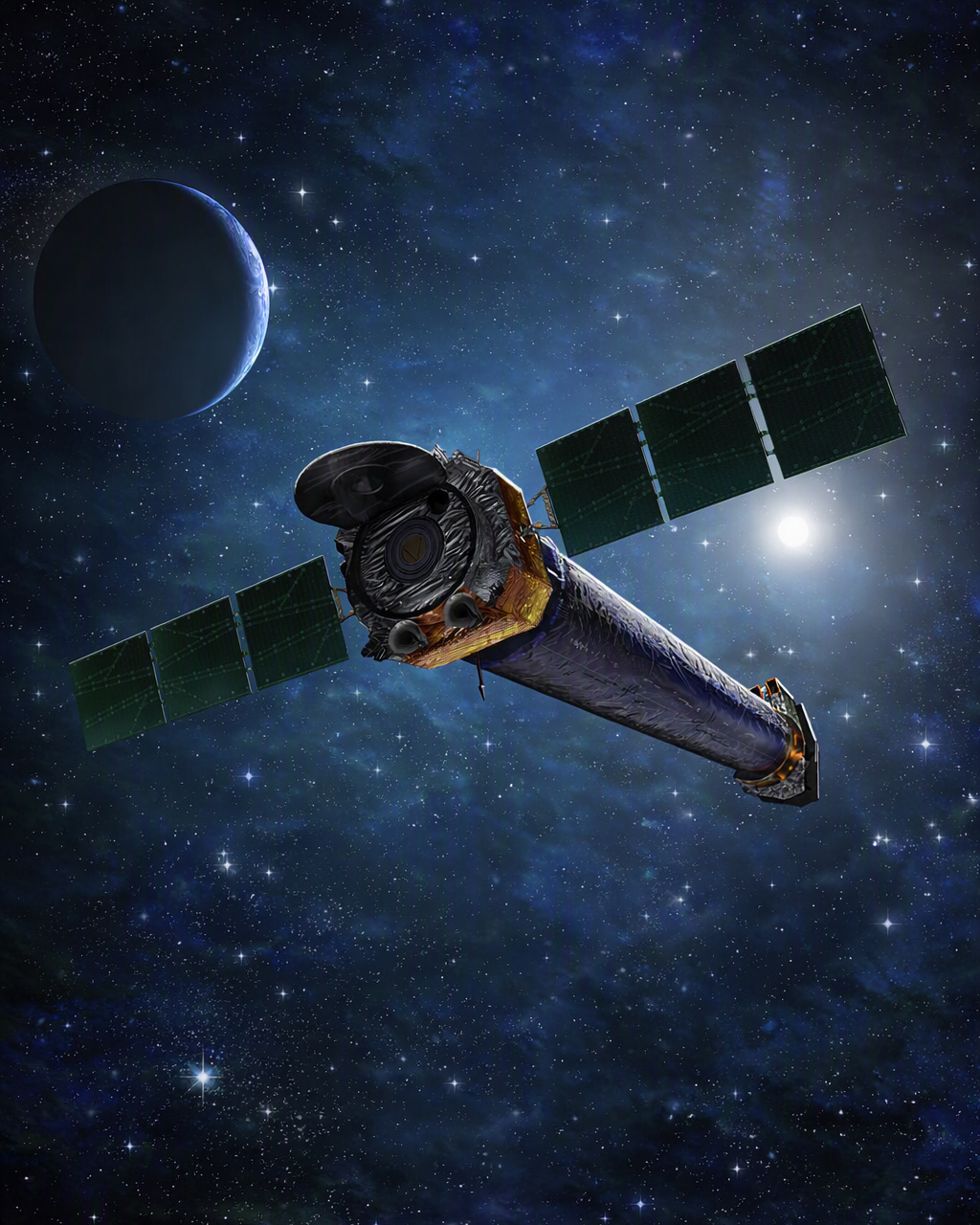
Artist's illustration of the Chandra X-ray Observatory in space. (Credit: NASA/CXC & J.Vaughan)
Over 27 years of observations from NASA's Chandra X-ray Observatory, the agency’s flagship X-ray mission, have created one of astronomy's richest scientific archives. Today, scientists are using artificial intelligence (AI) to uncover discoveries hidden within those decades of collected X-ray data.
The Chandra archive is a unique treasure — holding tens of thousands of separate pointings of the telescope and hundreds of millions of seconds of X-ray observations. Because the archive is openly available, scientists (and the public) can revisit decades of observations with new ideas and new tools. This enables new opportunities for discovery that were potentially not possible when the data were first collected.
While scientists consistently comb through the Chandra archive and make important and exciting discoveries, modern computational tools allow researchers to analyze this vast reservoir of data at unprecedented scale. This is where AI becomes a powerful scientific tool, serving as an extension of human ingenuity to uncover subtle patterns and produce new cosmic discoveries from invaluable open archives of data.
Acting like a microphone to a singer, AI can boost the capabilities of scientists and help them analyze more data and do so more quickly than without it. But just as there would be no song without the singer, there would be no science without the scientists. AI enhances, amplifies, and expands capabilities, but it does not replace what humans do in the scientific process.
Researchers decide what questions to ask, they train and evaluate the algorithms, and carefully verify and interpret every result before it becomes part of the scientific record. Whatever an AI system generates still needs to be rigorously checked and interpreted by researchers before those insights can be shared with the wider scientific community.
Three recent results show what is possible when Chandra’s vast stores of data, talented astrophysicists, and specialized AI models work together.
- In 2024 astronomers reported the discovery of eruptions from supermassive black holes in the centers of seven galaxies.
- Another team in 2025 reported that a rare type of black hole may have been discovered tearing apart a star.
- Then, later in 2025 scientists reported discovering many growing supermassive black holes buried beneath thick clouds of gas in a deep X-ray image.
AI can assist Chandra’s X-ray superpowers and enable these discoveries and dramatically accelerate the search for rare objects hidden within decades of observations.
Below there are more details on these examples of AI-assisted results using Chandra data. With new telescopes like the Vera Rubin Observatory in Chile and the recently-launched Nancy Grace Roman Telescope, astronomers will have access to more datasets than ever before. When coupled with deep archives from Chandra, Hubble, and other NASA missions, these tools open exciting new pathways for astronomers to use AI to learn more about our universe.
Under the Hood: How AI Unlocked Three Chandra Discoveries
1) Finding Hidden Black Hole Outbursts (2024)
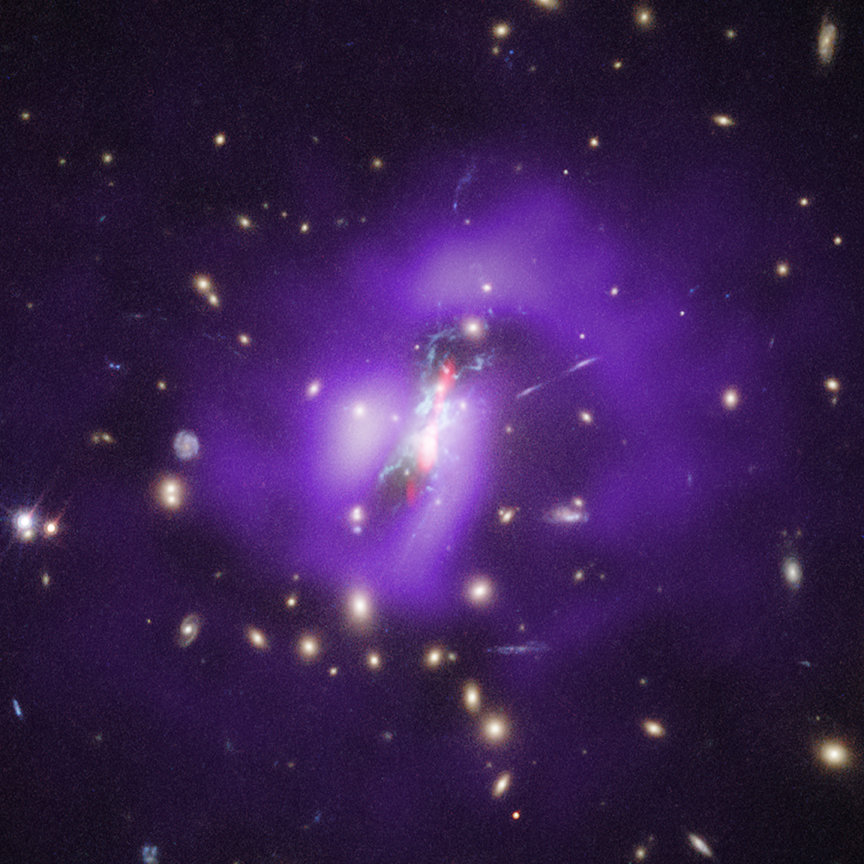
The Phoenix Cluster
(Credit: X-ray: NASA/CXC/MIT/M.McDonald et al.; Radio: NRAO/VLA; Optical: NASA/STScI)
Astronomers discovered seven previously unknown eruptions from supermassive black holes by using AI to search through years of Chandra observations. Outbursts from material surrounding a black hole can generate jets of energetic particles that displace the hot, X-ray emitting gas surrounding them, creating enormous pairs of cavities. By measuring the size of the cavities, the total amount of energy produced in the outbursts can be calculated, making these studies crucial for understanding the impact of black holes on their galactic neighborhoods. For example, energy released by the expansion of cavities can prevent the hot gas from cooling down and forming huge numbers of new stars. The AI program developed for this task was trained on computer simulations of Chandra data and when applied to real Chandra data, successfully recovered 93 of 97 cavities previously identified in galaxies, and all 14 cavities in clusters of galaxies. The program found seven new pairs of cavities in galaxies, and several other candidates, representing the discovery of powerful outbursts from supermassive black holes.
2) Catching a Rare Black Hole Devouring a Star (2025)
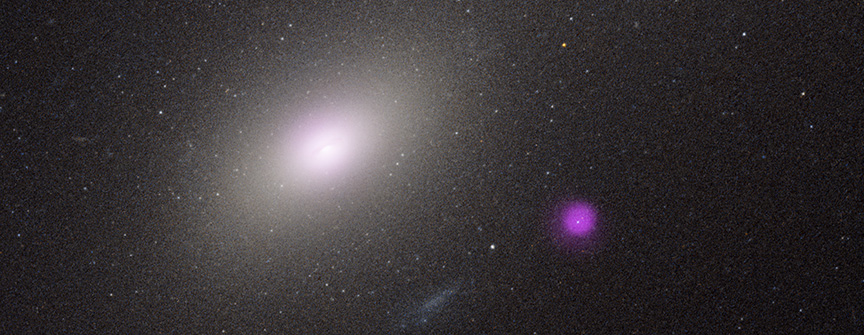
NGC 6099 HLX-1
(Credit: X-ray: NASA/CXC/Inst. of Astronomy, Taiwan/Y-C Chang; Optical/UV: NASA/ESA/STScI/HST; Image Processing: NASA/STScI/J. DePasquale)
This paper centered on a black hole that scientists think may have been discovered to be tearing a star apart, a process called a “tidal disruption event”. The search looked for extremely bright galactic sources in other galaxies that are primarily at lower energies than other bright galactic X-ray sources, a possible X-ray calling card for tidal disruptions. The study of such sources offers a unique and powerful opportunity to study matter falling onto supermassive black holes in extreme conditions. These types of sources are rare and difficult to find, so the authors used a double-pronged technique to efficiently search for them in the Chandra archive, using a manually-applied algorithm and a machine learning technique. This search uncovered a new candidate for a tidal disruption. The researchers found indications that the black hole is an elusive type called an “intermediate mass black hole” with a mass in between those of stellar-mass black holes formed from the collapse of massive stars and the supermassive variety found in the centers of galaxies. The event occurred between 2001 and 2002, making it one of the earliest tidal disruption events seen with Chandra.
3) Uncovering Buried Giants in the Deep Universe (2025)
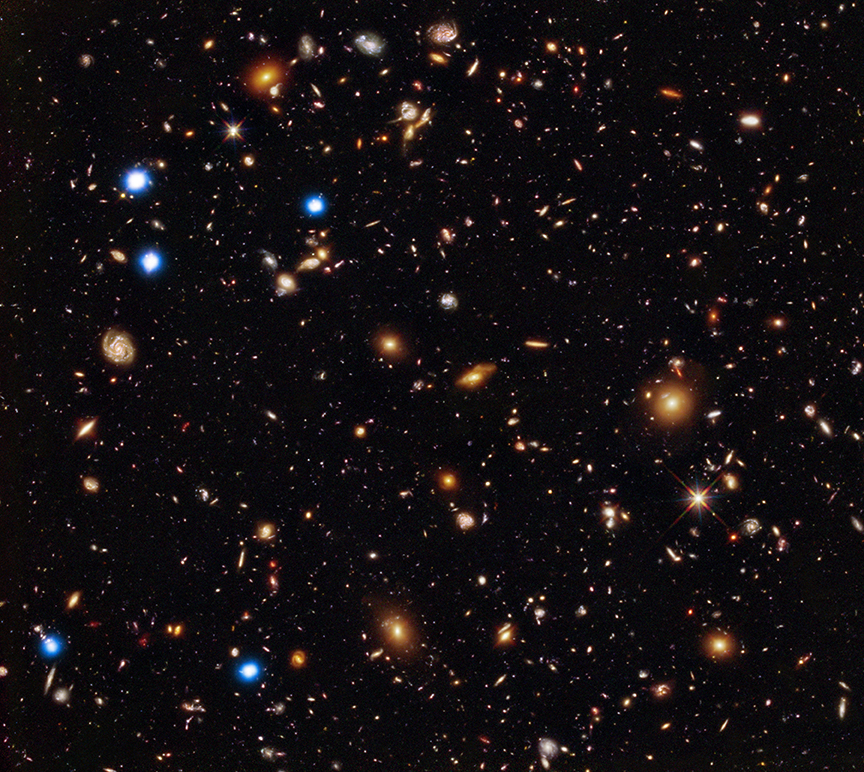
Chandra Deep Field South (CDFS)
(Credit: X-ray: NASA/CXC/U.Hawaii/E.Treister et al; Infrared: NASA/STScI/UC Santa Cruz/G.Illingworth et al; Optical: NASA/STScI/S.Beckwith et al.)
Scientists have developed theories that predict how many supermassive black holes are hidden under thick clouds of gas. A recent paper using AI helped look for these growing black holes (known as active galactic nuclei, or AGN) in the Chandra Deep Field-South (CDF-S), the most sensitive X-ray image ever obtained. Astronomers have predicted that these deeply buried AGN should make up a significant fraction of the total number of AGN, likely around 30% or more. However, in the CDF-S, only about 11% of the AGN have been identified as deeply buried. An AI technique was applied to the CDF-S to see if more buried AGN could be found. The AI was trained and tested using a set of 210 previously known AGN. The algorithm achieved a success rate of about 90%. The team then applied the AI to an additional group of likely AGN and detected 67 that are deeply buried. This work significantly increased the fraction of buried AGN in the CDF-S, making it closer to theoretical predictions.
Conclusion: AI + X-ray = Discovery
Ultimately AI is playing a role in expanding how much of the universe we can understand. Modern telescopes like Chandra are amassing giant datasets in their archives — holding undiscovered pieces to the cosmic puzzle. By giving scientists better tools to sift through the wealth of information, we can help ensure that every second of telescope time contributes to yielding new insights about how our universe works. Using AI with the data treasure troves like Chandra’s archive opens up new possibilities for discovery and exploration today and for future generations.
— K. Arcand, P. Edmonds, M. Watzke, CXC