
Chandra Reveals a Black Hole Jet around the “Red Potato,” an Early-Universe Galaxy Without Active Star Formation
We welcome Weichen Wang as a guest blogger. Weichen is the first author of a paper that is the subject of our latest press release. He is a postdoctoral researcher at the University of Milano-Bicocca in Milan, and his research focuses on the relationship between galaxies in the early Universe and their large-scale environments. Before moving to Italy in 2022, he lived in Baltimore for six years and earned his PhD at the Johns Hopkins University. He received his bachelor’s degree from Tsinghua University in Beijing in 2016.
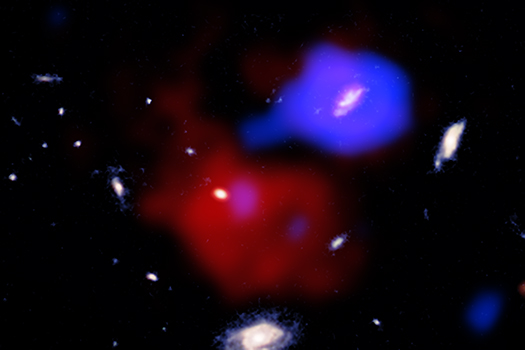
The history of galaxy formation is, in many ways, the story of diffuse cosmic gas being transformed into galactic stars. One important source of this fuel is the cool circumgalactic medium: gas surrounding galaxies that can eventually fall inward and help form new stars. Earlier observations showed that, in the early Universe, this cool gas is especially abundant in the densest intersections, or “nodes,” of the cosmic web. We therefore expected galaxies in these node regions to be actively forming stars.
In 2022, we observed such a cosmic web node region with NASA’s James Webb Space Telescope (JWST). Most of the galaxies detected in the region met our original expectation, namely actively forming stars. But one galaxy was strikingly different: a compact red galaxy sitting at the center of a large reservoir of cool gas yet forming very few new stars. We named it the “Red Potato” because of its red, rounded appearance in the JWST image.
Why would a galaxy stop forming stars while surrounded by so much cool gas? The puzzle reminded me of some of the most peculiar ecosystems on our own planet, the coastal deserts, which have been seen in Chile and Namibia. Although these deserts lie right beside the ocean, they receive almost no rainfall and have incredibly dry climates.
I remember bringing my laptop on one morning to Sebastiano Cantalupo, my post- doctoral advisor, and Andrea Travascio, my colleague and the Chandra expert of our group, to discuss this peculiar galaxy. We looked into data just collected from our new observations with NASA’s Chandra X-ray Observatory. Before long, we found an important clue: the cool gas reservoir surrounding the Red Potato galaxy is intersected by an extended X-ray jet, which is clearly powered by a massive black hole. Archival radio observations from the Australian Square Kilometer Array Pathfinder also provided strong evidence for this jet. Together with a detailed analysis of the gas kinematics, this finding suggests that the black hole jet may be stirring the cool gas around the galaxy. Rather than allowing the gas to settle inward and form stars, the jet may be keeping it turbulent and prevent it from condensing onto the Red Potato.
Our discovery demonstrates the strong impacts of black hole jets in early-Universe galaxy formation: these impacts add an extra layer of complexity to the connection between the cosmic gas and galaxy star formation. JWST is revealing more and more early-Universe galaxies with similarly little or no ongoing star formation. Does the story of the Red Potato galaxy apply to them as well? With its exceptional X-ray sensitivity, Chandra is certainly going to be instrumental for helping solve this bigger puzzle in the future.