
How Do You Measure the Distance to the Spiral Arms of Our Galaxy When You Are Sitting Inside It?

Beatrice Vaia (Credit: Beatrice Vaia)
We welcome Beatrice Vaia as a guest blogger. Beatrice is the first author of a paper that is the subject of our latest press release. She is a postdoc at INAF–IASF Milano and earned her Bachelor's and Master's degrees in Physics from Roma Tre University before completing her PhD in the National PhD Programme in Space Science and Technology at the Scuola Universitaria Superiore IUSS Pavia and the University of Trento.
Unlike external galaxies, which we can photograph from the outside, we must reconstruct the Milky Way's structure from our vantage point within its disk.
The European Space Agency's Gaia mission, launched in 2013, has transformed this effort by measuring the distances and brightnesses of more than a billion stars. By comparing the brightness and colors of stars at different distances, astronomers can map the distribution of interstellar dust across much of the Milky Way, since dust both dims and reddens starlight.
However, Gaia has difficulty probing the Galaxy's most distant spiral arms because their stars are either too faint to detect or obscured by thick clouds of dust.
To explore those remote parts of the Milky Way, astronomers have traditionally relied on radio observations of neutral hydrogen (H I) and carbon monoxide (CO), which trace the gas and molecular clouds concentrated along the spiral arms. The observed velocities of these clouds can be converted into distances using a model for how the Milky Way rotates. While this technique has revealed much of the Galaxy's large-scale structure, the inferred distances depend on astronomers’ incomplete understanding of how quickly the galaxy is rotating, leaving the exact locations of the outer spiral arms still uncertain.
In our new study, we took a different approach by using some of the most powerful explosions in the Universe: gamma-ray bursts. These events occur when a massive star collapses or when two ultra-dense stellar remnants merge, releasing an enormous amount of energy in different types of light.
When the X-rays from a gamma-ray burst pass through our own Galaxy, some of them are scattered by the dust grains in the Milky Way. The scattered X-rays take a slightly longer path to us than the direct ones, so they arrive later and appear as rings that grow larger over time.
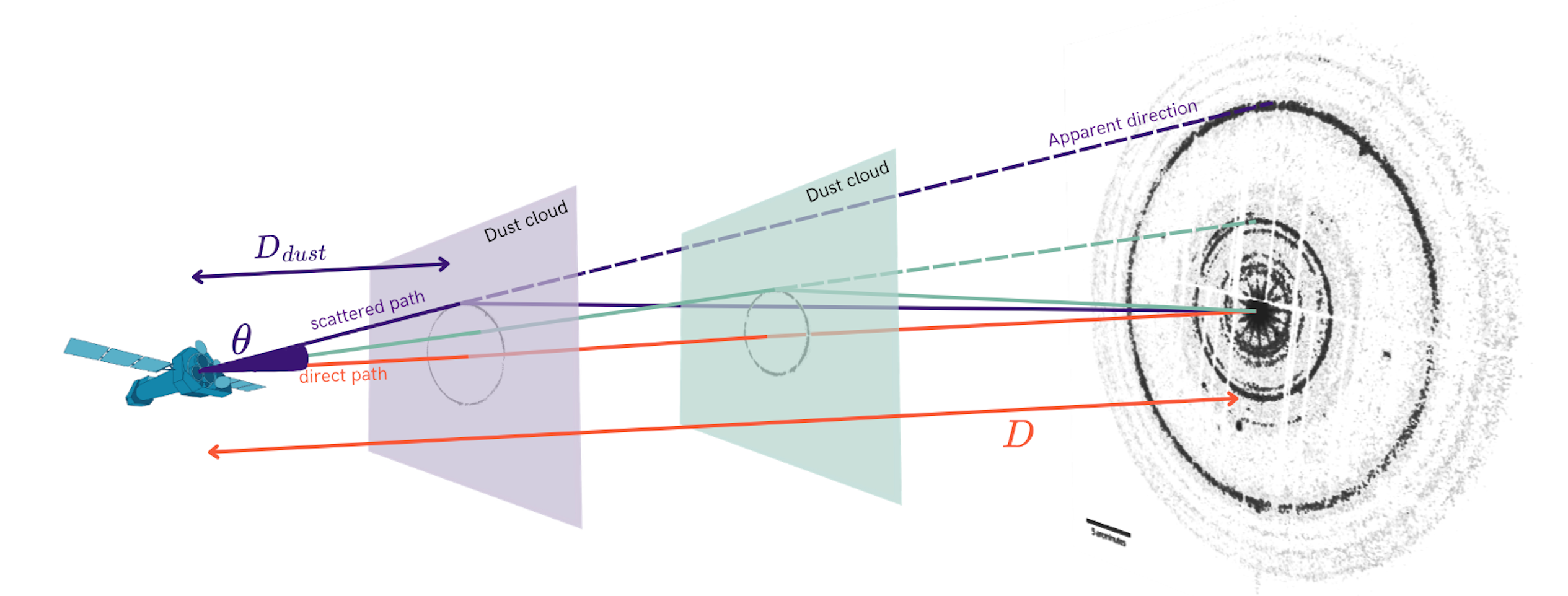
X-ray Pathway
Credit: B. Vaia and ESA/XMM-Newton/M. Rigoselli (INAF)
These expanding rings are a relatively recent addition to astronomers' toolbox. The story began more than 40 years ago, when astronomers discovered faint X-ray halos around bright Galactic X-ray sources and realized they were produced by interstellar dust.
A breakthrough came in 2003, when the gamma-ray burst GRB 031203 generated the first expanding X-ray rings ever detected. Astronomers soon recognized that these rings were much more than a spectacular phenomenon: By measuring how these rings expand, we can directly calculate the distance to the dust clouds that scattered the X-rays, providing a precise geometric measurement that does not rely on models of how the Milky Way rotates.
Using observations from NASA’s Chandra X-ray Observatory and ESA’s XMM-Newton satellite, we studied the dust-scattering rings produced by three gamma-ray bursts located close to the plane of the Milky Way. These observations allowed us to measure the distances to dust clouds associated with some of the Galaxy’s most distant spiral arms, including the Perseus Arm, the Outer Arm, and the faraway Outer Scutum–Centaurus Arm. For the Outer Scutum–Centaurus Arm, we measured its distance to within about 1%, improving on the previous best estimate, which was accurate to only about 10%.
Our results also suggest that the outer spiral arms may lie about 10% farther away than predicted by the most widely used models of the Milky Way. Those models — as already outlined — are largely based on the motions of gas clouds, whose distances are inferred using a model of the Galaxy's rotation. Our measurements are instead purely geometric. Improving — in this way — the distances to the Milky Way's spiral arms will help astronomers build a more accurate picture of our Galaxy and better understand its structure and evolution.