
NASA Finds Young Stars Dim in X-rays Surprisingly Quickly
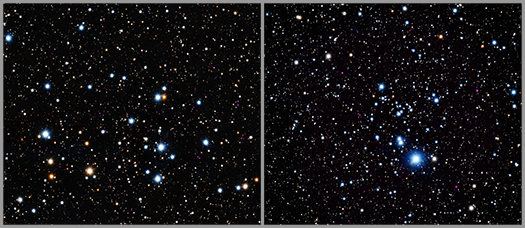
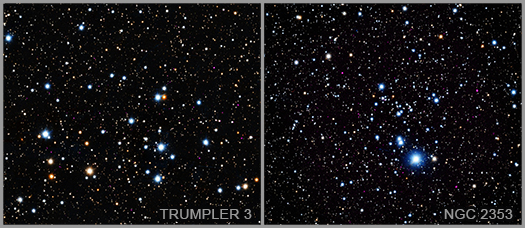
Trumpler 3 and NGC 2353
More images and information
Credit: X-ray: NASA/CXC/Penn State Univ/K. Getman; Optical/IR: PanSTARRS;
Image Processing: NASA/CXC/SAO/N. Wolk
These images of star clusters represent a new study from NASA’s Chandra X-ray Observatory that shows how young Sun-like stars are dimmer in X-rays than previously thought. As described in our latest press release, this result has implications for the prospects of life developing and surviving on planets in orbit around these stars.
Trumpler 3 and NGC 2353 are so-called open clusters that contains hundreds of young stars. These stars are tied to each other through gravity, having been formed from the same clouds of gas. Many of these stars have masses that are similar to our Sun, but are much younger. In these new composite images of Trumpler 3 and NGC 2353, X-rays from Chandra (purple) have been combined with an optical image from the PanSTARRS telescope in Hawaii (red, green, and blue). Another star clusters from the new Chandra study, NGC 2301 is shown in the same color schemes with the X-ray and optical data.
Credit: X-ray: NASA/CXC/Penn State Univ/K. Getman; Optical/IR: PanSTARRS; Image Processing: NASA/CXC/SAO/N. Wolk
The researchers found that stars with about the same mass as the Sun quieted down relatively rapidly — after a few hundred million years — while ones with less mass kept up their high levels of X-ray emission for longer. Combined with a decrease in the energy of the X-rays and the disappearance of energetic particles, the Sun-sized stars are apparently better suited to host planets with robust atmospheres and possibly blossoming life than previously thought.
The team used data from ESA’s Gaia satellite and X-ray data from the ROSAT mission. This data allowed them to identify the stars that were members of the clusters (not foreground or background stars). To measure the X-ray output from the stars, they made new Chandra observations of five clusters with ages between 45 million and 100 million years and Chandra and ROSAT data from archives to study three older clusters with ages between 220 and 750 million years.
A new paper describing these results has been accepted and appears in The Astrophysical Journal. The authors of the paper are Konstantin Getman (Penn State University), Eric Feigelson (Penn State), Vladimir Airapetian (NASA Goddard Space Flight Center), and Gordon Garmire (Penn State).
NASA's Marshall Space Flight Center in Huntsville, Alabama, manages the Chandra program. The Smithsonian Astrophysical Observatory's Chandra X-ray Center controls science operations from Cambridge, Massachusetts, and flight operations from Burlington, Massachusetts.