




CXC Home | Search | Help | Image Use Policy | Latest Images | Privacy | Accessibility | Glossary | Q&A
Download Image
More Information
More Images
Chandra X-ray Image with Scale Bar
(Credit: X-ray: NASA/IOA/Fabian et al. Optical: NASA/U. Durham/Smail et al.)
Related Images

Type 2 Quasar:
Gravitational Lens Helps Chandra Find Rare Type of Black Hole

Gravitational Lens Helps Chandra Find Rare Type of Black Hole
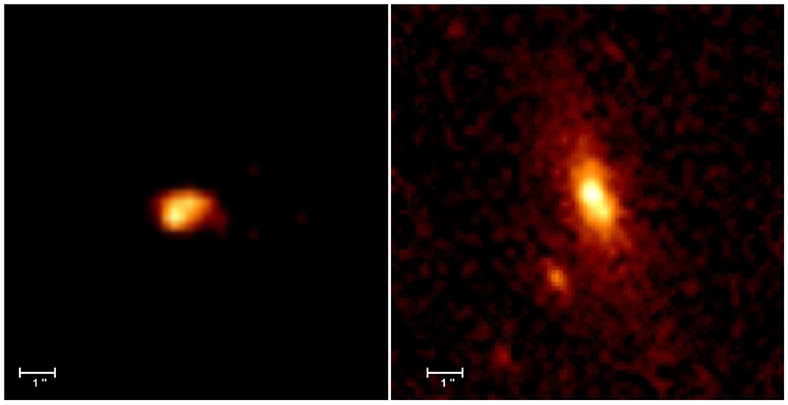
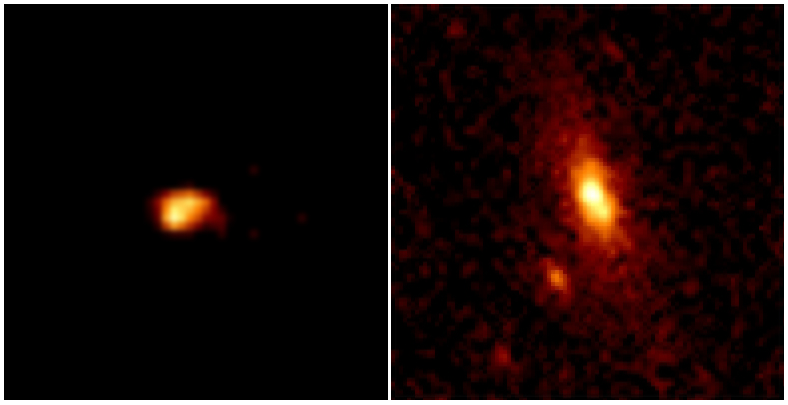
X-ray (left) and Optical (right) Images of Veiled Black Hole. The left hand panel shows the Chandra X-ray Observatory image of a powerful point-like source of X rays. The Hubble Space Telescope image (right panel) shows the spiral galaxy with which the X-ray source is associated. The X-ray source is located at the center of the galaxy, and has a deficit of low energy X rays, consistent with absorption by a thick cloud of gas. The combination of powerful X-ray emission, absorption of low energy X-rays, and the relatively normal optical appearance of the galaxy suggests that the source is a rare type of black hole called a Type 2 quasar.
The spread-out appearance of the X-ray source is an instrumental artifact. The distribution of X rays is consistent with this source being point-like. The X-ray and optical image panels have the same scale, which is 10 arcsec on a side.
Chandra X-ray Observatory Advanced CCD Imaging Spectrometer Image (ACIS) of CXOUJ215334.0+174240
|
||||||||||||||||||||||||
Visual Description:
The astronomical image features a Type 2 quasar, which is a powerful point-like X-ray source. This type of quasar is characterized by the presence of an active supermassive black hole at the center of a galaxy. The image consists of two frames, with one frame showing a bright concentrated light in the very center, while the other frame shows a larger, dimmer and more elongated light in the center. The colors of the image are predominantly orange and black, creating a dark and mysterious atmosphere. The Chandra X-ray Observatory image (left) is a powerful point-like source of X rays. The Hubble Space Telescope image (right panel) shows the spiral galaxy with which the X-ray source is associated. The X-ray source is located at the center of the galaxy, and has a deficit of low energy X rays, consistent with absorption by a thick cloud of gas. The spread-out appearance of the X-ray source is an instrumental artifact.


Revised: September 10, 2025