

Location: Visible in both Hemispheres
Coordinates:
Right Ascension: 22h
Declination: +20º
Source: Greek mythology
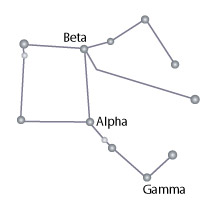
The story behind the name: Pegasus, the winged horse, was the son of Poseidon and Medusa. Medusa had been one of three beautiful sisters. Athena was angered that Medusa met with Poseidon in one of her temples. She changed Medusa into a terrible monster. Zeus kept Pegasus out of the world to placate Athena. Pegasus (and the warrior Chrysaor) sprang from Medusa's body after she was killed by Perseus.
Pegasus had been living on Mount Helicon, tended by the Muses for whom he created a drinking well. Bellerophon, a young man accused of murder, fled his city and took refuge with Proteus, the king of Tiryns. Proteus suspected Bellerophon of trying to seduce his wife (not true) and sent him to his father-in-law, King Iobates, with a sealed note repeating the story. Iobates decided to set Bellerophon so difficult a task that he would would not return alive. He asked him to destroy the Chimaera, a fire-breathing monster with a lion's head, a goat's body, and a serpent's tail. Bellerophon consulted a seer who advised him to catch and tame Pegasus. Some versions of the story say that the gods helped him, but in any case, Bellerophon caught and tamed Pegasus. He overcame the Chimera by flying above her and shooting her with arrows, and then forcing a lump of lead down her throat which melted from her fiery breath and burned her insides.
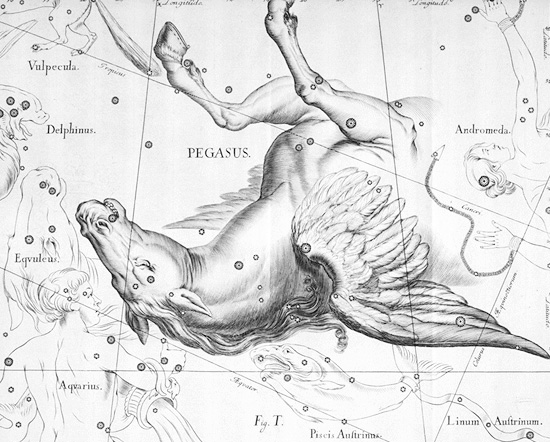
Then Bellerophon was given several more tasks, in which he also triumphed. King Iobates discovered the truth, that Proteus's wife had been lying, and rewarded Bellerophon with another of his daughters in marriage. He also made him heir to his throne. All of this went to Bellerophon's head and he attempted to fly Pegasus to Olympus, as if he were an immortal god. His presumption angered Zeus who sent a horsefly to bite Pegasus. Pegasus reared and Bellerophon fell to Earth, landing in a thorn bush. He spent the rest of his life wandering lame, blind, and shunned. Pegasus was accepted at Olympus where he carried Zeus's thunderbolts.
Introduction to Constellations | Constellation Sources | Constellations Index
Objects observed by Chandra in Pegasus: