

CXC Home | Search | Help | Image Use Policy | Latest Images | Privacy | Accessibility | Glossary | Q&A
March 20, 2000
CXC PR: 00-09
A team of astronomers from England and France have reported strong evidence for the existence of a rare type of black hole, called a Type 2 quasar. Using NASA's Chandra X-ray Observatory, they have discovered a powerful source of X rays that appears to be a giant black hole that is hidden from optical telescopes by a veil of obscuring material.
The latest discovery comes from a team led by British astronomers Andrew Fabian of the Institute of Astronomy in Cambridge and Ian Smail of the University of Durham. They used Chandra, NASA's Hubble Space Telescope, and the James Clerk Maxwell submillimeter telescope on Mauna Kea in Hawaii. By concentrating their search near two galaxy clusters, the astronomers exploited a gravitational lensing effect that can lead to a significant brightening of distant sources.
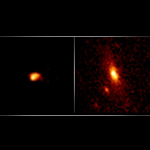
Four new X-ray sources and seven submillimeter sources were discovered. The brightest X-ray source is concentrated in the center of a distant galaxy. The point-like source has a deficit of low energy X rays, consistent with absorption by a thick cloud of gas. The combination of powerful X-ray emission, absorption of low energy X rays, and the relatively normal optical appearance of the galaxy led the scientists to conclude that the source is a strong contender to be a genuine Type 2 quasar.
Type 2 quasars have been predicted to exist by a popular model for quasars. Their discovery would confirm the so-called unified model for quasars, and help clarify the nature of the pervasive background glow at X-ray and submillimeter energies. Evidence for Type 2 quasars has been reported by other researchers, but the data were ambiguous. Now, the cloud of uncertainty is lifting, as scientists use Chandra to intensify the search.
According to the unified model of quasars, a thick doughnut of gas and dust surrounds a central black hole. The source looks different, depending on whether it is observed through the doughnut, through the hole, or at an intermediate angle. In extreme cases representing a Type 2 quasar, the optical radiation from the quasar is absorbed while the high-energy X rays penetrate the veil. The energy absorbed by the gas and dust is re-radiated at lower energy infrared and submillimeter wavelengths.
Six of the submillimeter sources that were discovered were not detected in X rays. This could mean that a central black hole is shrouded by an unusually thick cloud of dust and gas, or an additional source of submillimeter radiation is present, perhaps due to a burst of star formation.
A paper describing these results will be published in the Monthly Notices of the Royal Astronomical Society. The Chandra observations were made on November 5, 1999 using the Advanced CCD Imaging Spectrometer (ACIS). The team involved scientists from the Instititute of Astronomy, the University of Durham, University College London, and the Observatoire Midi-Pyrenees in France.
The ACIS instrument was built for NASA by the Massachusetts Institute of Technology, Cambridge, and Pennsylvania State University, University Park. NASA's Marshall Space Flight Center in Huntsville, Ala., manages the Chandra program. TRW, Inc., Redondo Beach, Calif., is the prime contractor for the spacecraft. The Smithsonian's Chandra X-ray Center controls science and flight operations from Cambridge, Mass.
For images connected to this release, and to follow Chandra's progress, visit the Chandra site at
: MEDIA CONTACTS
Steve Roy
Marshall Space Flight Center, Huntsville, AL
Phone: 256-544-6535
http://www.nasa.gov/centers/marshall/news
Dr. Wallace Tucker
Chandra X-ray Observatory Center
Harvard-Smithsonian Center for Astrophysics, Cambridge, MA
Phone: 617-496-7998


Revised: December 16, 2014