

CXC Home | Search | Help | Image Use Policy | Latest Images | Privacy | Accessibility | Glossary | Q&A
Cosmic Look-Back Time
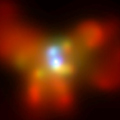 NGC 6240 |
The finite speed of light means that we must always be out of date, no matter how hard we strive to keep up with the times. Thus, the seemingly simple question — what is happening right now on the Sun? — cannot be answered by an observer on Earth, because it takes light 8 minutes to reach Earth from the Sun.
For distant galaxies, the light travel times are even longer, so our information about the galaxy NGC 6240, which is 400 million light years away, is 400 million years out of date! One consolation is that if astronomers on NGC 6240 are observing our Milky Way galaxy, they are likewise 400 million years behind the times — our times, that is. As Albert Einstein said, "The past, present and future are only illusions, even if stubborn ones."
 Albert Einstein (Credit: Caltech) |
The time in the past at which the light we now receive from a distant object was emitted is called the look-back time. When astronomers discuss events in distant objects, they take for granted that the actual event occurred earlier because of light travel time. It is similar to finding a series of photographs of a child in a 300 year-old time capsule. We could see how the child was developing 300 years ago, even though he/she would no longer be alive.
In the case of NGC 6240, the predicted merger of supermassive black holes has likely already occurred, perhaps 250 million years ago in NGC 6240 time. But we won't know about it for another 150 million years! See the following sample time line.
NGC 6240 sample time
relative to Earth time:
450 million years earlier - Galaxies merged
400 million years earlier - Supermassive black holes are 3000
light years apart (Chandra Observation)
250 million years earlier - Black holes merged
Earth
time:
50 million years ago: Galaxies merge
Now: Observe Supermassive black holes 3000 light years
apart
150 million years from now: Black holes merge

