
NASA's Chandra Releases Deep Cut From Catalog of Cosmic Recordings

Sagittarius A*
More images, videos, and information
Credit: NASA/CXC/SAO;
Image Processing: NASA/CXC/SAO/N. Wolk
Like a recording artist who has had a long career, NASA’s Chandra X-ray Observatory has a “back catalog” of cosmic recordings that is impossible to replicate. To access these X-ray tracks, or observations, the ultimate compendium has been developed: the Chandra Source Catalog (CSC).
The CSC contains the X-ray data detected up to the end of 2020 by Chandra, the world’s premier X-ray telescope and one of NASA’s “Great Observatories.” The latest version of the CSC, known as CSC 2.1, contains over 400,000 unique compact and extended sources and over 1.3 million individual detections in X-ray light.
Within the CSC, there is a wealth of information gleaned from the Chandra observations — from precise positions on the sky to information about the the X-ray energies detected. This allows scientists using other telescopes — both on the ground and in space including NASA’s James Webb and Hubble Space Telescopes — to combine this unique X-ray data with information from other types of light.
The richness of the Chandra Source Catalog is illustrated in a new image of the Galactic Center, the region around the supermassive black hole at the center of the Milky Way galaxy called Sagittarius A*. In this image that spans just about 60 light-years across, a veritable pinprick on the entire sky, Chandra has detected over 3,300 individual sources that emit X-rays. This image is the sum of 86 observations added together, representing over three million seconds of Chandra observing time.
A Scientist’s Journey: Subrahmanyan Chandrasekhar

Nicole Kuchta, Communications, Education and Engagement intern at NSF NOIRLab. Photo Credit: NOIRLab
Our guest blogger today is Nicole Kuchta. Nicole Kuchta is a Communications, Education and Engagement intern at NSF NOIRLab. She specializes in astronomy writing and content creation, having also worked with the Harvard-Smithsonian Center for Astrophysics and NASA’s Universe of Learning.
Every day our Sun rises in the east and sets in the west, but one day in the (very) distant future things will change. The stars in our universe, including our Sun, live for a finite period, and eventually die.
Right now, in the Sun’s core, hydrogen fuses together to form helium, letting out heat and light. In about 5 billion years, however, the Sun will run out of hydrogen. It will expand to a phase that astronomers call a red giant: a cooler and larger star combining atoms to form heavier and heavier elements. At this stage, the Sun will expand to swallow Mercury, Venus, and then, likely, our Earth.
When the Sun completely runs out of fuel, its glowing outer layers of gas will waft away into a vivid, airy, hot cloud called a planetary nebula. In the core of this ghostly structure will sit the remainder of the once-living Sun: a white dwarf. The Sun at this point will become a ball of carbon under intense pressure and heat, like a ghostly diamond in the sky. It’ll be half the Sun’s original mass packed into a sphere about the size of Earth.
All this might sound like the plot of a sci-fi movie, but it’s anything but fiction. How do we know the future of our Sun? Scientists have studied stars for decades, developing and testing ideas as new data becomes available. This field of study is what astrophysicists call stellar evolution, or the journey of stars’ lives.
The story of Subrahmanyan Chandrasekhar — a theoretical astrophysicist who revolutionized what we know about stellar evolution and namesake of the Chandra X-ray Observatory — helps explain how we arrived at our current understanding.
Supernova Remnant Video From NASA's Chandra Is Decades in Making
Kepler’s Supernova Remnant
More images, videos, and information
X-ray: NASA/CXC/SAO; Optical: Pan-STARRS
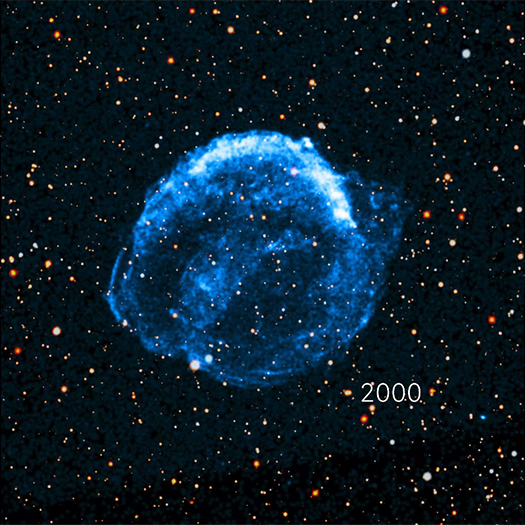
A new video shows changes in Kepler’s Supernova Remnant using data from NASA’s Chandra X-ray Observatory captured over more than two and a half decades with observations taken in 2000, 2004, 2006, 2014, and 2025. In this video, which is the longest-spanning one ever released by Chandra, X-rays (blue) from the telescope have been combined with an optical image (red, green, and blue) from Pan-STARRS.
Kepler’s Supernova Remnant, named after the German astronomer Johannes Kepler, was first spotted in the night sky in 1604. Today, astronomers know that a white dwarf star exploded when it exceeded a critical mass, after pulling material from a companion star, or merging with another white dwarf. This kind of supernova is known as a Type Ia and scientists use it to measure the expansion of the Universe.
NASA's Chandra Rings in New Year With Champagne Cluster

Champagne Cluster
More images, videos, and information
Credit: X-ray: NASA/CXC/UCDavis/F. Bouhrik et al.; Optical:Legacy Survey/DECaLS/BASS/MzLS;
Image Processing: NASA/CXC/SAO/P. Edmonds and L. Frattare
Celebrate the New Year with the “Champagne Cluster,” a galaxy cluster seen in this new image from NASA’s Chandra X-ray Observatory and optical telescopes.
Astronomers discovered this galaxy cluster Dec. 31, 2020. The date, combined with the bubble-like appearance of the galaxies and the superheated gas seen with Chandra observations (represented in purple), inspired the scientists to nickname the galaxy cluster the Champagne Cluster, a much easier-to-remember name than its official designation of RM J130558.9+263048.4.
Cosmic Holiday Greetings From NASA's Chandra X-ray Observatory
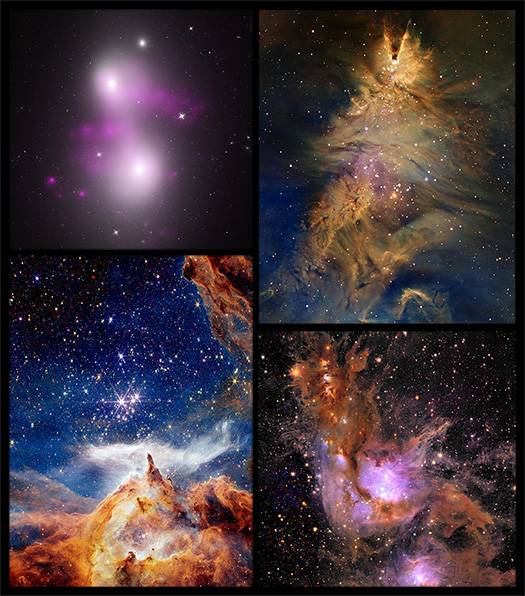
NASA’s Chandra X-ray Observatory is sending out a holiday card with four new images of cosmic wonders. Each of the quartet of objects evokes the winter season or one of its celebratory days either in its name or shape.
Chandra’s seasonal greetings begin with NGC 4782 and NGC 4783, a pair of colliding galaxies when oriented in a certain way resembles a snowman. The top and bottom of the snowman are each elliptical galaxies, separated by a distance of about 30,000 light-years. The galaxies, seen in an image from NASA’s Hubble Space Telescope (gray), are bound together through gravity. X-rays from Chandra (purple) show a bridge of hot gas between the two galaxies, like a winter scarf.
New Project Celebrates Views of the Very Big and Very Small

A new project from the Chandra X-ray Observatory reveals stunning connections between the vast universe and the microscopic world that we cannot see with the naked eye.
Chandra is one of NASA’s “Great Observatories”, which include the Hubble and James Webb Space Telescopes, that has offered unparalleled X-ray images of the cosmos for over a quarter century. Scientists regularly use Chandra, which is operated by the Smithsonian Astrophysical Observatory, in concert with other telescopes on the ground and in space.
Chandra’s “New Perspectives” project takes these space-based images and creates side-by-side comparisons with winning images from the Nikon Small World contest. The results from the latest Nikon Small World contest, an annual free microscopy competition, were announced in October 2025.
The goal of New Perspectives is to provide a new way to look at images from science — and realize the benefits from looking at our world from different points of view.
NASA's Chandra Finds Small Galaxies May Buck the Black Hole Trend

NGC 6278 and PGC 039620
More images, videos, and information
Credit: X-ray: NASA/CXC/SAO/F. Zou et al.; Optical: SDSS; Image Processing: NASA/CXC/SAO/N. Wolk
This two-panel graphic represents the results of a new study that suggests that smaller galaxies do not contain supermassive black holes nearly as often as larger galaxies do. The new study, as described in our latest press release, analyzed over 1,600 galaxies that have been observed with NASA’s Chandra X-ray Observatory over two decades. The findings imply that most smaller galaxies likely do not have supermassive black holes in their centers, which is in contrast with the common idea that nearly every galaxy has one of these giant black holes within their cores.
The two galaxies shown here, NGC 6278 and PGC 039620, are representative of the galaxies in the study. In optical and X-ray images (X-rays are purple), both galaxies are seen in optical light data from the Sloan Digital Sky Survey. The insets contain just the X-ray data from Chandra. NGC 6278 is roughly the same size as our home galaxy and has X-rays detected from its core. PGC 03620 on the other hand is a smaller galaxy — only a fraction of the size of the Milky Way — and does not show any evidence of an X-ray source.
Painting Galaxy Clusters by Numbers (and Physics)
Five Galaxy Clusters in the Sample
More images, videos, and information
Credit: X-ray: NASA/CXC/Univ. of Chicago/H. McCall
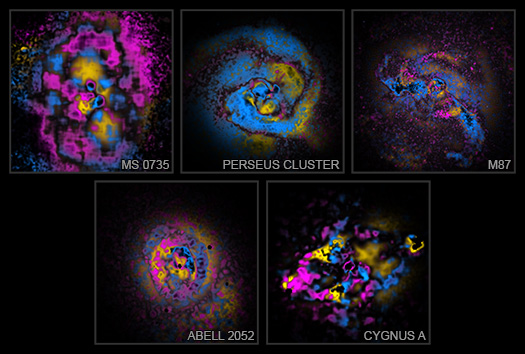
Galaxy clusters are the most massive objects in the Universe held together by gravity, containing up to several thousand individual galaxies and huge reservoirs of superheated, X-ray-emitting gas. The mass of this hot gas is typically about five times higher than the total mass of all the galaxies in galaxy clusters. In addition to these visible components, 80% of the mass of galaxy clusters is supplied by dark matter. These cosmic giants are bellwethers not only for the galaxies, stars and black holes within them, but also for the evolution and growth of the Universe itself.
It is no surprise then that NASA’s Chandra X-ray Observatory has observed many galaxy clusters over the lifetime of the mission. Chandra’s X-ray vision allows it to see the enormous stockpiles of hot cluster gas, with temperatures as high as 100 million degrees, with exquisite clarity. This blazing gas tells stories about past and present activity within galaxy clusters.
From Space to the Stage: New Symphony Inspired by NASA's Chandra
A new symphony based on data from NASA’s Chandra X-ray Observatory, as well as the James Webb Space Telescope, transforms astronomical observations into music that traces the life cycle of stars.
While there have been many original pieces of music inspired by the heavens, this musical composition is uniquely mapped from data of space. By using data sonifications from Chandra, compiled with Webb data, of both the Crab Nebula and Pillars of Creation (M16), this new composition provides an unprecedented connection to space through music via actual data.
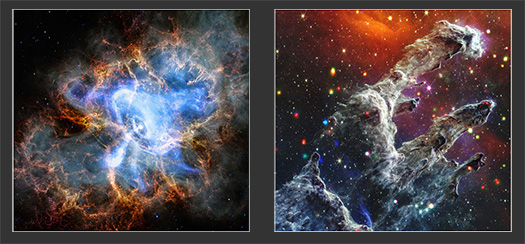
The Crab Nebula (left) from NASA’s Chandra and Webb telescopes is the data behind the piece “Return to Dust” and the Pillars of Creation (M16, right) from Chandra and Webb is the data behind the piece “Cathedrals of Dust & Light”
The Chandra X-ray Observatory is one of NASA’s “Great Observatories” and has been the world’s premier X-ray telescope for over a quarter century. It also leads in the innovative use of data sonification—the process of converting scientific data into sound.
This new two-part suite by composer Sophie Kastner builds on and pairs with her previous work, “Where Parallel Lines Converge,” which was based on the Chandra data sonification of the Galactic Center. In both the original composition and this latest 2-piece suite, Kastner has created musical vignettes that human musicians can play based on the NASA data and how it is represented in the sonification.
Fall Collection: Before Fall Leaves, See Seasonal Offerings from NASA's Chandra
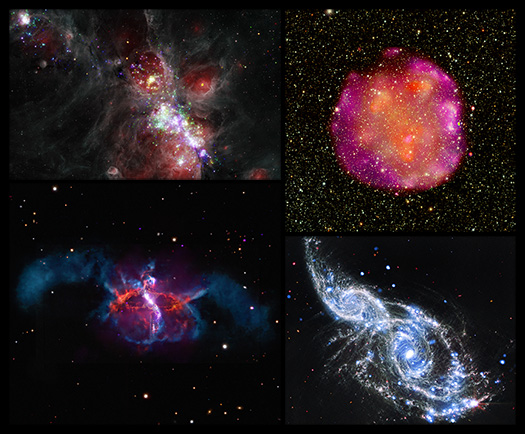
Before fall gives way to winter in the northern hemisphere, NASA’s Chandra X-ray Observatory has several images that celebrate autumn and its many delights to share. In spirit of the season, this collection gathers Chandra data with those from its telescopic family including NASA’s James Webb, Hubble, and Spitzer Space Telescopes, plus others in space and on the ground.