

CXC Home | Search | Help | Image Use Policy | Latest Images | Privacy | Accessibility | Glossary | Q&A
Related Images
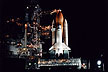
Preparing for Launch

STS-93 Launch!

Chandra Deployment

Chandra Deployment

Deployment of Chandra
STS-93 - Chandra Deployment Mission
View an abbreviated launch timeline & accompanying diagram.

View an abbreviated launch timeline & accompanying diagram.
On July 23, 1999 at 12:31 a.m. EDT, the solid rocket motors in the Solid Rocket Boosters on NASA Shuttle Transportation System 93 (STS-93) ignited. Under the command of Col. Eileen Collins, the shuttle lifted off the launch pad at John F. Kennedy Space Center in Cape Canaveral, Florida. Its mission: to carry NASA's Chandra X-ray Observatory into space.
Two minutes later, the burn from the Solid Rocket Boosters was completed and the boosters separated from the shuttle. Parachutes blossomed and carried the boosters gently into the Atlantic Ocean where they were recovered.
Eight minutes after launch the main engine cut off and the disposable external fuel tank separated. Forty-five minutes after launch the shuttle orbiter Columbia achieved a circular orbit 320 kilometers (200 miles) above Earth.
At two hours into the mission, the payload doors opened and the astronauts prepared to deploy the Chandra X-ray Observatory. For six hours, while Columbia silently orbited Earth, all the systems on the Chandra spacecraft were checked out and the satellite reached equilibrium with the conditions in space.
Eight hours and 42 minutes after launch, a small spring gently catapulted the giant satellite into space. Columbia pulled away a safe distance, and at 9 hours and 41 minutes into the mission, the first of two solid rocket motors attached to Chandra's spacecraft module ignited. The rocket burned for two minutes before shutting off and separating from the spacecraft. Three minutes later the second rocket fired. These firings lifted the Chandra X-ray Observatory into a highly elliptical orbit that took the satellite 64,000 kilometers away from Earth before returning to a closest approach of 320 kilometers. The solar panels deployed and the second solid rocket motor separated.
Over the course of the next nine days a second propulsion system fired five times to take the observatory to its final orbit. In this orbit, the distance of Chandra from Earth ranged from 16,000 km (9,942 miles) to 133,000 km (about 82,646 miles), more than a third of the way to the moon. The time to complete an orbit is 64 hours and 18 minutes. This allows for observation times as long as 52 hours, much longer than can be achieved with the low-Earth orbit of a few hundred kilometers used by most satellites.
While the secondary propulsion system maneuvered Chandra into its final orbit, instructions were sent to the spacecraft to power up the scientific instruments and allow them to adjust to the low temperatures and vacuum of space. This process took about two and a half weeks. The Sunshade door opened toward the end of the third week after launch and Chandra's mirrors focused X-rays from a cosmic source onto the CCD detector.
The first few days of observing were used to get the detectors in focus, and to check out the performance of the mirrors and instruments. All the instruments were moved in and out of the focus during this checkout, or calibration phase. This procedure took an additional few weeks before completion, but the Chandra science team was rewarded with beautiful images about one month after launch. Visit our Photo Album for the first images observed!!!


Revised: March 14, 2016