

CXC Home | Search | Help | Image Use Policy | Latest Images | Privacy | Accessibility | Glossary | Q&A
Page 1
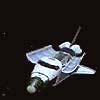
1. Shuttle Columbia
MP4 (1.19 MB)
Forty-five minutes after launch the shuttle orbiter Columbia has achieved a circular orbit 320 kilometers (200 miles) above Earth. This animation shows Space Shuttle Columbia fly by with the Chandra spacecraft in its cargo bay.
[Runtime: 0:04]
(Animation: NGST)
MP4 (1.19 MB)
Forty-five minutes after launch the shuttle orbiter Columbia has achieved a circular orbit 320 kilometers (200 miles) above Earth. This animation shows Space Shuttle Columbia fly by with the Chandra spacecraft in its cargo bay.
[Runtime: 0:04]
(Animation: NGST)
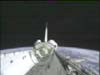
2. Deployment
MP4 (9.29 MB)
At two hours into the mission, the payload doors open and the astronauts prepare to deploy the Chandra X-ray Observatory. For six hours, while Columbia silently orbits Earth, all the systems on the Chandra spacecraft are checked out and the satellite reaches equilibrium with the conditions in space. Eight hours and 42 minutes after launch, a small spring gently catapults the giant satellite into space. Shuttle Columbia pulls away a safe distance.
[Runtime: 0:08]
(Animation: NGST)
MP4 (9.29 MB)
At two hours into the mission, the payload doors open and the astronauts prepare to deploy the Chandra X-ray Observatory. For six hours, while Columbia silently orbits Earth, all the systems on the Chandra spacecraft are checked out and the satellite reaches equilibrium with the conditions in space. Eight hours and 42 minutes after launch, a small spring gently catapults the giant satellite into space. Shuttle Columbia pulls away a safe distance.
[Runtime: 0:08]
(Animation: NGST)
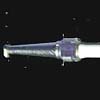
3. IUS Burn
MP4 (2.28 MB)
At 9 hours and 41 minutes into the mission, the first of two solid rocket motors attached to Chandra's spacecraft module ignite. The rocket burns for two minutes before shutting off and separating from the spacecraft. Three minutes later the second rocket fires. These firings lift the Chandra X-ray Observatory into a highly elliptical orbit.
[Runtime: 0:07]
(Animation: NGST)
MP4 (2.28 MB)
At 9 hours and 41 minutes into the mission, the first of two solid rocket motors attached to Chandra's spacecraft module ignite. The rocket burns for two minutes before shutting off and separating from the spacecraft. Three minutes later the second rocket fires. These firings lift the Chandra X-ray Observatory into a highly elliptical orbit.
[Runtime: 0:07]
(Animation: NGST)
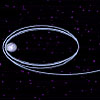
4. Chandra Orbit Path
MP4 (5.20 MB)
This animation shows the highly elliptical orbit of the Chandra spacecraft that takes the satellite more than a third of the way to the moon (140,000 kilometers or about 87,500 miles) before returning to a closest approach of 10,000 kilometers (about 6,200 miles). The time to complete an orbit will be 64 hours and 18 minutes. This allows for observation times as long as 52 hours, much longer than can be achieved with the low-Earth orbit of a few hundred kilometers used by most satellites.
[Runtime: 0:23]
(Animation: NGST)
MP4 (5.20 MB)
This animation shows the highly elliptical orbit of the Chandra spacecraft that takes the satellite more than a third of the way to the moon (140,000 kilometers or about 87,500 miles) before returning to a closest approach of 10,000 kilometers (about 6,200 miles). The time to complete an orbit will be 64 hours and 18 minutes. This allows for observation times as long as 52 hours, much longer than can be achieved with the low-Earth orbit of a few hundred kilometers used by most satellites.
[Runtime: 0:23]
(Animation: NGST)
5. Solar Arrays Unfold
MP4 (2.95 MB)
This animation depicts the Chandra solar array and contamination cover deployments. The solar panels consist of two, 3-panel, silicon solar arrays (2,350 watts) that charge three nickel-hydrogen backup batteries. They were made by Fokker Space in the Netherlands.
[Runtime: 0:09]
(Animation: NGST)
MP4 (2.95 MB)
This animation depicts the Chandra solar array and contamination cover deployments. The solar panels consist of two, 3-panel, silicon solar arrays (2,350 watts) that charge three nickel-hydrogen backup batteries. They were made by Fokker Space in the Netherlands.
[Runtime: 0:09]
(Animation: NGST)
6. Photon Path
MP4 (8.31 MB)
X-ray photons entering the telescope are reflected at grazing angles and focused onto an electronic detector to make an image of a cosmic source.
[Runtime: 0:23]
(Animation: NGST)
MP4 (8.31 MB)
X-ray photons entering the telescope are reflected at grazing angles and focused onto an electronic detector to make an image of a cosmic source.
[Runtime: 0:23]
(Animation: NGST)
7. Chandra in Space
MP4 (5.20 MB)
This animation shows a 360 degree shot of Chandra in space.
[Runtime: 0:11]
(Animation: NGST)
MP4 (5.20 MB)
This animation shows a 360 degree shot of Chandra in space.
[Runtime: 0:11]
(Animation: NGST)
Page 1


Revised: March 31, 2025