

CXC Home | Search | Help | Image Use Policy | Latest Images | Privacy | Accessibility | Glossary | Q&A
The Man Behind The Name
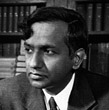 Chandra in his early years
(Photo: AIP)
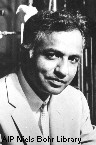 Chandra in his middle years
(Photo: AIP)
NASA's premier X-ray observatory was named the Chandra X-ray Observatory in honor of the late Indian-American Nobel laureate, Subrahmanyan Chandrasekhar (pronounced: su/bra/mon'/yon chandra/say/kar). Known to the world as Chandra (which means "moon" or "luminous" in Sanskrit), he was widely regarded as one of the foremost astrophysicists of the twentieth century.
Chandra immigrated in 1937 from India to the United States, where he joined the faculty of the University of Chicago, a position he remained at until his death. He and his wife became American citizens in 1953.
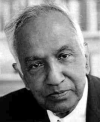 Chandra in his later years
(Photo: Univ. of Chicago)
Trained as a physicist at Presidency College, in Madras, India and at the University of Cambridge, in England, he was one of the first scientists to combine the disciplines of physics and astronomy. Early in his career he demonstrated that there is an upper limit — now called the Chandrasekhar limit — to the mass of a white dwarf star. A white dwarf is the last stage in the evolution of a star such as the Sun. When the nuclear energy source in the center of a star such as the Sun is exhausted, it collapses to form a white dwarf. This discovery is basic to much of modern astrophysics, since it shows that stars much more massive than the Sun must either explode or form black holes.
Chandra was a popular teacher who guided over fifty students to their Ph.D.s. His research explored nearly all branches of theoretical astrophysics and he published ten books, each covering a different topic, including one on the relationship between art and science. For 19 years, he served as editor of the Astrophysical Journal and turned it into a world-class publication. In 1983, Chandra was awarded the Nobel prize for his theoretical studies of the physical processes important to the structure and evolution of stars.
According to Nobel laureate Hans Bethe, "Chandra was a first-rate astrophysicist and a beautiful and warm human being. I am happy to have known him."
"Chandra probably thought longer and deeper about our universe than anyone since Einstein," said Martin Rees, Great Britain’s Astronomer Royal.
- How the Chandra X-ray Observatory got its name: See the press release.
- Press Release: NASA Names Premier X-ray Observatory & Schedules Launch
Chandra's Career
- October 19, 1910 Born in Lahore to Sita Balakrishnan and Chandrasekhara Subrahmanya Ayyar.
- 1918 Moved to Madras
- 1925-1930 B.Sc. Physics student at Presidency College, Madras
- 1929-1939 Studies of White Dwarf Stars
- 1930-1933 Ph.D. student at Cambridge, under R.H. Fowler
- 1931-1932 Papers on white dwarf stars
- January 11, 1935 Battle with Eddington at the RAS
- September 1936 Married Lalitha Doraiswamy
- January 1937 Moved to Yerkes Observatory, University of Chicago
- 1939 Publishes Introduction to the Study of Stellar Structure
- 1938-1943 Studies of Stellar Dynamics
- 1942 Publishes Principles of Stellar Dynamics
- 1943-1950 Studies of Radiative Transfer
- 1950 Publishes Radiative Transfer
- 1952 Editor of Ap.J. (till 1971)
- 1952-1961 Studies of Hydrodynamic and Hydromagnetic Stability
- 1961 Publishes Hydrodynamic and Hydromagnetic Stability
- 1961-1968 Studies of Figures of Equilibrium
- 1968 Publishes Ellipsoidal Figures of Equilibrium
- 1962-1971 Studies of GR and Relativistic Astrophysics
- 1974-1983 Studies of the Mathematical Theory of Black Holes
- 1983 Publishes The Mathematical Theory of Black Holes
- 1983 Nobel prize for physics
- August 21, 1995 Died in Chicago
More on Subrahmanyan Chandrasekhar
- "CHANDRA, a Biography of S. Chandrasekhar"; by Kameshwar C. Wali; The University of Chicago Press, 1991.
- "S. CHANDRASEKHAR, The Man Behind the Legend"; Editor, Kameshwar C. Wali; Imperial College Press, 1997.
- For more information on Subrahmanyan Chandrasekhar, read Chandra's autobiography.
Some of Chandra's Key Papers on Dense Matter and Relativity
- ‘The highly collapsed configurations of a stellar mass’, Mon. Not. Roy. Astron. Soc., 91, 456-66 (1931).
- The maximum mass of ideal white dwarfs', Astrophys. J., 74, 81 - 2 (1931).
- ‘The density of white dwarfstars’, Phil. Mag., 11, 592 - 96 (1931).
- ‘Some remarks on the state of matter in the interior of stars’, Z. f. Astrophysik, 5, 321-27 (1932).
- ‘The physical state of matter in the interior of stars’, Observatory, 57, 93 - 9 (1934)
- 'Stellar configurations with degenerate cores', Observatory, 57, 373 - 77 (1934).
- 'The highly collapsed configurations of a stellar mass' (second paper), Mon. Not. Roy. Astron. Soc., 95, 207 - 25 (1935).
- 'Stellar configurations with degenerate cores', Mon. Not. Roy. Astron. Soc., 95, 226-60 (1935).
- ‘Stellar configurations with degenerate cores’ (second paper), Mon. Not. Roy. Astron. Soc., 95, 676 - 93 (1935).
- ‘The pressure in the interior of a star’, Mon. Not. Roy. Astron. Soc., 96, 644 - 47 (1936).
- ‘On the maximum possible central radiation pressure in a star of a given mass’, Observatory, 59, 47 - 8 (1936).
- 'Dynamical instability of gaseous masses approaching the Schwarzschild limit in general relativity', Phys. Rev. Lett., 12, 114 - 16 (1964); Erratum, Phys. Rev. Lett., 12, 437 - 38 (1964).
- ‘The dynamical instability of the white-dwarf configurations approaching the limiting mass’ (with Robert F. Tooper), Astrophys. J., 139, 1396 - 98 (1964).
- ‘The dynamical instability of gaseous masses approaching the Schwarzschild limit in general relativity,’ Astrophys. J., 140, 417 - 33 (1964).
- ‘Solutions of two problems in the theory of gravitational radiation’, Phys. Rev. Lett., 24, 611 - 15 (1970); Erratum, Phys. Rev. Lett., 24, 762 (1970).
- ‘The effect of gravitational radiation on the secular stability of the Maclaurin spheroid’, Astrophys. J., 161, 561 - 69 (1970).


Revised: May 15, 2024