
Getting the Scoop on Space for Kids
This week, we're getting our foot in the door of an exciting new project. The European Southern Observatory has teamed up with the Universe Awareness project to produce kid-friendly versions of press releases on astronomy.

Meet an Astronomer: Joseph DePasquale
In this installment of our Meet An Astronomer video blog, we sit down with Joseph DePasquale. Joe is the Chandra science image processor who works hard to create the astronomy images that appear in press releases, on our web site, in print materials, and elsewhere. We think he has a pretty cool job, with a great combination of science and art.
Meet An Astronomer: Julia Lee
Back by popular demand is our video blog series, Meet An Astronomer.
Julia Lee is an associate professor in the astronomy department at Harvard. We caught up with Julia at a moment when she wasn't busy with her regular duties of running a research lab, teaching students, and everything else that a full-time position at a university like Harvard entails. Julia sat down with our "Meet an Astronomer" crew to explain how various choices she made led to her current career.
A Cosmic Exclamation Point

VV 340, also known as Arp 302, provides a textbook example of colliding galaxies seen in the early stages of their interaction. The edge-on galaxy near the top of the image is VV 340 North and the face-on galaxy at the bottom of the image is VV 340 South. Millions of years later these two spirals will merge - much like the Milky Way and Andromeda will likely do billions of years from now. Data from NASA's Chandra X-ray Observatory (purple) are shown here along with optical data from the Hubble Space Telescope (red, green, blue). VV 340 is located about 450 million light years from Earth.
Music Meets Astronomy at the Newport Folk Festival
Ever since we publicized the "deepest note in the Universe" in 2003, I have admired outreach efforts that combine music and astronomy. These efforts have continued this summer and fall with a program by Don Lubowich, from Hofstra University, who has organised astronomy exhibits to be installed at a large number of music festivals and events. My small role in this program involved displaying images from the "From Earth to the Universe (FETTU)" exhibit on the first day of the Newport Folk Festival at the end of July, added to Don's astronomy banners which also included material from FETTU.

A Birthday Card for Chandra
This is a slightly abridged version of a note that was recently sent around to the Chandra team by Harvey Tananbaum (Director of the Chandra X-ray Center) and Roger Brissenden (CXC Manager and Deputy Director of the Harvard-Smithsonian Center for Astrophysics) to congratulate everyone on Chandra’s 12th birthday.
At The Youth Slam
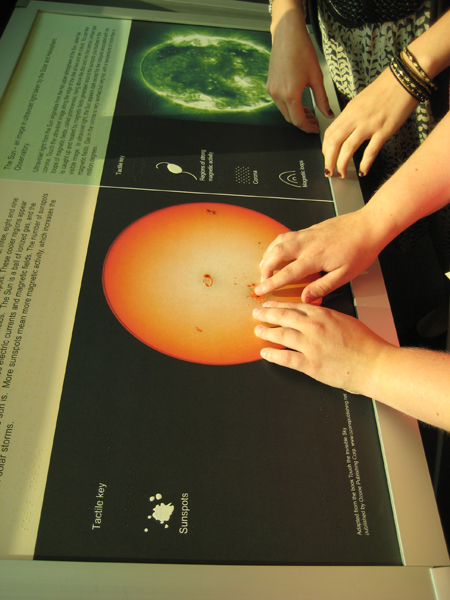
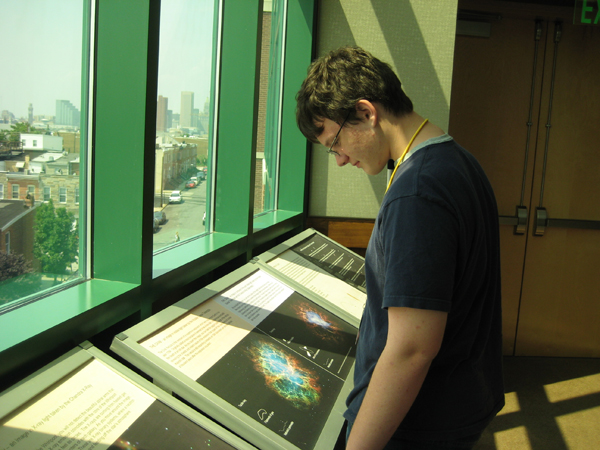
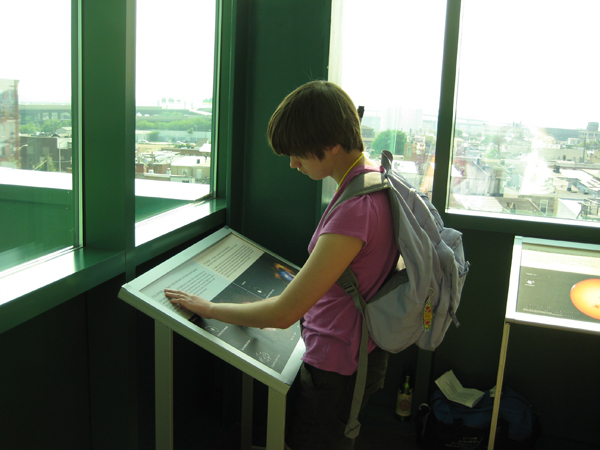
The International Year of Astronomy continues to reach new audiences. Photographs from the "From Earth to the Universe" (FETTU) gallery have been viewed by people all over the world in a variety of venues since 2009. A tactile version of the FETTU exhibit, based on the book Touch the Invisible Sky by Grice, Steel and Daou, was also created in 2009 so people could explore the multi-wavelength universe non-visually, by touch.
On July 20, 2011 the tactile FETTU exhibition continued on to the National Federation of the Blind (NFB) headquarters in Baltimore, Maryland. The images were examined by students attending the National Federation of the Blind Youth Slam - an innovative STEM enrichment program for high school students who are blind or have low vision. Noreen Grice was a course instructor for the Youth Slam Space Track and was on-site at the exhibition. She verbally described the color images as students explored the tactile counterparts by touch. The tactile FETTU exhibition will now be on permanent display at the National Federation of the Blind and will hopefully continue to excite a new generation of science enthusiasts.
-Noreen Grice
(Photos by N.Grice)
Chandra Images Gas Flowing Toward Black Hole
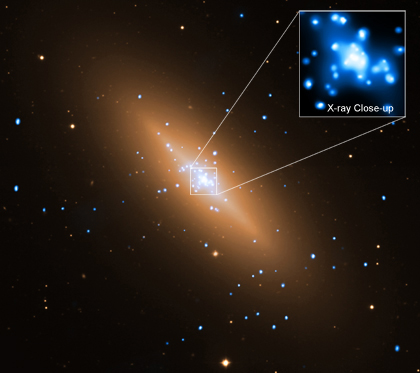
The galaxy NGC 3115 is shown here in a composite image of data from NASA's Chandra X-ray Observatory and the European Southern Observatory's Very Large Telescope (VLT). Using the Chandra image, the flow of hot gas toward the supermassive black hole in the center of this galaxy has been imaged. This is the first time that clear evidence for such a flow has been observed in any black hole.
Women in the High-Energy Universe: Kim Arcand
Kimberly Arcand has been a member of the Chandra Education & Public Outreach group since 1998. As the Media Production Coordinator, Kim's role includes oversight of a range of science outreach products and activities, including imaging and astronomical visualization, multimedia and print product development, exhibition creation and coordination, and development of museum/planetarium and broadcast products.
A Pulsar and its Mysterious Tail

A spinning neutron star is tied to a mysterious tail - or so it seems. Astronomers using NASA's Chandra X-ray Observatory have found that this pulsar, known as PSR J0357+3205 (or PSR J0357 for short), apparently has a long, X-ray bright tail streaming away from it.
This composite image shows Chandra data in blue and Digitized Sky Survey optical data in yellow. The two bright sources lying near the lower left end of the tail are both thought to be unrelated background objects located outside our galaxy.