

Data from NASA's Chandra X-ray Observatory have been used to discover 26 black hole candidates in the Milky Way's galactic neighbor, Andromeda, as described in our latest press release. This is the largest number of possible black holes found in a galaxy outside of our own.
A team of researchers, led by Robin Barnard of the Harvard-Smithsonian Center for Astrophysics, used 152 observations of Chandra spanning over 13 years to find the 26 new black hole candidates. Nine were known from earlier work. These black holes belong to the stellar-mass black hole category, which means they were created when a massive star collapsed and are about 5 to 10 times the mass of the Sun.
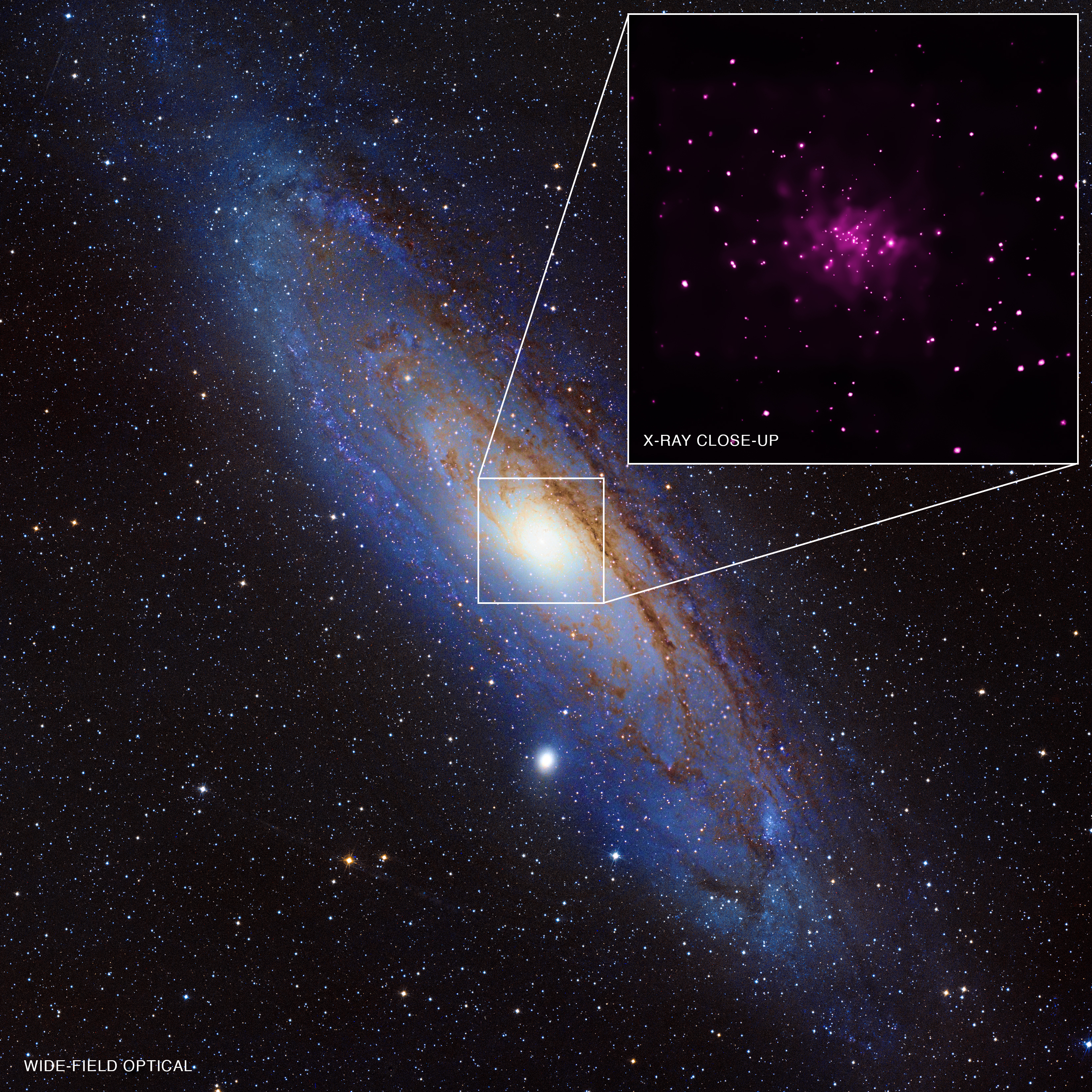
This wide-field view of Andromeda contains optical data from the Burrell Schmidt telescope of the Warner and Swansey Observatory on Kitt Peak in Arizona. Additional detail of the core and dust in the spiral arms comes from an image taken by astrophotographer Vicent Peris using data from two of his personal telescopes. In this combined optical image, red, green, and blue show different bands from the visible light portion of the electromagnetic spectrum.
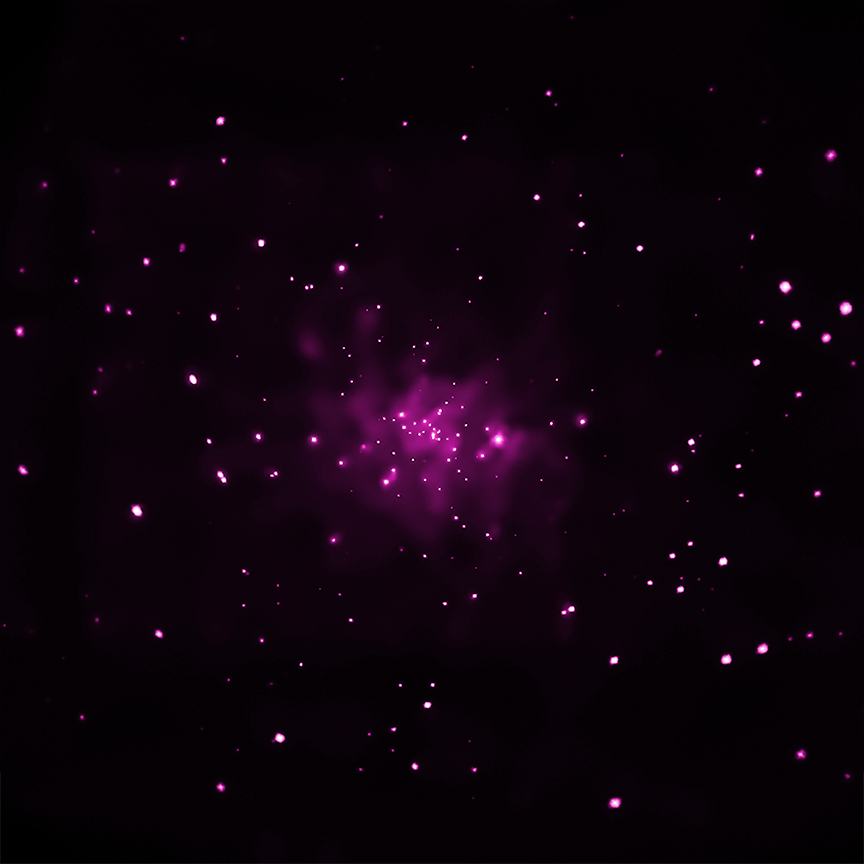
The inset contains X-ray data from multiple Chandra observations of the central region of Andromeda. This Chandra image shows 28 of the 35 black hole candidates in this view, visible by mousing over the image. The other seven candidates can be seen in this Chandra image with a larger field of view.

Seven of the 35 black hole candidates are within only 1,000 light years of the Andromeda Galaxy's center (mouse over the image for the dotted circle enclosing these sources). This is more than the number of black hole candidates with similar properties located near the center of our own Galaxy. This, however, does not take astronomers by surprise, since the bulge of stars in the middle of Andromeda is bigger, allowing more black holes to form.
Eight of the nine black hole candidates that were previously identified are associated with globular clusters, the ancient concentrations of stars distributed in a spherical pattern about the center of the galaxy. This also differentiates Andromeda from the Milky Way as astronomers have yet to find a similar black hole in one of the Milky Way's globular clusters.
Andromeda, also known as Messier 31 (M31), is a spiral galaxy located about 2.5 million light years away. It is thought that the Milky Way and Andromeda will collide several billion years from now. The black holes located in both galaxies will then reside in the large, elliptical galaxy that results from this merger.
These results are available online and will be published in the June 20th issue of The Astrophysical Journal. Many of the Andromeda observations were made within Chandra's Guaranteed Time Observer program.
The image features the Andromeda galaxy, also known as Messier 31 (M31), which is a spiral galaxy approximately 2.5 million light-years away from Earth. In the image, the Andromeda galaxy has a bright blue hue with pale yellow and rust highlights. The structure of the Andromeda galaxy is similar to that of our own Milky Way galaxy, with a central bulge surrounded by a disk of stars, gas, and dust. This wide-field view of Andromeda contains optical data from the Burrell Schmidt telescope. Additional detail of the core and dust in the spiral arms comes from an image taken by astrophotographer Vicent Peris using data from two of his personal telescopes. In this combined optical image, red, green, and blue show different bands from the visible light portion of the electromagnetic spectrum. There is also a pullout box from the center showing an X-ray closeup of the central region. The inset contains X-ray data from multiple Chandra observations of the central region of Andromeda, colored in bright purple. This Chandra image shows 28 of 35 black hole candidates in this view.
|
||||||||||||||||||||||||||||||

| Share This |


|