Images by Date
Images by Category
Solar System
Stars
White Dwarfs
Supernovas
Neutron Stars
Black Holes
Milky Way Galaxy
Normal Galaxies
Quasars
Groups of Galaxies
Cosmology/Deep Field
Miscellaneous
Images by Interest
Chandra for Kids
Multiwavelength
Sky Map
Constellations
3D Wall
Photo Blog
Top Rated Images
Image Handouts
Desktops
High Res Prints
Fits Files
Image Tutorials
Photo Album Tutorial
False Color
Cosmic Distance
Look-Back Time
Scale & Distance
Angular Measurement
Images & Processing
AVM/Metadata
Getting Hard Copies
Image Use Policy
Web Shortcuts
Chandra Blog
RSS Feed
Chandra Mobile
Chronicle
Email Newsletter
News & Noteworthy
Image Use Policy
Questions & Answers
Glossary of Terms
Download Guide
Get Adobe Reader
More Information
Normal Galaxies & Starburst Galaxies
Related Podcasts
NGC 3627 in 60 Seconds


Rate This Image
  • Currently 2.68/5
Rating: 2.7/5
(203 votes cast)
Download Image

More Information

More Images
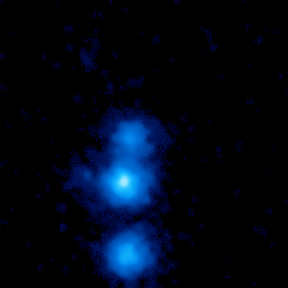
Center of Andromeda taken before January 2006
(Credit: NASA/CXC/SAO/Li et al.)

Animation & Video
Animation
Tour of M31
(Runtime: 00:47)

More Releases
M31
M31
(17 Feb 10)
M31
M31
(05 Jun 06)
M31
M31
(12 Oct 01)
M31
M31
(14 Jan 00)

Top Rated Images
Vela Pulsar Jet

NGC 6543
  • Currently 3.54/5

NGC 7662
  • Currently 2.35/5

M31:
Nearby Black Hole is Feeble and Unpredictable


M31
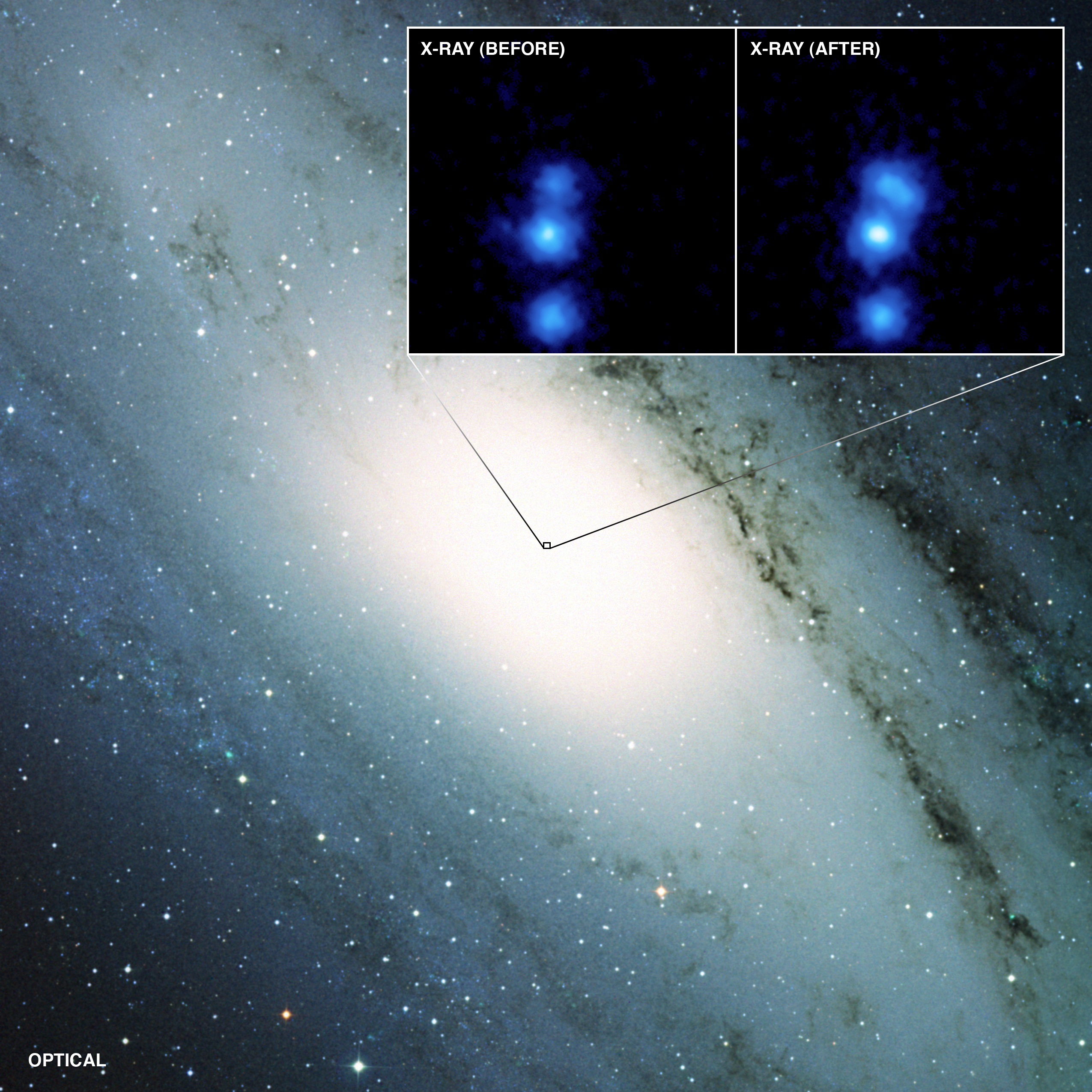
Credit: X-ray (NASA/CXC/SAO/Li et al.), Optical (DSS)

The large image here shows an optical view, with the Digitized Sky Survey, of the Andromeda Galaxy, otherwise known as M31. The inset shows Chandra X-ray Observatory images of a small region in the center of Andromeda. The image on the left shows the sum of 23 images taken with Chandra's High Resolution Camera (HRC) before January 2006 and the image on the right shows the sum of 17 HRC images taken after January 2006. Before 2006, three X-ray sources are clearly visible in the Chandra image, including one faint source close to the center of the image. After 2006, a fourth source, called M31*, appears just below and to the right of the central source, produced by material falling onto the supermassive black hole in M31.

A detailed study of Chandra observations over ten years shows that M31* was in a very dim, or quiet, state from 1999 to the beginning of 2006. However, on January 6, 2006, the black hole became more than a hundred times brighter, suggesting an outburst of X-rays. This was the first time such an event had been seen from a supermassive black hole in the nearby, local universe. After the outburst, M31* entered another relatively dim state, but was almost ten times brighter on average than before 2006. The outburst suggests a relatively high rate of matter falling onto M31* followed by a smaller, but still significant rate.

Just like the supermassive black hole in the center of the Milky Way, M31* is surprisingly quiet. In fact, Andromeda's black hole is ten to one hundred thousand times fainter in X-ray light that astronomers might expect given the reservoir of gas around it. The black holes in both Andromeda and the Milky Way provide special laboratories to study the dimmest type of accretion ever seen onto a supermassive black hole.


Fast Facts for M31:
Credit  X-ray (NASA/CXC/SAO/Li et al.), Optical (DSS)
Scale  Optical image is 1 degree across; inset image is 8 arcsec across
Category  Normal Galaxies & Starburst Galaxies
Coordinates (J2000)  RA 00h 40m 27s | Dec +40° 40' 12
Constellation  Andromeda
Observation Dates  40 pointings between November 1999 and December 2008
Observation Time  164 hours (6 days 20 hours)
Obs. IDs  267-278; 1569-1570; 1912; 2904-2906; 5925-5928; 6177; 6202; 7283-7286; 8526-8530; 9825-9829; 10838; 10683-10684
Color Code  X-ray (Blue); Optical (Red, Green, Blue)
Instrument  HRC
Also Known As Andromeda
Distance Estimate  About 2.9 million light years
Release Date  May 25, 2010

Visitor Comments (6)

Are there IR pictures of this area taken at the same time?

Posted by daniel on Monday, 08.30.10 @ 10:11am


Hi

These are wonderful snaps. I'm actually working on one of my project in my institute "United World" on the role of private-public partnership in research field. I'm going to use these snaps to highlight how much progress we can make if we can both private and public resources work together.

Thank you Regards
Tamana

Posted by Tamana Usman on Monday, 05.31.10 @ 08:27am


I often wonder as to where will this Universe end and whether mankind will ever be able to travel in the Universe with such a vast distances. What is there beyond this Universe and what is the end of after that and finally where does every thing end.

I like Chandra's site the best as I see all those heavenly bodies which I could have never seen it in my life time. Chandra have really revolutionized Astronomy. Many bodies I still do not comprehend properly but at least I watch them and I am very very happy to know about them. We are really thankful to Chandra Ob.

Posted by s s yadav on Friday, 05.28.10 @ 23:32pm


Another great useful observation. It shows just how rapid changes can be.
Many thanks.

Posted by Mark Ballington on Thursday, 05.27.10 @ 04:57am


M31 is a name of the galaxy -name M31- for the 4th additional source would suggest to me it is a separate galaxy. The author suggests the source is due to “material falling onto black hole in M31”. Since material in space is concentrated in “interstellar clouds” it does not seem too surprising if the intensity changes, reflecting movement of the black hole from an area of lower density to a more dense “cloud”.

Posted by Ed on Thursday, 05.27.10 @ 03:33am


This information is so interesting. I am going to start studying so that I will better understand Chandra.

Mary Walsh

Posted by Mary Walsh on Wednesday, 05.26.10 @ 17:54pm


Leave Your Comment

Name:

Email:

Comments:


Rules