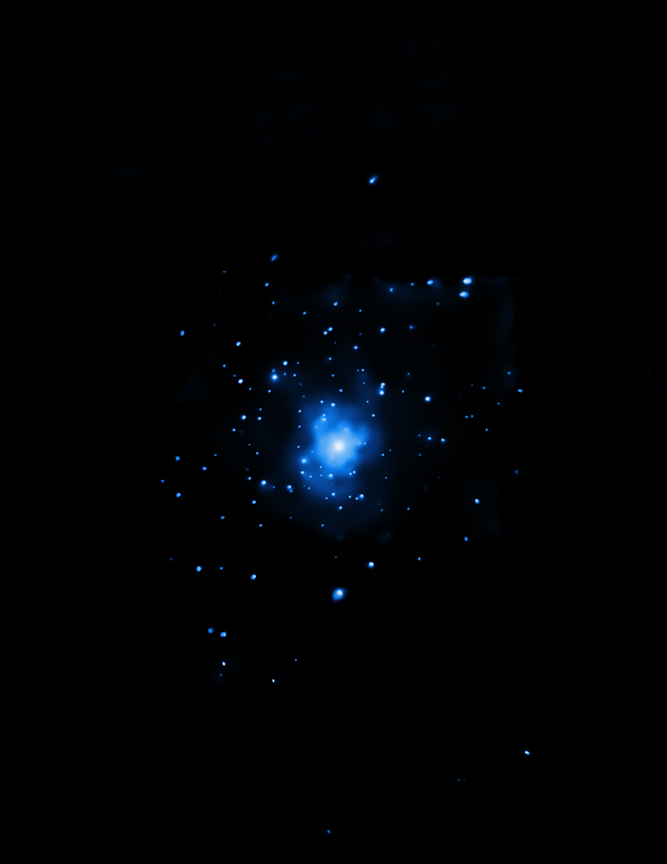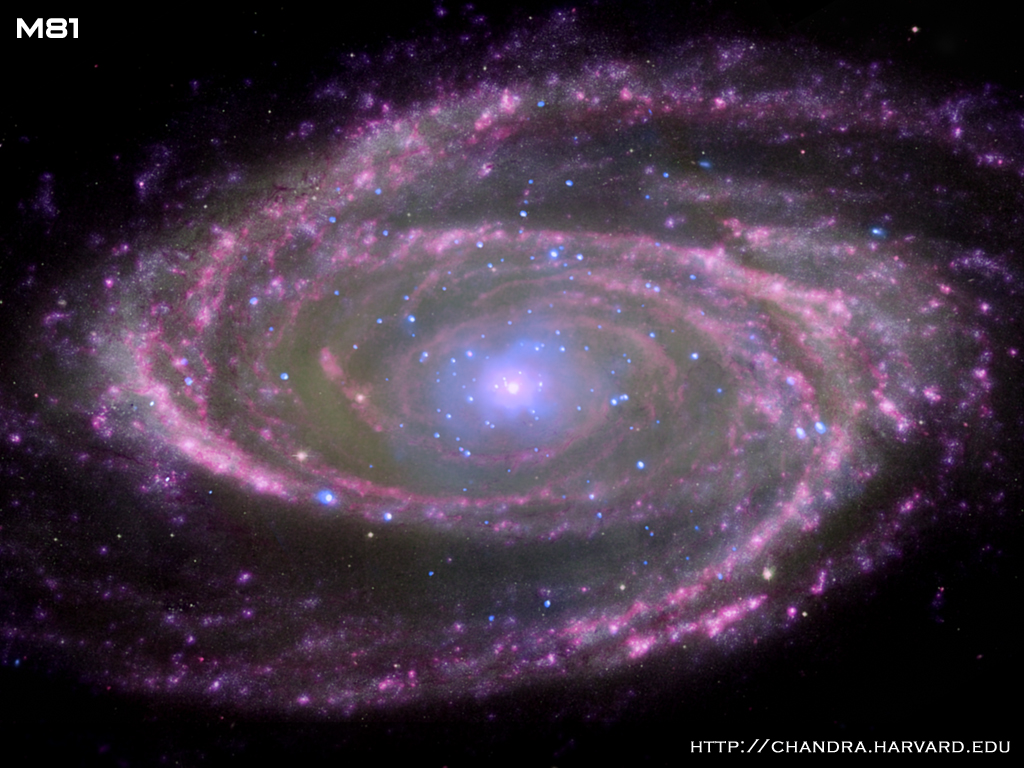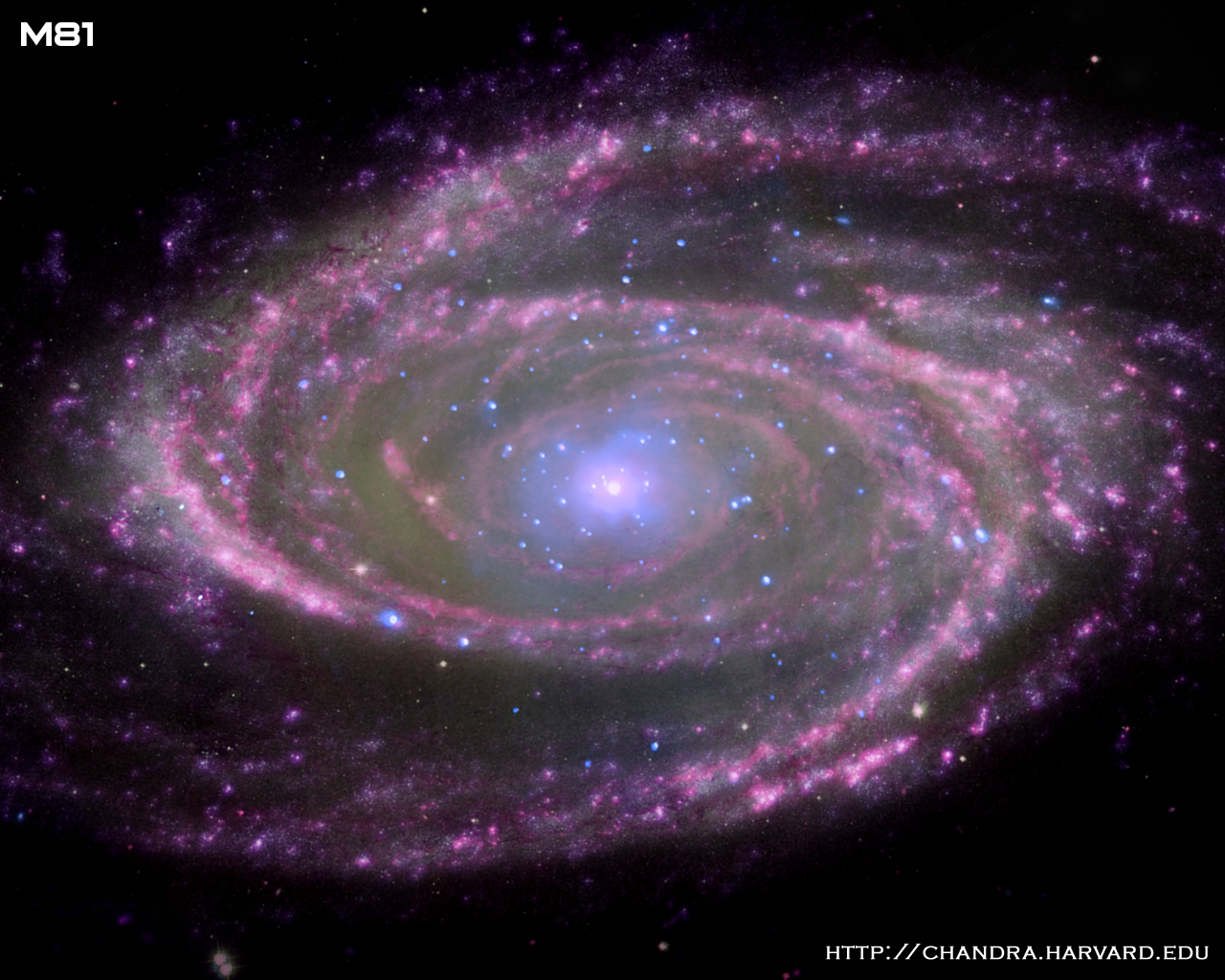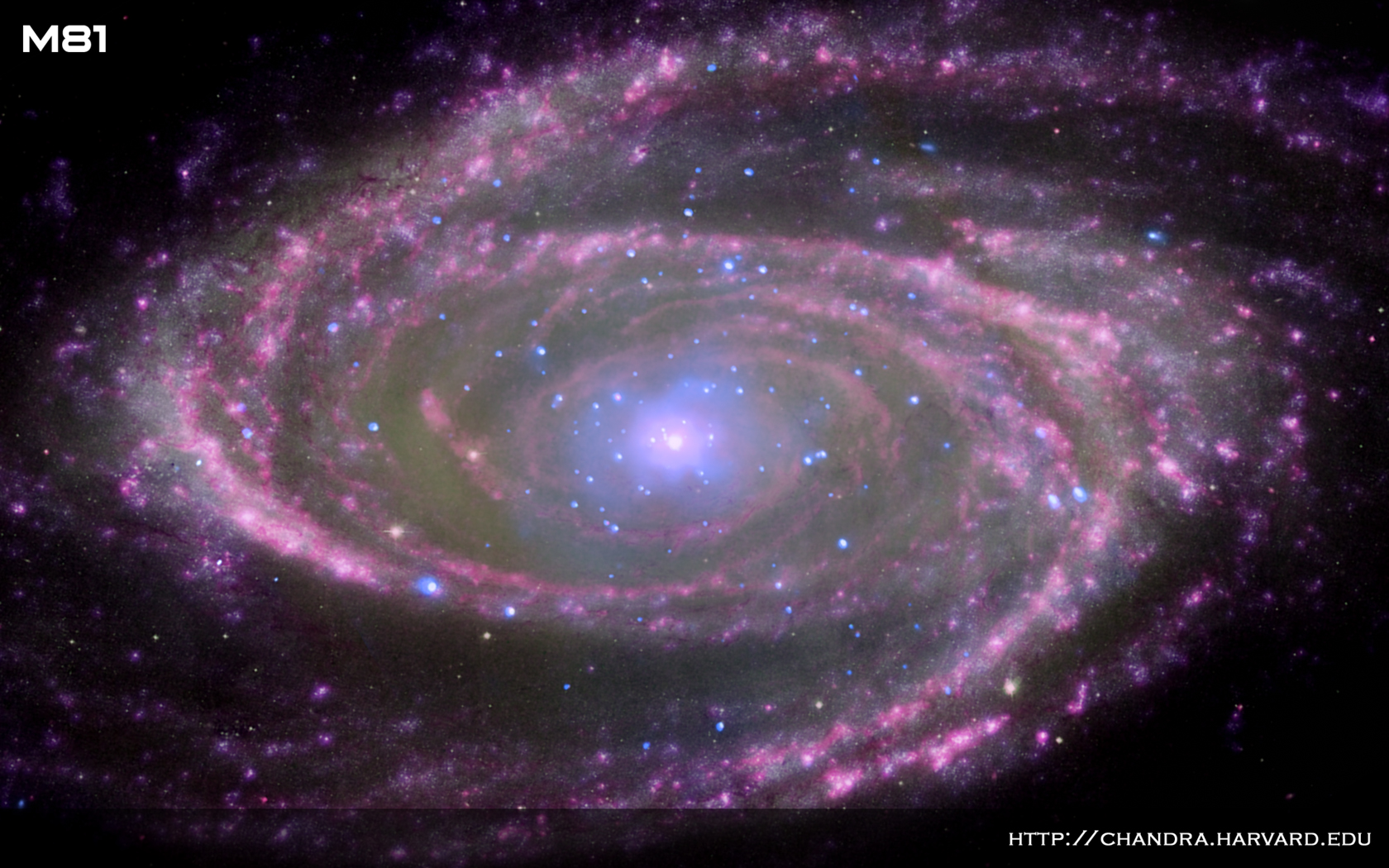

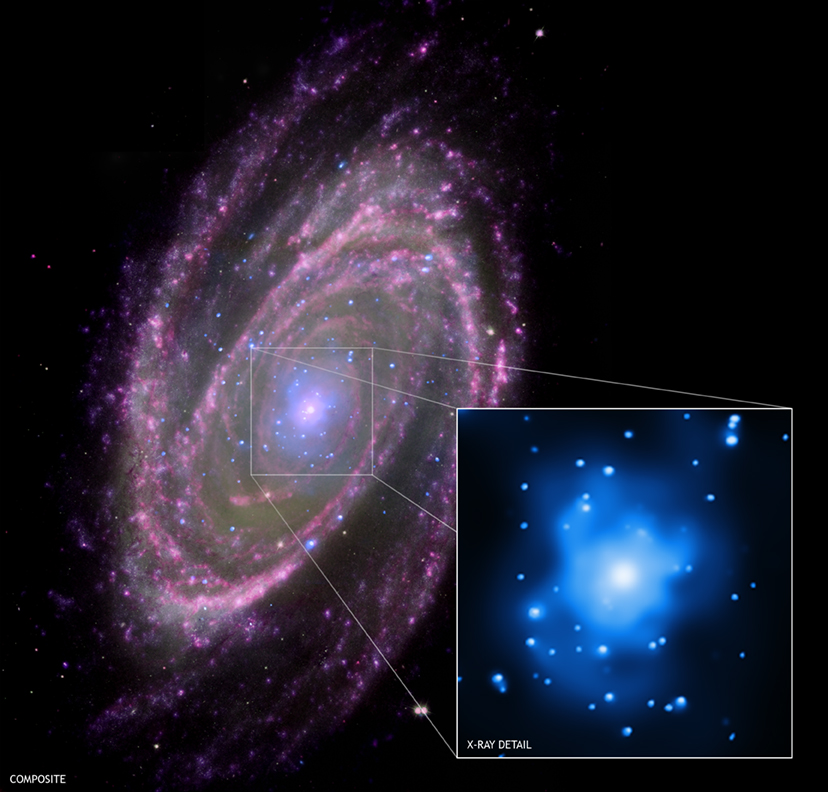
This composite NASA image of the spiral galaxy M81, located about 12 million light years away, includes X-ray data from the Chandra X-ray Observatory (blue), optical data from the Hubble Space Telescope (green), infrared data from the Spitzer Space Telescope (pink) and ultraviolet data from GALEX (purple). The inset shows a close-up of the Chandra image. At the center of M81 is a supermassive black hole that is about 70 million times more massive than the Sun.
A new study using data from Chandra and ground-based telescopes, combined with detailed theoretical models, shows that the supermassive black hole in M81 feeds just like stellar mass black holes, with masses of only about ten times that of the Sun. This discovery supports the implication of Einstein's relativity theory that black holes of all sizes have similar properties, and will be useful for predicting the properties of a conjectured new class of black holes.
In addition to Chandra, three radio arrays (the Giant Meterwave Radio Telescope, the Very Large Array and the Very Long Baseline Array), two millimeter telescopes (the Plateau de Bure Interferometer and the Submillimeter Array), and Lick Observatory in the optical were used to monitor M81. These observations were made simultaneously to ensure that brightness variations because of changes in feeding rates did not confuse the results. Chandra is the only X-ray satellite able to isolate the faint X-rays of the black hole from the emission of the rest of the galaxy.
The supermassive black hole in M81 generates energy and radiation as it pulls gas in the central region of the galaxy inwards at high speed. Therefore, the model that Markoff and her colleagues used to study the black holes includes a faint disk of material spinning around the black hole. This structure would mainly produce X-rays and optical light. A region of hot gas around the black hole would be seen largely in ultraviolet and X-ray light. A large contribution to both the radio and X-ray light comes from jets generated by the black hole. Multiwavelength data is needed to disentangle these overlapping sources of light.
This image is a composite of an X-ray, optical, ultraviolet (UV), and infrared (IR) views of the spiral galaxy M81. The dominant colors in the image are purple-pink, blue, and grey. The shape of the galaxy is that of a well-formed spiral, which is seen face-on. This composite NASA image of M81 includes X-ray data from the Chandra X-ray Observatory shown in blue, and concentrated at the core of the galaxy. An inset to the lower right shows an X-ray only view of the data. It is shaped like a very wide irregular peanut with textured blobs and specs of bright light. The optical data from the Hubble Space Telescope is in grey-green, with infrared data from the Spitzer Space Telescope in pink, and ultraviolet data from GALEX in purple. At the center of M81, the bright core of the image, hides a supermassive black hole that is about 70 million times more massive than the Sun.
|
||||||||||||||||||||||||||||||