





CXC Home | Search | Help | Image Use Policy | Latest Images | Privacy | Accessibility | Glossary | Q&A
Download Image
More Information
More Images
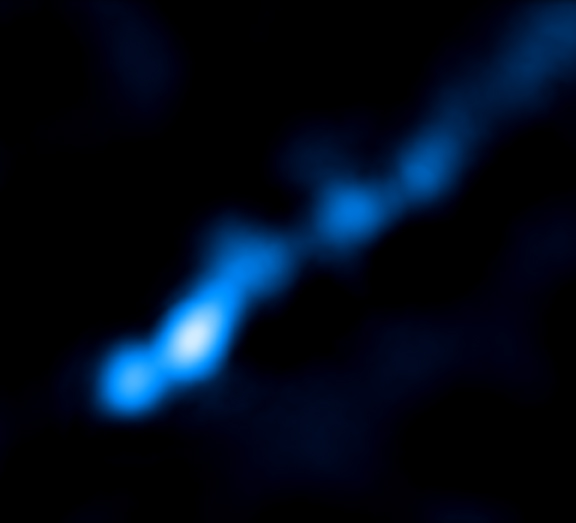
Chandra X-ray Image of
Abell 3627
Abell 3627
(Credit: X-ray: NASA/CXC/MSU/M. Sun et al. )
Animation & Video
More Releases

Related Images


Abell 3627:
Orphan Stars Found in Long Galaxy Tail
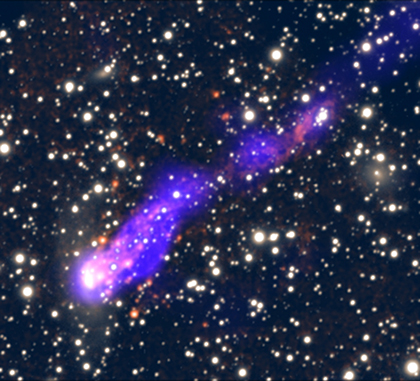
Credit: X-ray: NASA/CXC/MSU/M.Sun et al; H-alpha/Optical: SOAR (MSU/NOAO/UNC/CNPq-Brazil)/M.Sun et al.

Orphan Stars Found in Long Galaxy Tail

Credit: X-ray: NASA/CXC/MSU/M.Sun et al; H-alpha/Optical: SOAR (MSU/NOAO/UNC/CNPq-Brazil)/M.Sun et al.
Visual Description:
This composite image of X-ray and optical light shows a tail that has been created as a galaxy plunges into a cluster, shedding material and forming stars behind it. In this image, X-rays from NASA's Chandra X-ray Observatory (blue) are seen to extend for over 200,000 light years behind the galaxy called ESO 137-001. Emission from hydrogen light (red), known to astronomers as "H-alpha", and the continuum of optical light (white) were gathered from the Southern Astrophysical Research telescope (SOAR) in Chile.
The tail was created as gas was stripped from ESO 137-001 as it descends toward the center of Abell 3627, a giant cluster of galaxies. The tail in X-rays reveals multimillion-degree gas from the cluster and the H-alpha radiation, which stretches for about 130,000 light years, is much cooler gas. Evidence for star formation in this tail includes 29 regions of ionized hydrogen that are glowing in H-alpha, from the light of newly formed stars. These regions are all downstream of the galaxy, located in or near the tail. The researchers believe the stars formed in the tail within the last 10 million years or so. Two Chandra X-ray sources near these regions represent extra evidence for star formation activity.
|
||||||||||||||||||||||||||||
Visual Description:
The image is an X-ray and optical composite of the galaxy cluster Abell 3627 and features one particular galaxy, ESO 137-00. The image is dominated by purple and blue colors. The structure of the image is characterized by a large number of bright sources - stars and galaxies - which can be seen as small white dots scattered throughout the image. In the center of the image, there is a long, tail-shaped object in bright blue with some wispy red, that stands out from the surrounding stars and galaxies. It shows a tail that has been created as a single galaxy plunges into a galaxy cluster, shedding material and forming stars behind it. In this image, X-rays from NASA's Chandra X-ray Observatory are in blue, and are seen to extend for over 200,000 light years behind galaxy ESO 137-001. Emission from hydrogen light is red, with broader optical light in white, and were gathered from the Southern Astrophysical Research telescope (SOAR) in Chile. The tail was created as gas was stripped from ESO 137-001 as it descends toward the center of Abell 3627, a giant cluster of galaxies.


Revised: September 03, 2025