




CXC Home | Search | Help | Image Use Policy | Latest Images | Privacy | Accessibility | Glossary | Q&A
Download Image
More Information
More Images
X-ray/Optical Composite of C153 (alternative color scheme)
(Credit: NASA/UMass/D. Wang et al.)
Animation & Video
Related Images
C153:
Too Fast, Too Furious: A Galaxy's Fatal Plunge
Credit: X-ray: NASA/CXC/SAO/UMass/D. Wang et al. Optical: NASA/STScI/U. Alabama/W. Keel Radio: NSF/NRAO/F. Owen Optical [OII]: NSF/NOAO/KPNO/M.Ledlow

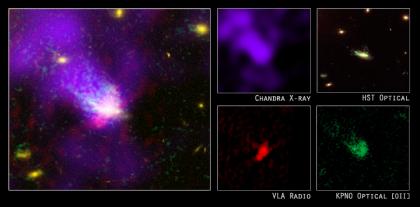
Too Fast, Too Furious: A Galaxy's Fatal Plunge
Credit: X-ray: NASA/CXC/SAO/UMass/D. Wang et al. Optical: NASA/STScI/U. Alabama/W. Keel Radio: NSF/NRAO/F. Owen Optical [OII]: NSF/NOAO/KPNO/M.Ledlow
Visual Description:
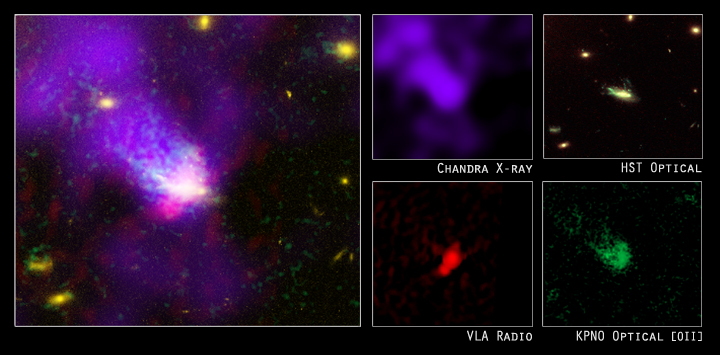
These images offer a dramatic look at C153, a galaxy being ripped apart as it races at 4.5 million miles per hour through a distant cluster of galaxies. The infalling galaxy's gas is being stripped by the pressure of 20-million-degree Celsius gas that permeates the cluster.
At left is a composite image made by combining the four images at right, taken in X-ray, radio, and visible wavelengths as well as the visible, green light emitted by oxygen ions. Long comet-like streamers of gas can be seen flowing from the galaxy as it travels through the cluster called Abell 2125. The images span about one million light years.
The Chandra X-ray image shows a tail of hot gas extending from C153. The temperature of the gas tail is about 10 million degrees Celsius, cooler than the surrounding cluster gas. This temperature difference is further evidence that gas is being stripped from the galaxy. The image taken in visible light from glowing oxygen ions shows a similar tail forming as gas with a temperature of about 10,000 degrees Celsius is pulled from the galaxy.
Hubble's broad band visible-light image reveals intricate detail in the distribution of stars and dust within C153. The galaxy exhibits evidence of a large-scale disturbance that has left its star-forming regions concentrated to one side of its disk and beyond. Dust features are twisted into chaotic patterns, obscuring any spiral pattern the galaxy once had.
Radio observations depict high-energy particles as they spiral through the galaxy's magnetic field, with some escaping in a perpendicular direction to the galaxy's disk. The high-energy particles probably came from a supermassive black hole.
|
||||||||||||||||||||||||||
Visual Description:
These images offer a dramatic look at C153 which is a galaxy being ripped apart as it races at 4.5 million miles per hour through a distant cluster of galaxies. The colors are primarily purple with bits of red, yellow and green. The infalling galaxy's gas is being stripped by the pressure of 20-million-degree Celsius gas that permeates the cluster. On the left is a composite image made by combining the four images at right, taken in X-ray (purple), radio (red), and visible wavelengths (yellow), as well as the visible, green light emitted by oxygen ions (green). Long comet-like streamers of gas are seen flowing from the galaxy as it travels through the cluster called Abell 2125. The images span about one million light years. On the right, we see each of these layers separately. The Chandra X-ray Observatory image shows a huge tail of hot gas extending from C153. The temperature of the gas tail is about 10 million degrees Celsius, cooler than the surrounding cluster gas. This temperature difference is further evidence that gas is being stripped from the galaxy. The visible light image from glowing oxygen ions shows a small galaxy and a similar tail forming as gas with a temperature of about 10,000 degrees Celsius is pulled from the galaxy. Hubble's broadband visible-light image reveals intricate detail in the distribution of stars and dust within C153. Radio observations depict high-energy particles as they spiral through the galaxy's magnetic field, with some escaping in a perpendicular direction to the galaxy's disk.


Revised: September 08, 2025